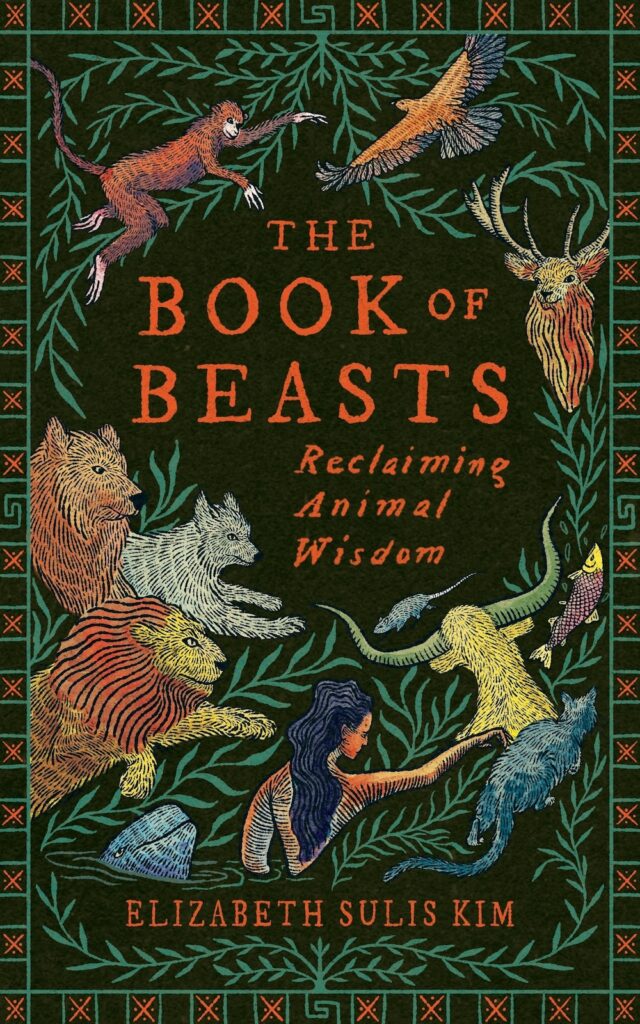
September’s Book of the Month is Elizabeth Sulis Kim’s ‘Book of Beasts: Reclaiming Animal Wisdom’. Read an extract, on the infinite lives of the Salmon of Knowledge, below.
There was once a salmon who swam upstream to reach the source of the river where she was born. We don’t know whether her journey was propelled by instinct or conscious desire, but either way, it was time to spawn her children. She swam against the current for miles. Salt water gave way to fresh water. She leapt up waterfalls. As she travelled, her silvery scales turned a pinkish hue. Her muscles weakened and wasted. The journey seemed impossible, and at times she was on the point of giving up. She saw other fish plucked from the river, by claws, hands and sharp beaks; at any moment, her own life could be taken too, but still she followed her destiny, moving ever closer to that place half-remembered.
Back then, thousands of salmon made this perilous journey each autumn, though few survived to tell the tale. When the salmon arrived at their destination, the people who lived beside the river rejoiced. They were dependent on the river’s bounty – its clean water and the plants that grew along its banks: watercress, raspberries, hazel – and the salmon’s arrival signalled its continued health. Soon, gathered on the banks were all manner of beasts, otters, herons and more, here to join the feast.
But back to our salmon, swimming upstream, watched by someone who would go on to recount her story far and wide. The river she swam up twisted and turned and then narrowed. A strange mist veiled the land. The river became a meandering mesh of smaller waterways, and the salmon pressed on, moving through the streams. By chance, or fate, she arrived in a place of great stillness, a well or a pool. She was hungry. She sought shelter from the glaring sun above in the shade of a tree whose branches overhung the water. A nut, ripe and creamy, fell from this tree. The salmon devoured it. Then, she swam back through the river maze to join her kin.
The tale is told again and again, transforming with each retelling. Of the salmon who slipped, by choice or chance, into the Celtic Otherworld. The salmon who feasted upon hazelnuts from a sacred tree at the Well of Wisdom, and gained all the knowledge of the world. It was a burden for such a small fish for, although she now knew that she would live for many years, she knew, too, what – or rather, who – would kill her.
Word spread quickly among humans of the Salmon of Knowledge that, once eaten, would impart sacred awareness of everything that ever was and everything that ever would be. Years later, the story reached a poet named Finn Eces. Upon hearing it, he set out on a quest to capture the salmon. Finn spent seven fruitless years fishing along Ireland’s great rivers, until he eventually caught the fish in the River Boyne, which was known then as the River of the White Cow. How he distinguished this fish from the others was anybody’s guess. Was she fatter? Were her scales more iridescent? Or perhaps it was just a feeling, not unlike those that came to him in moments of flow, from which words sprung forth like water from a spring. Finn asked his servant, Fionn mac Cumhaill, to prepare the salmon for him, instructing the young boy to eat none himself, not even a bite. Yet, as the boy cooked it, a drop of oil spat at his finger and he instinctively licked the burn to soothe it. No sooner had the oil touched his lips than suddenly the boy knew everything that ever was and everything that ever would be.
Later, people across the land would tell stories of the great exploits of Fionn mac Cumhaill, a hero and a seer, who need only suck his thumb to connect with his otherworldly knowledge. The salmon had seen all as it would be, and through each other’s stories, both Fionn and the salmon led infinite lives.
The tale of the Salmon of Knowledge is from the Fenian cycle of Irish mythology, penned between 900– 1200, though it may well preserve older stories. It’s the summer of 2021, and I am in Dundee, with a vague notion to follow the River Tay – Scotland’s longest river – to meditate on what the salmon knew. Ireland may be the source of this myth, but Scotland absorbed these stories too. Scholars don’t agree on how Gaelic language and culture first transmitted to Scotland but the prevailing consensus among linguists is that Irish settlers came to Scotland around 500, bringing with them their language and culture. The distinctive Scottish Gaelic came from Irish. While I could travel to the River Boyne in Ireland, to the Salmon of Knowledge’s ancestral homeland, it feels more urgent to meditate on the salmon here in Scotland, because it’s one of the world’s largest players in the salmon industry, producing more than 150,000 tonnes of farmed Atlantic salmon annually. (Ireland, by contrast, produces less than one tenth of that.)
*
‘Book of Beasts: Reclaiming Animal Wisdom’ is out now and available here (£22.90), published by Chatto & Windus.