Published today by The Bodley Head, Rachel Morley’s ‘Church Crawling’ is a kaleidoscopic history of place and community straight from its author’s expressive heart, writes Alex Woodcock.
In 1993 the artist Rachel Whiteread cast in concrete the interior of a Victorian terraced house in the east end of London. At a stroke the ordinary became strange: interiors were now exterior, fireplaces stuck outwards, doorknobs drew shadows into deep, rounded hollows. The transformation revealed the everyday spaces where life is lived to be spectacular and mysterious, the dead air in a room or the depth of a window for the first time present, as real and rich as a sculpture. Suddenly, absence had a voice.
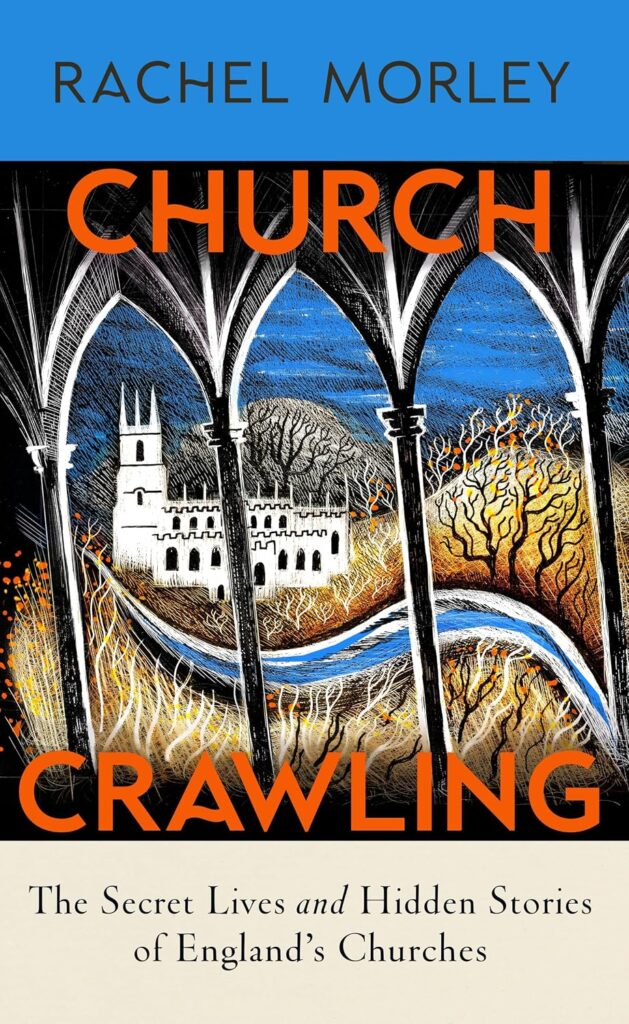
Rachel Morley’s book Church Crawling: The Secret Lives and Hidden Stories of England’s Churches in many respects sets out to do something similar to that of her namesake artist, but for a different type of building: the church. Hence it is no straightforward history, though it is crammed with history, but as she writes, an attempt to ‘draw out what our old churches are, not what they are made of, and why that matters, and ultimately why we need them’. These are grand ambitions but perhaps nobody is better placed to achieve them than Morley, a buildings conservator by trade and for the last few years Director of the charity Friends of Friendless Churches, which rescues and protects historic and redundant places of worship in England and Wales. The cover, by the artist Ed Kluz, alerts us to the fact that the book in fact has grander ambitions still. Kluz is known for his dramatic reimagining of historic buildings and landscapes and Morley likewise is inviting us to completely reconsider these often-ignored places and recognise the ‘cacophony of lifetimes’ that they have witnessed. If that weren’t enough, throughout, she writes like a dream, by turns poetic, occasionally caustic, often hilarious, casually leapfrogging decades with colourful anecdotes.
Time is the star of the book. In Eccentric Spaces the pioneering architectural writer Robert Harbison suggested that a building represented ‘the simplest experience of being in more than one place at a time’. Church Crawling turns that inside-out, revealing churches to be buildings where, due to the great depth of histories that have accumulated within them, time has become porous: here the personal time of lives lived, the geological time of materials and the historical time of events all overlap into a beguiling non-linearity offering us the chance to experience being in more than one time in the same place. Accordingly, the book is divided into six parts organised thematically rather than overtly chronologically, for example ‘Making Nowhere into Somewhere’, ‘Makers’ and ‘Revelations’ that are themselves divided further into chapters that pursue aspects of that theme. In this way Morley’s fascination with the looseness and ambiguity of time and the ability of churches to ‘invite interaction, and sensory fulfilment and connection in a very real way’ stays in the foreground.
Objects are crucial to this sense of connection and materials especially so, Morley’s love of their textures and stories shining through many of the chapters. Bricks contain ‘a soft warmth in their colour and texture’ while glass we are reminded is mainly composed of sand – ‘the past, pulverised […] a mountain, a boulder formed millions of years ago, eroded down to the tiniest particle’. Flint, however, is the one, ‘the most beguiling of all materials’. Morley, I feel, could write a book just on flint – I would certainly read it – given her ability to conjure its wayward beauty. ‘The surface is restless’ she writes, describing its vitreous, often mottled colour of charcoal blacks and deep blue-greys. ‘Speckled and shimmering. It’s an oil spill, it’s a swatch of camouflage, it’s a universe’.
If Morley is well-used to working with materials hundreds of years old, the occasional sudden crystallisation of a moment in time before her eyes can still elicit a shock at the sense of freefall through the centuries. Tracking a lost rose brass, a commemorative late medieval plaque, to a bank vault, she hopes that by taking it home she is not ‘summoning a ghost’. Or uncovering, by accident, a twelfth-century sculpture of a bird behind the plaster on the wall of a pub toilet in Herefordshire how she ‘sobbed in my cold little cubicle’. In fact, the further you read the more you realise that Church Crawling is that rare thing, accessible and entertaining, built upon considerable research, but without losing the expressive heart of its writer. It’s a potent blend that lends itself to some of the most sensuous writing about historic buildings I’ve yet encountered, for example, that about Binham Priory in Norfolk:
‘These days Binham Priory is majestic and marooned. Fat Norman arches stomp along the walls and give way to the most delicate early Gothic window tracery, which was eventually savagely infilled with traffic-cone orange brick in the nineteenth century. On two sides, stumps of its former self endure. A blueprint of ruins. Dressed blocks of masonry, once carefully cut and shaped to fit around the rubble core of the church’s columns, are now randomly stacked, frozen mid-air like a game of Tetris that’s been paused.’
We are living through a good moment for writing about historic buildings and materials. Books have proliferated on the subject in the last decade or so, often using personal narratives and unconventional quests; Pamela Petro’s The Slow Breath of Stone from 2005, for example, in which she wanders the Romanesque abbeys of southwest France in pursuit of both the twelfth-century and a twentieth-century scholar, was an early herald in this regard. Church Crawling takes the widest remit, if you like, following no particular narrative or aspect of churches, but rather exploring everything that they are, from their walls to their windows to the plurality of events that have shaped them. What emerges from its pages is a kind of kaleidoscopic history of place and community, with churches a reliquary containing the shadows of lives long spent. And I think that this is the point. Like Whiteread’s casts this book throws into relief things normally invisible and in doing so brings us back to what churches really are: ’spaces given over to mystery – the great mysteries of existence and its meaning – where we are invited to dwell in and contemplate that which is beyond our understanding’. Morley’s gift is to make us see this in every aspect of the building, from the raw materials to the design, to the characters connected to them, to the history they have both witnessed and participated in.
‘Naturally we can only mourn what is absent or missing’ writes Judith Schalansky in An Inventory of Losses, ‘if some vestige of it, some whisper, perhaps little more than a rumour, a semi-obliterated trace, an echo of an echo has found its way to us.’ In Church Crawling Morley has made sure that some of these echoes and whispers reach us, and moreover, that as well as mourning what has been lost we must celebrate the traces of the past that have survived and continue to reverberate, in so many unforeseen ways, throughout our lives now.
*
Rachel Morley’s ‘Church Crawling: The Secret Lives and Hidden Stories of England’s Churches’ is out now and available here, published by The Bodley Head (£20.90).
Alex Woodcock is a writer, artist and former cathedral stonemason with a background in buildings archaeology. His book ‘King of Dust: Adventures in Forgotten Sculpture’, was published in paperback in 2024 by Little Toller Books. His first poetry pamphlet, ‘For the Futures Left Behind’, is out with Broken Sleep Books in 2027. Follow him on Instagram here.