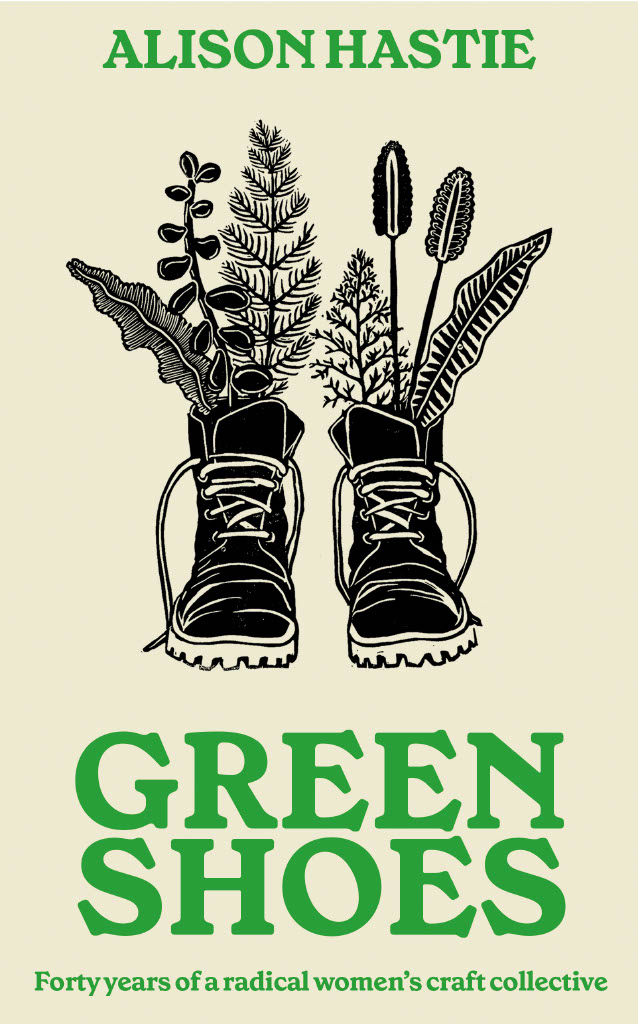
In an extract from ‘Green Shoes: Forty years of a radical women’s craft collective’, published this Thursday by The Indigo Press, Alison Hastie recalls how she first pursued a career in shoemaking in the 1970s.
I knew that I wanted to earn my living using my hands. I had previously got as far as thinking about weaving, but shoemaking was, quite literally, a better fit, as shoes were a necessity for everyone and something I found difficult to find. I had no idea about how to become a shoemaker, so I went to the careers office on campus for advice. The interview was quite awkward, as the poor careers advisor was almost lost for words. ‘We once had a student who wanted to become a thatcher’ was her first response. However, she did make the very useful suggestion that I find work near craft workers so that I could pick up leads to a shoemaker or to shoemaking itself.
So that is exactly what I did. After my finals I got a summer job at Bickleigh Mill craft centre, working in the cafe and then running it. My plan worked: the wood turner at the centre told me about Hood Fair. He showed me a beautiful hand-drawn flyer advertising the fair, which was taking place midsummer near Dartington, south Devon. Somehow I had not heard about this village, which was a hotbed of radical bohemianism, so different from the conventionality of Exeter University and the rest of Devon at that time. It sounded fun and would expand my limited knowledge of what was going on beyond my university bubble. This was 1978, years before the internet and mobile phones, so contacts literally had to be made on the ground (it’s already hard to remember the world where you didn’t just search online for ‘shoemakers in Devon’).
That would have been my search because I loved being in Devon. I had grown accustomed to the simple rural life we had lived as students: growing vegetables, making our own bread and socialising with friends. I could just about afford to run my old Mini, pay my rent in a shared house and have a social life on my waitress wage. It wasn’t a flashy lifestyle; you had to make it work as there was no such thing as a credit card. Living beyond your means was not an option and I was completely used to my hand-to-mouth existence. I was young with no debts, contracts or responsibilities beyond myself.
That midsummer Saturday I happily loaded my Mini with a blanket on which to sell my wares, a bundle of vintage clothes and some jewellery that I had made, to seek, if not my fortune, then some leads for my future. My previous experience of selling from a blanket on the ground was at Barsham Faire in Suffolk, just after my A-levels. Barsham was the precursor to Hood Fair, and it came to an end in 1976 as a victim of its own success. Too many people came, and at the end of the fair a leaflet was handed out on which was written the instruction ‘Build another Barsham’. If you enjoyed this, it said, then go home and make one happen where you came from – and that’s what a bunch of people did in Totnes.
Barsham was an amazingly simple festival, where the site became the size of a village for a week, attracting locals and alternative types from miles around. Stalls were built that could have lasted for years, selling wholefoods, bread, baskets, candles, jewellery and wooden bowls, many of which were made on site during the festival. It was full of activity and energy, and the sun always shone. Pennants were put up around the site, and there was a great sweep down to a wide-open space for performances from the many theatre groups and performers who turned up. Music was played on all manner of instruments; there was a medieval vibe with lots of dressing up: men with long hair and beards in tights and tunics, women with Maid Marian-style dresses and flowing locks. Groups of children played and roamed around the site. There was plenty of beer and mead, followed by sore heads and sleeping minstrels. It was the perfect 1970s version of ‘a field full of folk’, the evocative phrase from Piers Plowman by William Langland, whose medieval allegorical poem I studied in Medieval English as part of my degree.
The best way to be at the fair was to be part of the action, so my friend Helen and I rather shyly laid out the necklaces and hand-woven purses that we had made on a blanket by a track. It was fun to be there and make some money, and we certainly looked the part in our Afghan dresses and long hair. As people wandered by, they would stop and look. It was one of my first experiences of selling something I had made, and it felt satisfying. When we’d had enough for the day, we would roll up the blanket and go home.
I realised that Hood Fair was Devon’s answer to Barsham Faire, a non-electric medieval-style festival held in Hood Meadows, outside Dartington. It was brimming with ideas about counterculture and had a strong focus on performance and craft. Here again was a ‘field full of folk’ but this time on the banks of the River Dart. When I arrived, I was directed to a pitch, and there, just down the field, was a stall displaying a few pairs of handmade shoes. What luck! But the two men were both bearded and wearing work aprons; they looked old – at least thirty – and intimidating. I had to pluck up courage to go over and talk to them. First, I looked at the boots. There was just one style: an ankle boot made in light brown leather, the foot shaped with three lace holes and a brown crêpe sole. I loved them. Andy Langford and Graham Kitchener of The Conker Shoe Company, as they soon became, told me that they were just starting out themselves. My request to volunteer in their workshop in return for instruction on how to make shoes was received with little interest. ‘It’s tough work for a woman,’ said Graham.
However, I made a date to visit their workshop and volunteer my services. They agreed but didn’t think I would turn up. When I did, they didn’t believe that I would be consistent and reliable, but I was. They didn’t put me off shoemaking, but I understood their coolness. Why should they want to share their skills? I would have to make myself useful. Apparently, many people had said they would like to come to their workshop to learn but had never appeared.
I tried to be helpful. Andy and Graham were operating from Andy’s mother-in-law’s basement in a large house called ‘Lakemead’, which was high above the River Dart in Totnes and had a walled garden. We largely kept to the basement, but in forays upstairs I was introduced to Andy’s wife Verity and her extended family. The house belonged to Guida Swan, a poet, whose husband Donald had taught at Dartington Hall School and had recently died. It was a beautiful and simply decorated house – artistic and intellectual – with wooden furniture, patchwork cushions, and paintings and books everywhere. I loved it, and it was typical of many of the houses I visited in Totnes at the time. However, the atmosphere was a little strained, as the extended family of three generations tried to find a way of living together in their new situation. I am not sure that having a shoemaking workshop below them helped. Graham and I would work in the basement while Andy pursued his main job as a business consultant above us in the study.
We accessed the workshop through the back gate from the lane so that we didn’t disturb the household. It was a large room with a big window looking out onto the yard. As you entered, behind the door on the right was a pile of leather. A long workbench ran through the centre of the space and was equipped with a small grinding wheel for finishing the shoes and a couple of boards for cutting out the leather. Another workbench, in front of the window, came with a vice used to hold a raised workstation, which I would learn to dislike. At the far end of the room was a fireplace, and attached to the mantelpiece was a vintage pipe-whistle communicating device, a relic from the days of servants. By blowing down the tube, a whistle would sound. You would then pull out the bung and hear what was being relayed down the pipe. We used the device to communicate with Andy upstairs.
I was given an apron and simple tasks: punching and awling holes, then gradually moving on to hand sewing. That summer I would sit outside for my break, while Graham would often go for a pub lunch and never return. It was all rather chaotic, but I absolutely loved it. One day I was hammering away, punching holes in a component, when the worksurface I was using fell out of the vice and onto my right foot, splitting the upper of my precious red Clarks T-bar sandals. Blood spurted everywhere and we were all in shock. I remember a bowl and towels being found, then being helped into the back of Graham’s 2CV and driven slowly up the hill to Totnes Hospital. This careless, painful accident has acted over the years as a cautionary tale in the workshop as a reminder to think about how I work. It took weeks of healing before I could drive again. At the time, I thought I’d got away with no lasting scar, but now, in my sixties, I can see and feel that my foot was damaged.
This mishap did not put me off. I continued to go to the workshop during the week, while on Saturdays Andy and Graham had a stall at Dartington Cider Press Craft Market. Local people were interested in our endeavour to make comfortable, robust and repairable shoes. Customers had their feet drawn around and chose their colour and style, as by then we had a couple of options. As summer moved into autumn Andy and Graham asked me to work longer hours, as orders were increasing. However, they were not yet able to pay me, and I was still learning, so they wanted me to sign on for unemployment benefit while working for them. Up until then I had been working evenings and weekends at The Market House pub in Crediton to earn money. I was too nervous to sign on and work, as that was illegal, so it was agreed that they would pay me a little. Then, with perfect timing, my friend Jill rang one evening to say she had found a job that came with a cottage in Manaton on Dartmoor, and would I be interested in sharing? I quickly looked at the map and saw that Manaton was much closer to the workshop at Totnes than Sandford, where I was then living. I said yes, as I needed somewhere more convenient; at that time my daily return journey was eighty miles.
*
Green Shoes: Forty years of a radical women’s craft collective by Alison Hastie is out on 8th October (The Indigo Press, £14.99). Buy a copy here.