Elizabeth Sulis Kim’s ‘The Book of Beasts’ removes the distinctions between humans and animals, encouraging us to be less bordered, less exact; more beast, writes Anna Goldreich.
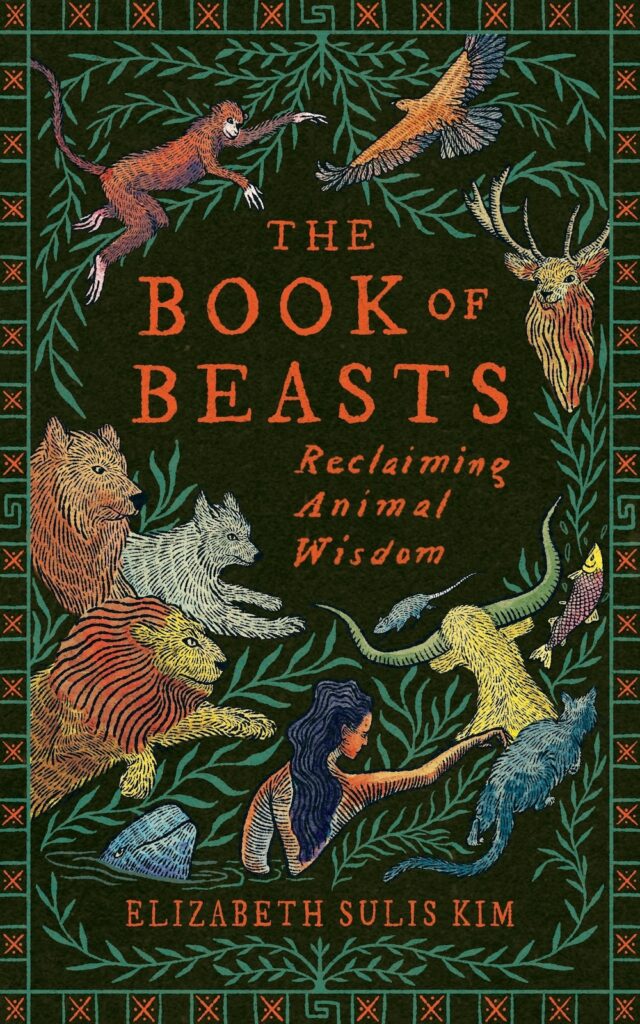
As a child, Elizabeth Sulis Kim felt aware of her place within the world of creatures that she encountered, the bats and birds that flew around her, the cows who lived close by, the cat who would accompany her for walks. She found it ‘impossible not to see a web of life… [she] saw other animals as [her] equals.’ As adulthood approached, and she moved into that strange, self-conscious place of adolescence, Sulis Kim found herself feeling alone, alone in a forest, though it was full of lives, full of small beings. She had, over time, become ‘more sharply human, more bordered and exact, less free – less animal.’ I think this is something many of us relate to, this movement into school and work, supermarkets and bills, rent and commutes. Soon, the bodily animal slips away. The Book of Beasts reads as Sulis Kim’s attempt to explore this loss, to follow the animal to the ‘Otherworld’, and to find it again.
Elizabeth Sulis Kim does something rare and wonderful with The Book of Beasts. She manages to weave science, folklore and history together with personal account into something beautiful, evocative and lyrical. Through lilting and vivid language, we are taken on a journey through continents and countries, we move from the past to the present, and into the future with ease. The contents of the book are vast, spanning time and place, but I never once felt lost, never felt left behind. Sulis Kim is so assured in her writing and in her storytelling, that I felt comfortable and excited to follow her wherever she might lead me.
Over the course of the book, we get to know twelve animals. We encounter Lion, Rat, Wolf, Bear, Bird, Cat, Cow, Salmon, Monkey, Whale, Deer and Human. Each animal chapter is preceded by a beautiful illustration by Kaitlyn Copithorne. These images bring to mind a tarot card. There is something magic here, prophetic even, and imbued with more meaning than meets the eye. So I have picked my first card, the Lion, how do I read it? What does it mean? Sulis Kim introduces the reader to the animal in question, we learn about this animal in relation to folklore. We are told stories, tales which have been told and retold since the beginning of our collective memory. We learn about the different ways that humans have thought about animals, how we have worshipped them, used them as symbols, projected onto them, scapegoated them. Animals have always been such a big part of our lives, and now our relationship to them has changed. It’s important to spend a while with this change, to learn about the current state of our relationships with these individual animals, how we harm them, how we farm them, or hunt them or rob them of their habitats and their food. Also, how we might be able to help, how we might go about repairing our bonds with them.
There are aspects of The Book of Beasts which could almost be seen as travel writing. Sulis Kim has travelled extensively, has encountered different people and animals across the world. She is open and curious about the people she meets and their relationships with the creatures who live alongside them. All these encounters feel equally special, from talking with a man in Istanbul about his love for the feral cats he feeds, to drinking mate in Playa Paraná, watching a whale appearing and disappearing into the water, only metres from the beach.
This book is also highly personal, we get to know parts of Elizabeth, the writer, the person, the creature. This is one of the aspects of the book that I most adored. We are given pieces of a life. We learn something of how she came to her research, but also how she feels about these animals, her relationships with them individually. In the Cow chapter, we read about Sulis Kim’s experience of growing up vegetarian in a rural part of the UK, she tells us, ‘a friend’s father suggested I had been indoctrinated.’ (an experience which resonates with me, as a person who also grew up vegetarian in a farming village.) She remarks, ‘animals are our friends… who would want to eat their friends?’ and I completely agree.
The Book of Beasts is written with such kindness, sensitivity and empathy, directed towards animals and humans alike. The book closes on the final animal, the Human, because, as we see throughout this book, we are animals too. This need to know and to repair our relationships with non-humans, is the need to know and repair our relationships with ourselves. As humans, we position ourselves as separate to and above non-human animals, but we see throughout The Book of Beasts that this distinction has not always been so stark. Perhaps it’s time to find our way back to them, to listen to them and respect them, the beasts.
*
‘The Book of Beasts: Reclaiming Animal Wisdom’, which was our September Book of the Month, is out now and available here (£22.90), published by Chatto & Windus. Read an extract from the book here, and an interview with Elizabeth Sulis Kim here.
Anna Goldreich’s debut novel, ‘The Leveret’, was published by Hamish Hamilton in June 2026. You can follow her on Instagram here.