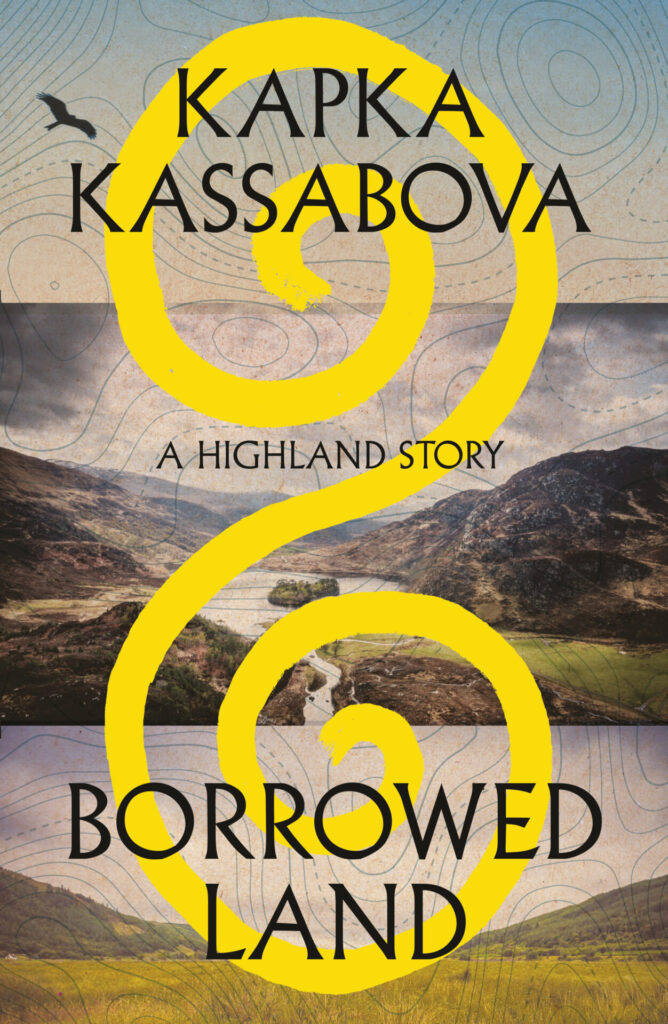
Rich in sonic detail, Kapka Kassabova’s ‘Borrowed Land’ is vital testimony to the ecocide and damage to human health being committed in the name of the energy transition, writes Sally Huband.
Sound is not sound alone, it’s touch.
John Cotter, Losing Music
My nerves were on edge when I visited the Barbican’s Feel the Sound exhibition two summers ago. I had become fearful of sound and wanted to transform this fear back into love. An energy company had built a hyperscale wind power plant near my Shetland home. The low frequency noise of the turbines rewired the auditory processing in my brain, among other neurological harms. I moved house and slowly recovered but louder sounds continued to cause pain.
I needn’t have worried. I suffered no pain at the Barbican exhibition. The subwoofer bass of the souped-up cars in the underground carpark was a gentle nudge compared to the brain punch of industrial wind turbines. I’m deaf and have long known that sound can be felt as much as heard. It was good to see artists explore this. In a video exhibit, Evelyn Glennie talked of teaching the world to listen but with our bodies, hearts and mind. If I had to choose a book that does just this it would be Borrowed Land by Kapka Kassabova.
The deep listening in Borrowed Land takes place in the Scottish Highlands. The writing is rich in sonic detail. A cave becomes the inner ear of the glen and birches whisper. I hear the stories told in Borrowed Land but I feel them too. Kassabova’s Highland home place, like my Island home place, is a sacrifice zone. Ecocide is being committed in the name of the energy transition and human health is collateral damage in the pursuit of corporate profit. Kassabova’s lived experience is vital testimony. The low frequency noise of a new electricity substation sends workers home with migraines, panic, nausea, a malaise and Kassabova herself is made ill by the pylons that are built next to her home. She, like me, is forced to leave.
I’ve come to know and love the setting of Borrowed Land while staying at Moniack Mhor, a creative writing centre that sits high on a hillside. The rooms have views across a wooded glen, mountains form the backdrop and the light is always shifting. I mention Moniack’s views deliberately. Those of us arguing that all is not well in the energy transition are accused of being more concerned with views than the climate emergency. If only this were true. A wind power plant called Ballach, with turbines 230 m high, is planned 10 km from Moniack Mhor. If it is built, I would hesitate to stay there again and not because the landscape would change. The soundscape would change, it would become unsafe.
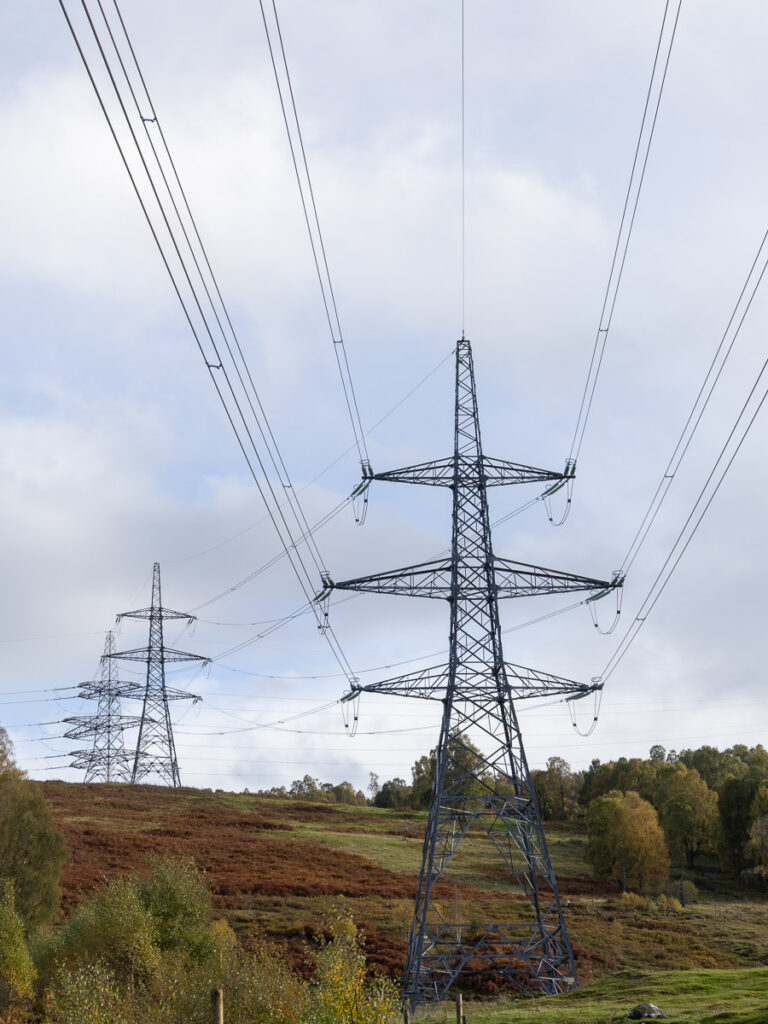
Photo: Cliff Green
Each time that a turbine blade passes a tower, a pulse of low frequency noise is flung out. This noise is too low in frequency to be heard by the human ear but it can still be sensed. Think of sound waves as waves of pressure and of turbine harm as barotrauma. Bats can die from pulmonary barotrauma if they fly near turbines, the blood vessels in their pliable lungs burst. In humans, turbine barotrauma causes neurological harm. My brain was rewired and my heart was hacked, it would race uncontrollably. I could tell if the turbines were on or off without looking. It is difficult to describe sensing a turbine other than to say that it is sensory torture.
When I explain turbine acoustic harm to people, they ask if noise cancelling headphones help, or sound absorbing panels. The answer is no. Blade pass emissions cannot be stopped from entering a home, or a body. These pulses can be as low as 0.1 Hz which means soundwaves that are vast in scale and travel many kilometres. I now live 14 km from the hyperscale power plant here in Shetland but I can still sense the turbines in settled weather. The taller the turbine, the worse the blade pass pollution. Ballach wind power plant must never be built.
Building wind power plants a safe distance from homes and workplaces would increase construction and operation costs and decrease profits. This is why the wind industry claims that turbines are safe. They argue that the harm is psychogenic in origin (we are simply stressed because turbines have been built in our view). Despite mounting evidence of direct harm to human health, governments concertedly look the other way and for a while I did not understand why but in Scotland, at least, the reason is becoming alarmingly clear.
Renewables produced more electricity than is consumed in the country for the first time in 2022. The construction of new energy infrastructure continues apace because Scotland is being positioned as a ‘green’ data centre superpower. Twenty-six hyperscale AI datacentres have been proposed so far. As Kassabova astutely observes in Borrowed Land, renewable energy infrastructure is being built in Scotland to open new markets for profit and not for the good of the planet. These profits do not stay in Scotland. Promised jobs do not materialise and fuel poverty remains. The energy company responsible for ecocide and harm to health in Borrowed Land is the same company that built the hyperscale power plant here in Shetland. Its main shareholder is BlackRock, named by the UN as complicit in the economy of genocide.
Shetland is not a wooded place and I am drawn to Kassabova’s portrait of a low impact forester called Dylan. He extracts timber with Nomad the horse, a process that Kassabova describes as hard toil and bright joy. We meet him sitting on his cabin porch listening to rain falling on leaves. In spring, he listens for the sound of sap rising before planting trees. It used to rise in March but now rises in February. The power company intend to build a pylon where he is constructing a barn for Nomad. If he does not agree to leave, the land will be compulsory purchased. As Dylan concludes, We need renewable energy, but this is just wrong. Borrowed Land is a book ahead of its time, a clarion call that cuts through all the corporate energy company noise.
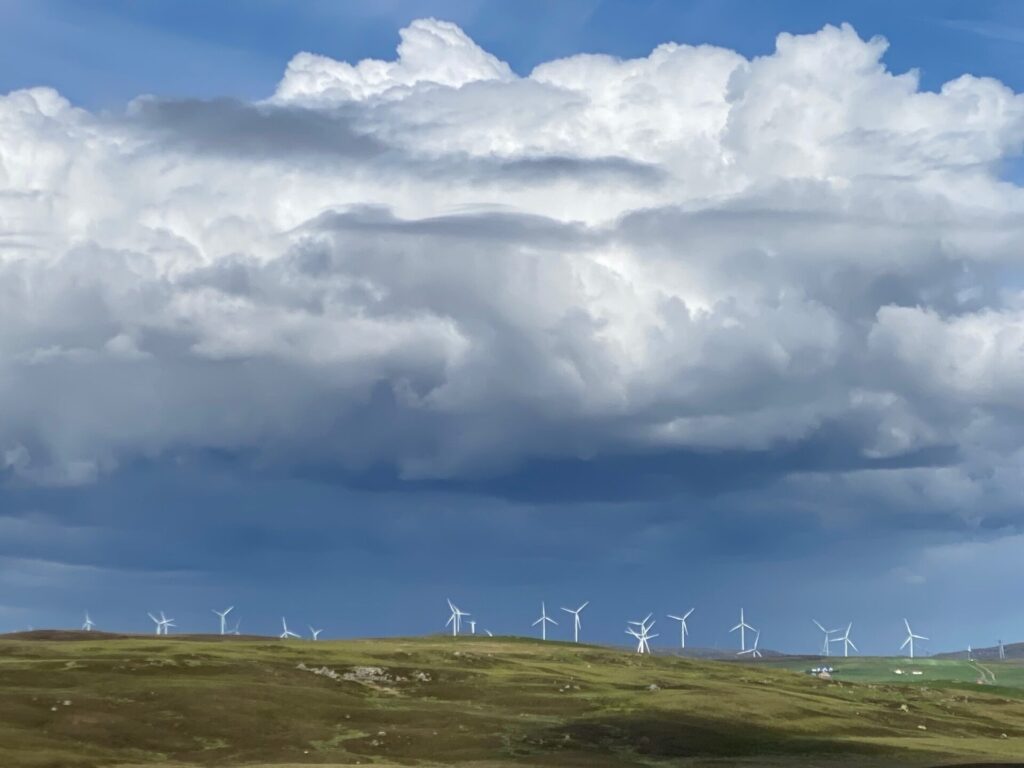
The 103 turbine Viking Wind Farm, Shetland. Photo by Sally Huband
*
Kapka Kassabova’s ‘Borrowed Land: A Highland Story’ is out now and available here, published by Jonathan Cape (£20.90).
Sally Huband’s memoir, ‘Sea Bean’, won the Highland Book Prize and ‘saltwaterisland&’, produced with Gaada, recently featured in the Dundee V&A Design and Disability exhibition. For ‘The Book of Bogs’ anthology, Sally co-wrote with Polly Atkin an innovative call and response piece on turbine acoustic harm.