Meadow, moor and mountain are vividly bright in copper, gold, umber, ochre and russet as autumn arrives on the crofts of Kirsteen Bell and Annie Worsley.
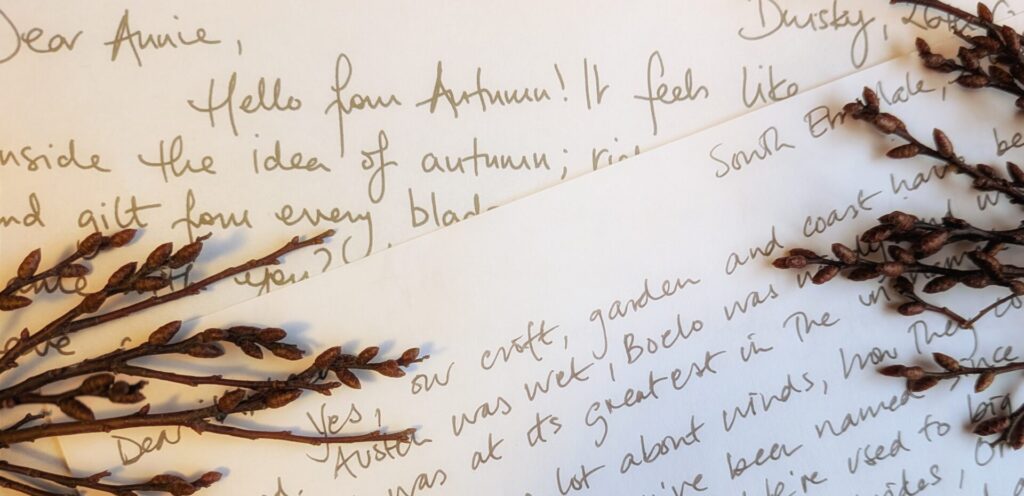
Duisky, 26th October
Dear Annie.
Hello from Autumn! It feels like we’re living inside the idea of autumn; rich sunlight draws fire and gilt from every blade, leaf and branch. Is it the same with you? After the storms it feels like the trees have come down to meet me. Wading through leaves creates the sensation I imagine people get from wild swimming, that sense of vast wild force embracing you.
In truth, things have been turned upside down in places. Walking at dusk takes on an uncanny tone, the ravens quarrelsome above me. New shapes and lines, light where there was no light, inner bark exposed creating pale faces that peer at me through the dusk. Countless tiny interruptions of the patterns my mind knows so well.
A clear slope in the field now holds a huddled grey-brown shape, that at first I take to be a roedeer, despite the logic that the dog would never have run right past it. Dark rings blur into wet fur, a tawny patch at the top is a scrap of hide. Even now as I step by, my perspective morphs around the shape, and it’s not until I can see the moss still attached to its underside that it solidifies into a rock. Looking up the old wall, it seems unlikely for so great a stone to be dislodged from this remnant that is largely embedded into earth. I think though of the wall that used to match this one on the east side of the croft, now turned inside out by pig snouts. Tonnes of small infill stones scattered around behemoth boulders you wouldn’t believe a pig could move, but there we are. Still, no pigs to blame for this stone, but I guess a red stag would have the necessary weight behind it.
And sure enough, in the lee of the wall up the slope, there are rushes pulled down flat to the earth, oak leaves pressed closed together into a mat. It’s unusual to see a deer’s resting place on the west side of the wall, in the face of the prevailing winds, but we had such fierce gales from the south that this wee dip under the bank was about as much protection as a large mammal would get.
All my usual trails are disrupted too. A thick rowan is a new horizontal hurdle behind one of the ruins, and the crown of an oak is now an impenetrable curtain pulled across the bottom of the old road up to the grazings. Some of the windfall we will undoubtedly leave, and some will be carried down the hill to become firewood. It’s the ones across my paths I hope will go first. I know there are myriad benefits to leaving fallen trunks to molder and nourish, new little habitats for new life, but I like a clear path too.
How are your paths through autumn? How did the croft fare after our trio of storms?
With love,
Kx
*
South Erradale, 30th October
Dear Kirsteen,
Yes, our croft, garden, valley and coast have been battered. Austen was wet, Boelo was windy and wet, but wind speed was at its greatest in the un-named storm.
I’ve written a lot about winds, how they have colour and personality and how they’ve been named since anything of power was first described. We’re used to big storms here, just as the islanders of the Hebrides, Orkney and Shetland are. This is an exposed coast and although we are sheltered to some degree by the Outer Isles, when nor’ westerlies or southerlies blow hard, the mountains of Wester Ross and Skye create a funnelling effect along the Minch, and we suffer. Gusts were in excess of 80mph during the un-named storm but happily, there was little damage to croft and house. Afterwards, everywhere just looked tired and disheveled.
The shore paths and beach at Opinan were a different matter. High-speed winds and high tides ripped up the old arrangements of rock cobbles, shingle and sands. Stones and rocks were hurled over the “Seaweed” trail, kelps and bladderwracks were draped over fences or piled into huge great tangles and heaps. The wee summer coastal garden mentioned in my last letter vanished. Only a week ago a few bedraggled clumps of sea-chamomile were still in flower. What had been a narrow, wet path through tall grasses was infilled with gravels. Old drainage ditches were scraped clear then refilled with stones and kelp. As you said about your croft and woodland, the very familiar was suddenly un-raveled, rewritten, redrawn and reorganized. The last time this kind of upheaval happened was during the great storms of winter 2013-14. Since then, the trails and paths along and around our stretch of coastline had become as familiar to me as the wrinkles on my hands. The very small features – stones, boulders patterned with lichens, mosses atop fence posts, the position of stepping stones, places where I found otter spraint and plovers’ eggs, or sheltered spots to hide and watch the birds – became so well known and loved because I’ve spent years following the same patterns and lines across the land. Daily noticing and learning. Desire lines. I need to begin again. I’ll be re-raveling, re-drawing, re-writing until I can see the new shapes and patterns in my sleep.
Our croft is sodden. The drainage ditches are clogged up. To walk here means sinking as if I’m out on the peats. For the first time in years, rushes are sprouting in the hay meadows – bold green needles coming up through pale turf. Everywhere squelches and oozes.
The young crofters from Opinan had to herd their hill-wandering cattle back from the shores of Loch Torridon, miles away. They’d roamed far and wide over the Maol Ruadh looking for better, drier grazing. Even in good weather, it’s a long and arduous walk across treacherous and difficult hill country. And after the torrential rains of summer and autumn their cows struggled, up to their hocks in wet peat. They were all exhausted by the time they arrived home safely.
The wee ponies, our mob-grazing helpers, will have to be moved soon. They are in the pairc just now but they’ve almost cleared it. Our large meadows await. But first there are storm-damaged fences to fix and several sheep to be moved (they scrabbled their way onto the croft where the damaged fences are at their weakest). Have you managed to clear the fallen branches? And gathered in your extra firewood?
I have just been called by our visiting grandchildren. Apparently, we have Halloween cupcakes to bake and witch hats to make. The children are asking if any ghosts will come visiting. Of course they will, I say, they’ll be in need of a cupcake or two.
With Halloween hugs,
A xx
*
Duisky, 16th November
Dear Annie,
Oh the plague of rushes on every farmer and crofter that has wet acidic soil. L’s Uncle last ploughed his field a couple of years ago, presumably at the time the rush spores were loose, and you can see thick wiry stalks growing in the neat lines that were dug open for hay. Controlling rushes was one of the reasons we started with the pigs here. Not expecting pigs to eat them of course, we just hoped to knock them back and give other grasses and flowers the chance to see sunlight. It is depressing how vigorously the rushes rebounded. We might have to start considering goats. I have heard that hardy breeds of cattle or ponies will tackle the new rush shoots though; do your ponies browse them?
Since last writing, our autumnal landscape has been washed over in delicate white. I woke last night to a sparkling sky, the dark tips of birch stretched up into endless stars. This morning, those clear skies had left their mark, torn scores across the glass, as if the ice had attempted to claw its way in.
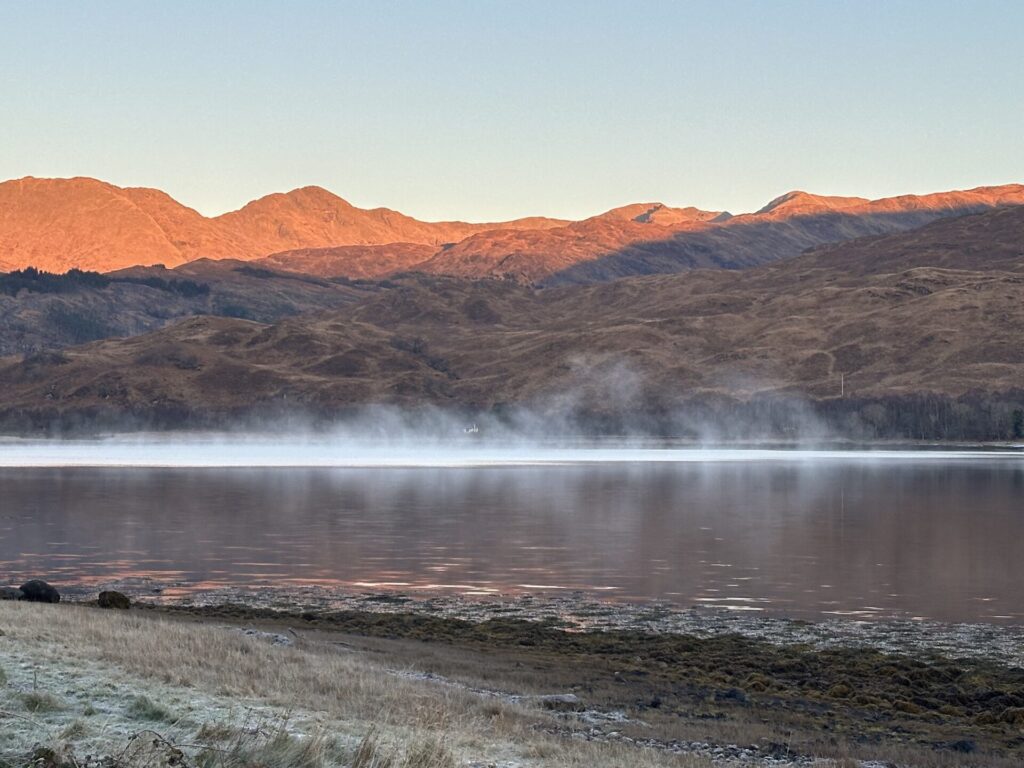
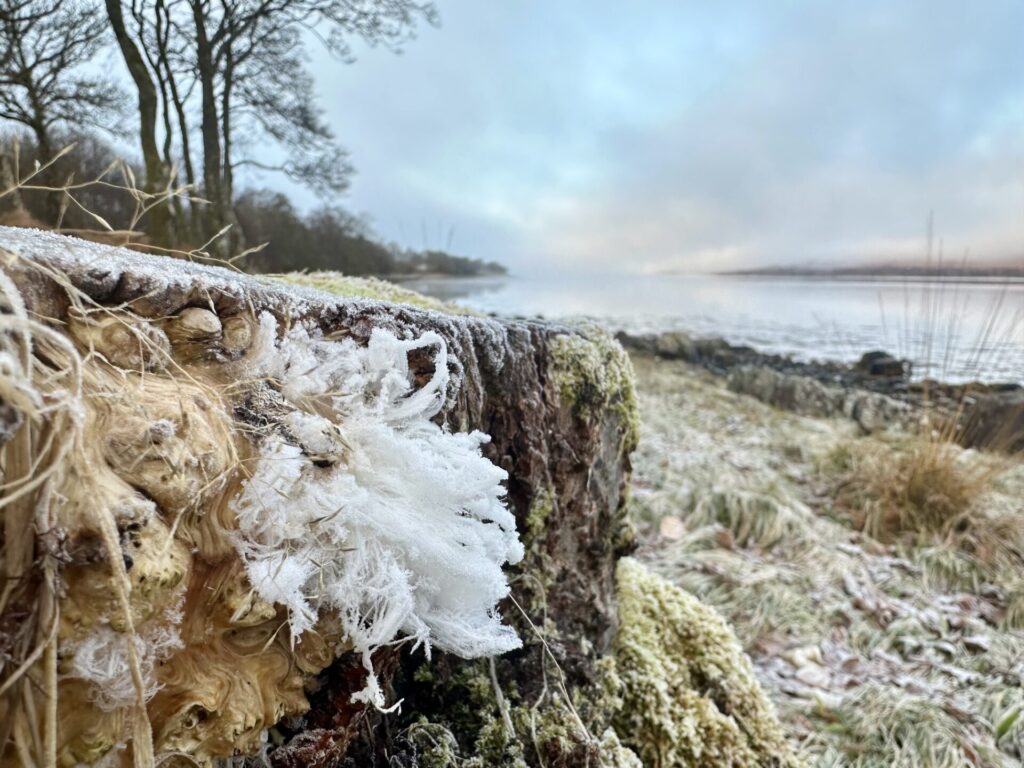
Cold mist and golden light shift and dance above the loch throughout the day, I love this slow magical dance that conceals and reveals in equal measure. The water holds some of its summer heat, drawing wisps from the cool air that hover and drift above the surface. And on the shore, stumps frilled with turkey-tail fungus are feathered now too with hair ice that melts instantly under the heat of my touch. This is without a doubt my favourite time of year. (Do I say that every year?)
I find it easier to see what needs done on the croft too. On a completely practical level, I can set foot in the polytunnel again without having to hack my way through a forest of bracken, without having to cover myself from head to prevent ticks from finding skin. I can walk more easily on the common grazings without tall mounds of sedge hiding bog still deeply divoted from hooves, despite not having had cows on it for years. I can see where fence posts will need to go, what ditches need cleared, and it seems somehow more achievable without the intensity of summer green.
I should be up there now. L is obsessed with getting the new stove installed, unsurprisingly given the drop in temperature. This gentle freeze is good for the physical work of carrying some of the those fallen logs off the hill, but I find myself under the duvet writing to you instead!
Tell me of your changes, have you also got a to-do list emerging from the croft?
With love,
Kx
*
South Erradale, 20th November
Dear Kirsteen,
Your letter arrived with a spell of fine autumn weather. It’s cold but at least it’s dry. (Are you warm and toasty by your new stove?) At long last, the wind has dropped and we have sunshine. And oh my, the colours! I’m not sure if they feel deeper and richer than in years past simply because I’ve been longing for some good days, or whether this is nature’s response to months of dreary chill and constant rain.
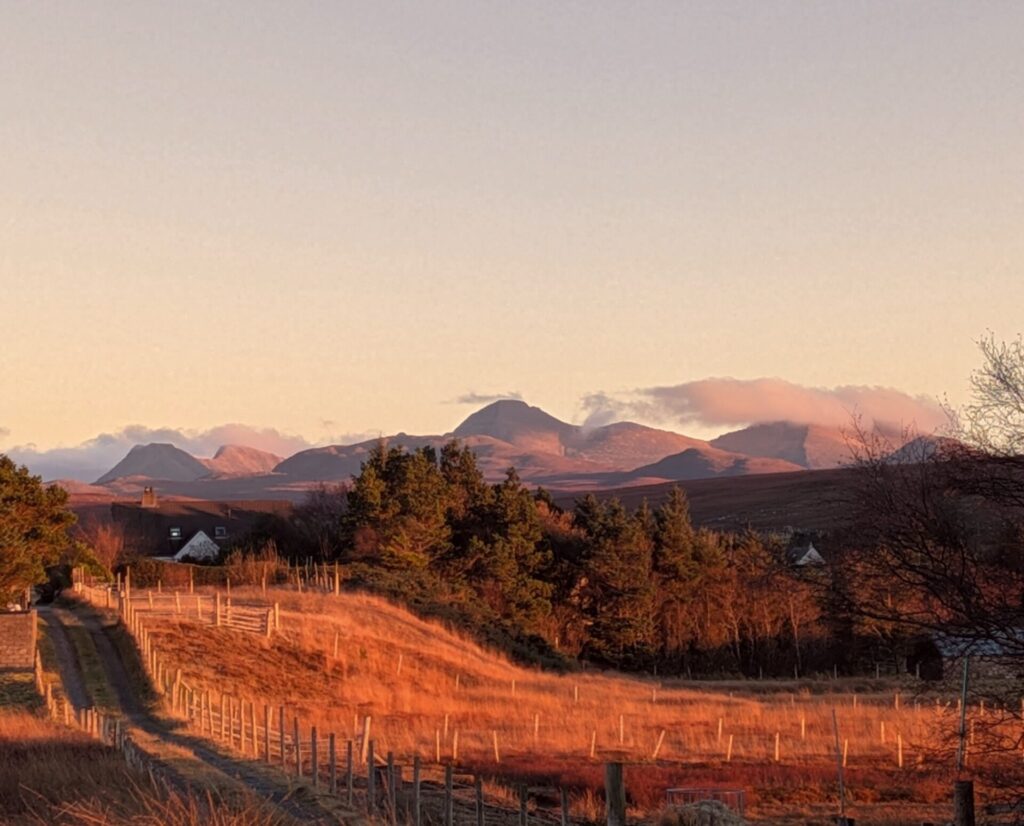
Everywhere looks clean and polished. Meadow, moor and mountain are vividly bright in copper, gold, umber, ochre and russet. It’s as if this place absorbed every fleeting drop of summer sun and now it’s time to give it all back.
Our valley has been really busy. In the still air I’ve heard chainsaws, hammering and banging, laughter and shouting, tractors, cattle, sheep, deer, chickens and birds singing. After weeks of silence (apart from the sound of rain and gusting winds), everyone came out to work and play. We snatch up every bit of good weather to get as many jobs done as possible before winter arrives. I’m sure it’s the same there.
D came to move the ponies onto the main meadows. The wee devils were excited and skittish. They ‘broke out’ through the pairc gate and careened up and down the track. They made a dash for freedom across the peats but quickly realized deep bog was not for them. Finaly, after a kerfuffle with buckets of treats, they were enticed back onto the croft. I wish you could have seen the cavorting. And yes, now they’ve settled, the wee trio are happily munching the newly sprouted rushes.
Our ditches are still clogged but some of the gorse has been cut back so the old ford across the Red River is usable once more. R and neighbour J fixed the storm-broken fences around the largest plot of woodland and the rogue sheep were collected by their owners. So, much has been accomplished in the weather window.
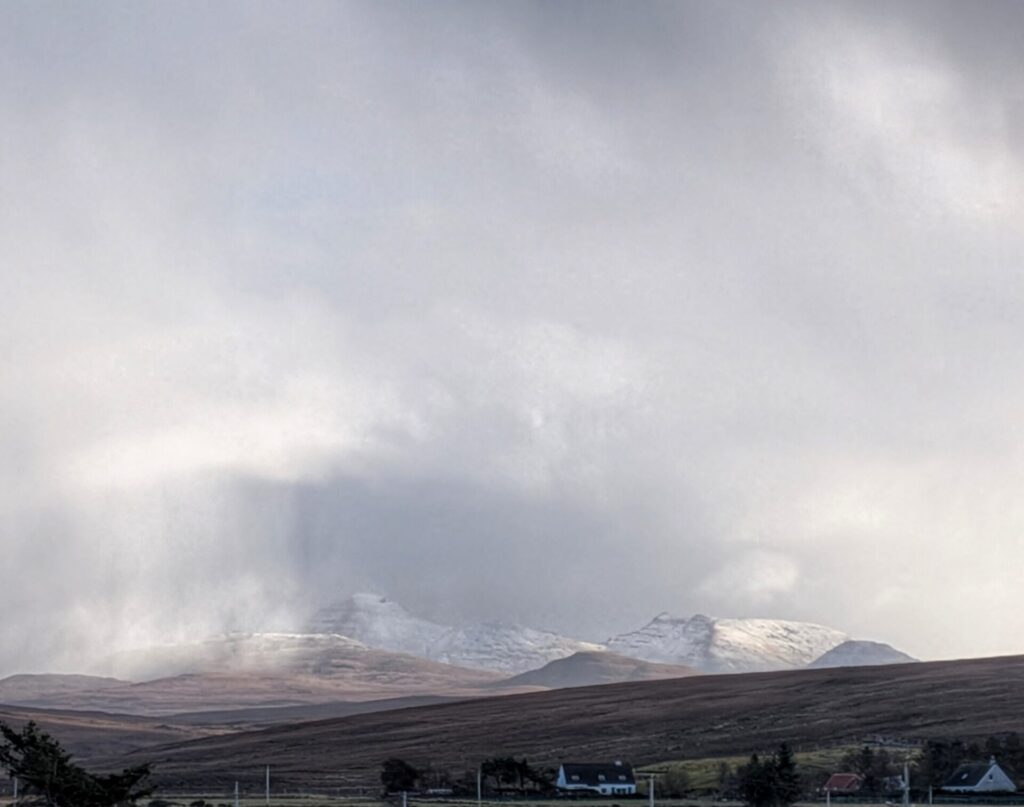
Over the last few days, temperatures have plummeted. Ushered firmly by strong northerly gales, snow squalls piled in. They were ghostly and fast moving, and they’ve whitened the hills. We’ve not had any snow down at sea level, but the cold has been biting. And yet there are buds on the bog myrtle, and they’re already aromatic. In the coming winter months, the incense will become concentrated. These tiny buds, tightly curled and densely packed, now contain the promise of another scented spring.
With love,
A x
*
Kirsteen Bell is a Scottish writer of narrative non-fiction and sometimes poetry. All her words are gathered from the croft in Lochaber where she lives, and the surrounding Scottish Highlands. Her writing and reviews can be found in such places as Paperboats, Caught by the River, The Guardian Country Diary, The Lochaber Times, and Northern Scotland Journal. Kirsteen can also be found at Moniack Mhor, Scotland’s Creative Writing Centre, where she is Projects Manager and Highland Book Prize Co-ordinator.
Annie Worsley is a writer, crofter, grandmother and geographer with an enduring love of the Scottish Highlands. In 2013 she and her husband moved to the crofting township of South Erradale near Gairloch. While her husband was a community pharmacist, Annie worked on Red River Croft. She began a blog about life on the croft and then wrote essays on nature and environment for various publications including Elementum Journal, Women on Nature, the Seasons’ Anthologies edited by Melissa Harrison, Caught by the River and Inkcap Journal. Her first book about life on Red River Croft and the natural history of Wester Ross, ‘Windswept: Life, Nature and Deep Time in the Scottish Highlands’, was published by William Collins in 2023, and is out now in paperback.