Beneath trees he’s known his whole life, Malcolm Anderson considers the European Beech’s uncertain future in the warming West Dorset climate.
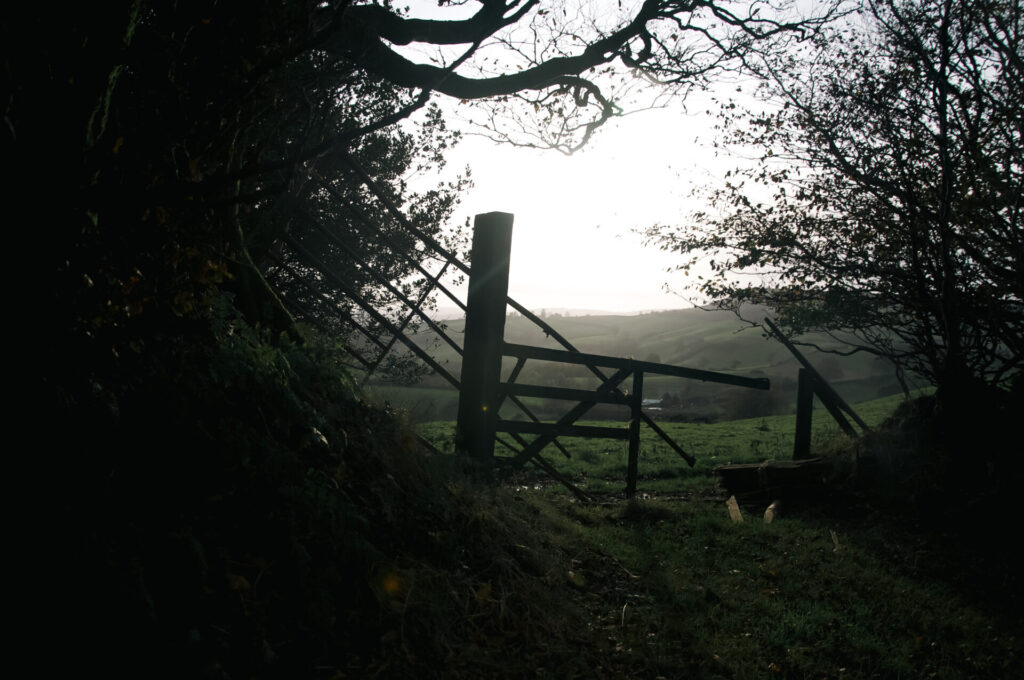
We all have those days, right? Well, today is one of those days.
Work pressure has given me a thumping headache that I can’t shift and the weather has settled into that distinctly British, spirit-sapping cold, grey gloom. Dreich I guess it’d be called if I was further north: here under a west country sky I’d call it cloam or cloomy.
I’ve come out for a walk to try to clear my head from plans, budgets and people problems but I’m regretting my clothing choices as my trouser legs are now dark and clinging to my legs, my thighs are cold.
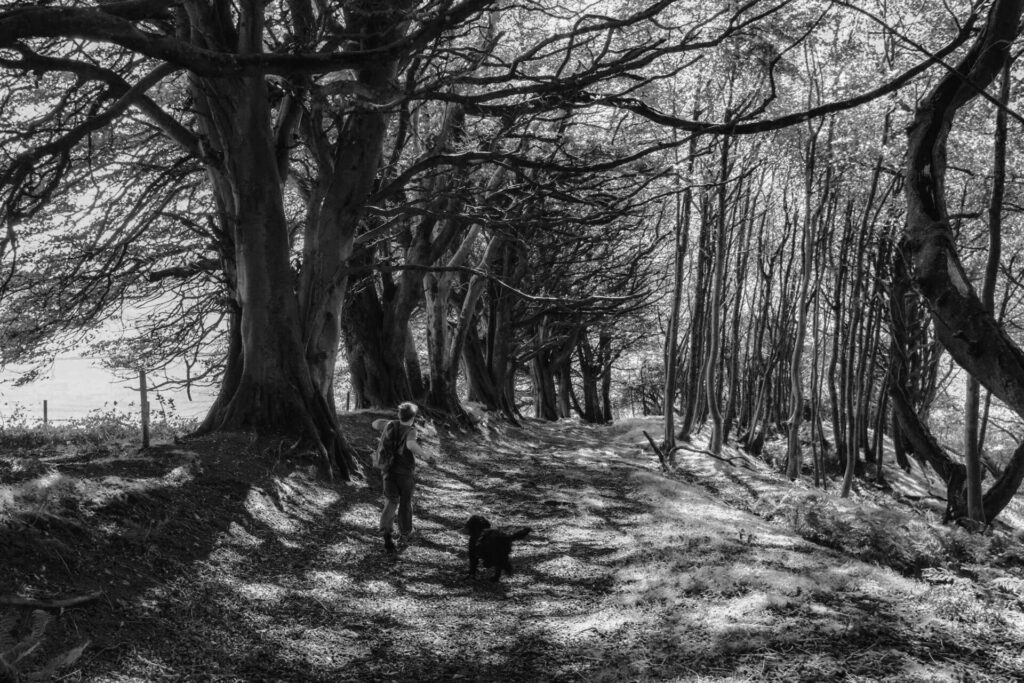
As often when I need to escape I come back to places I’ve known all my life, somewhere that every bend in the path connects to lived memory, where the past feels eerily close to the surface. Today I’ve come up the beech and bracken-clad flanks of Lewesdon Hill as it glows gold and amber against the deepening bruise of a sky. The trunks of the gnarled and windswept trees on the Brimley Coombe side of the hill are running black on their southwest sides, soaked like my legs. In the ghostliest of breezes the beeches lose their fluttering bronze-winged butterflies which tumble unhurriedly to earth around me.
Here under the beeches it is easy to mistake shelter for permanence. These gnarled boughs have a steady settled authority, a weight like the shadow of a mountain glimpsed through fog, something felt as much as seen. Their solidity giving a sense of things which seem to have been here before us humans started shaping the landscape around me; before the hillforts, hamlets and deeply furrowed field systems, before the barrows and holloways.
In reality the beeches around me are, geologically-speaking, youngsters — the oldest of them probably only dating back to the 18th or 19th century. The hill itself having been a bare-sided hillfort and a beacon site, warning of the Spanish Armada at other times in its life. That sense of permanence is I suppose an illusion fed by the fleeting impermanence of our human lives, but sat here, cold and wet on the mossy bank that lines the old track, these giants feel unswervingly solid and as much a part of my West Dorset as the Chesil Bank at Cogden as it curves on towards the smudge of Portland on the horizon, or the sweep of the Frome as it meanders across the fields beyond Maiden Newton.
I find myself getting lost in the years often these days. Maybe it’s just getting older, but these spaces often put me in an introspective mood.
I’ve been coming up here for at least fifty years. I’ve walked the paths through snow and bluebells, fog and sunshine. I once snowboarded down through the trees on a particularly heavy hoar frost. I played amongst these trees as a child and then watched as my own son formed attachments to the same place. I can’t help but look backwards when all around me, the paper-thin whispers of years gone by are fluttering to the ground on the breeze.
For 27 of those circuits around the sun I’ve also been working in sustainability, and that has had me thinking about the future. Years of being referred to as Cassandra at work, doomed to understand, as best any of us can, the future we’re heading into, yet feeling unable to get people to listen.
Sure, I’ve fixed sewage systems and cleaned up oil spills, I’ve installed heat pumps on cottages and solar panels on castles. I’ve written strategies, adaptation plans, risk matrixes, developed carbon literacy courses and talked until I’m blue in the face about water security. But as I sit here surrounded by my past, I can’t help but think about what a future Dorset climate looks like and I’m wracked, as I often am these days, by a gnawing anxiety, a deep sense of looming threat and shock at people’s indifference or inattention to the signs we see around us every day. The problems heading our way are things that can be mitigated, stopped from being as bad as they could be if you will, and they can be adapted to. Fly a bit less, eat more plants, walk more. Buy less shit. It’s not rocket science.
But it only works if we do all those things we know we need to do. The signs are that humans are stupid, and despite seeing what’s happening around us, we’re not acting. For that I feel a deep-seated guilt; a guilt that I haven’t done enough, haven’t used the right clever words, haven’t made a big enough change myself, haven’t got people to listen to the reality of what’s coming.
These trees I’m sat under sheltering from the weather have been given a date to die. All things must die eventually I guess, but this is a peculiar guilt; loving the beech’s place in this landscape, the southwesterly swept branches, the water-filled hollows and burrs (sphaeroblasts technically, a word I’ve wanted an excuse to write for years) while belonging to the very human consumerist world that is making this dappled shade harder to sustain as the climate shifts around the trees.
The BGCI (Botanic Gardens Conservation International) have a tool on their website where you can select an area of the world, select a scenario for future climate emissions and select a tree species. The tool then illustrates the species temperature range from ‘mostly occurs at this temperature’ to ‘not known to occur at this temperature’.
Selecting Fagus Sylvatica (European Beech), and using Abbotsbury Sub Tropical Gardens as a reasonably close location, the beeches in our current climate are comfortably in the ‘known at this temperature’ ranges across the different sources listed.
If we assume that human society has acted to reduce emissions somewhat but not universally and use the Shared Socioeconomic Pathway SSP2 (a measure used to project how human society, demographics and economies might evolve into the future), we see that by 2050 the beech is now edging into the limits of its known temperature range, with global temperatures at around 2 degrees above pre-industrial levels (worth noting at this point that the garden I work at in Surrey has already recorded 1.4 degrees of long-term warming at its own weather station).
If we assume for a second that the current geopolitical malaise continues and we carry on as we are, we keep burning fossil fuels and don’t cut emissions, we apply SSP3 and see global temperature increases of 2.1 degrees by 2050, and then somewhere between 3 and 4.6 degrees of warming by 2090.
In this last ‘business as usual’ scenario we see these beech trees above me, a species so dominant in the landscape here that it’s hard to imagine these hills without them, start to struggle within 20-30 years, and by 2090 the species is at the absolute limits of its temperature tolerance.
These cold-hardy beech trees have long thrived in the moist, humid conditions of West Dorset, but a changing climate poses severe overlapping threats beyond just the temperature shifts. Their shallow root systems leave them acutely vulnerable to water stress during repeated hot, dry summers, while also increasing the risk of uprooting during more frequent autumn and winter storms. Warmer conditions allow novel pests and diseases to establish, further compounding these physical stresses and impairing the trees’ ability to recover.
I’m not saying that Lewesdon will lose every beech — aspect, shelter, protection from groups of trees together, water availability can all mean that some trees will hang on — but the writing is on the wall for their dominance west of the historic Wash to Severn Estuary line.
Beech is one small living illustration of the change we will see across West Dorset, not a statistic or percentage in a scientific report. Having lived and breathed climate science for the best part of thirty years, I too often feel that we have lost sight of the personal story. We fail to connect what science is telling us to what that actually means on the ground.
Perhaps living with change begins not in loving West Dorset less because it cannot stay the same, but in learning to love the things we have even more deeply while we have them.