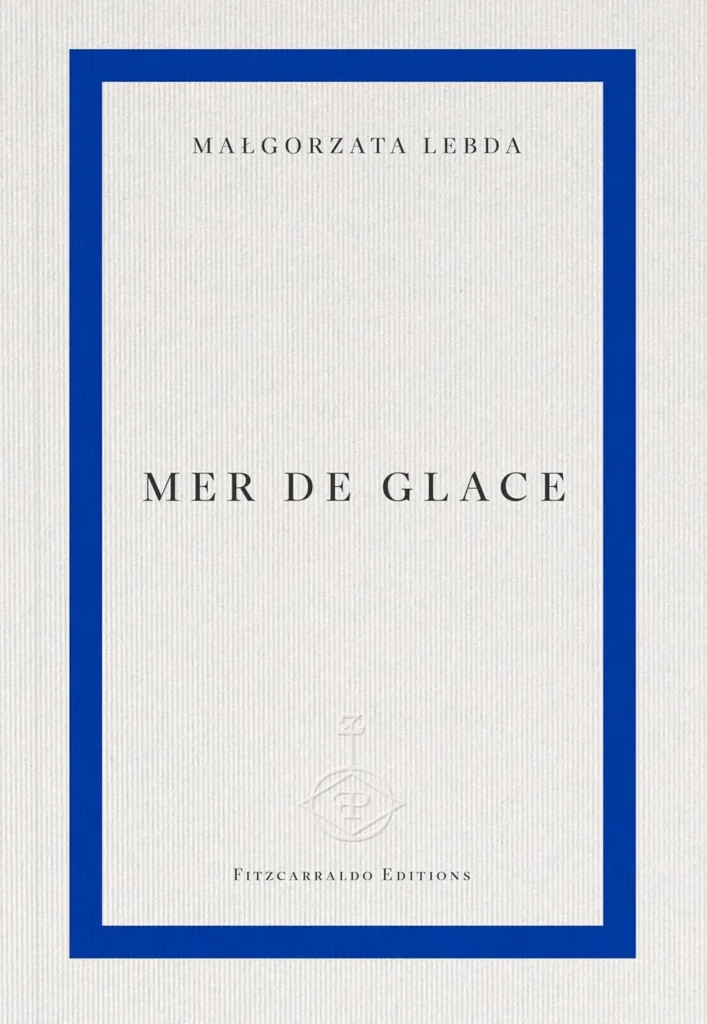
To read Małgorzata Lebda’s ‘Mer de Glace’ (trans. Mira Rosenthal) — our November Book of the Month — is to be transformed, writes Tallulah Brennan.
‘I was left with a feeling that the only way to experience the truth about your body is with pathological horror. The truth is that it does not have sealed boundaries and that objects pose a direct threat to your body … Your body is not inviolable. Your body is infecting the world — you leak.’ – Daisy Hildyard, The Second Body
‘Writing transforms the thing seen or heard ‘into tissue and blood.’’ – Micheal Foucault, Ethics: Subjectivity and Truth
‘From the Body’ is a funny title for a poem. After all, every poem surely comes from the body. Into my writing goes the sticky feeling, and of course, the good feelings, small and big pleasures, or else the feeling under which I might otherwise crumple; all things to be expelled. Then there’s the weather that day. How Winter arrives all at once. The condensation on the window, the first visible breath, the children with their red cheeks, the furry muffs on their ears, my cold feet on someone else’s cold feet. The day’s beginning all the way through to its end, having passed through my head all the way to my toes. All of this life, consciously or unconsciously, will find its way into what I write, either now or in the future.
There are too many memorable poems in Mer de Glace, but maybe the most mundane of all, ‘Zinc’, stays with me the longest: A woman talks about the woods, white spots of a zinc deficiency on her fingernails. From the white blotch of a fingernail, to how neighbours lean as they smoke, or how little boys mimic their mothers, ‘brrr’-ing at Lebda’s wintery figure: Look how these writers care. Is it not infectious? Amongst all of the beauty in Mer de Glace, the thoughtful translation, the ecology which sits so sensitively amongst the poeticisms, these are the words which indeed ‘do radical things’ inside me.
All of this is to say that we are porous. Writers, certainly. This works both ways; we are permeable too. Małgorzata Lebda grew up by a river in a Polish village which mostly functioned as a sewage dump (hardly a novel experience for anyone who lives in the UK). Now she lives in the countryside on a farm. It was inevitable then, that ‘The earth, the landscape, the mud, and the animal fur, would become her vocabulary.’ On BBC Radio 4’s The Verb, Mira Rosenthal, the translator of Mer de Glace, says that not a day goes by where she does not worry about whether her home expects rain, about sea levels. Rosenthal lives on the Pacific Coast of California. While translating Mer de Glace, she drew upon memories of the Athabasca Glacier which is part of the Columbia Icefield in Canada, where she was once in residence nearby. Ice (or the lack of it), dirty freshwater, and rising oceans made these two writers. While Lebda affirms in our interview, it would be ‘arrogant’ to suggest the river knows she exists, the two years she spent running along the Vistula river were spent ‘in service’: ‘it confirmed a hierarchy I carry within me, in which the river, the water, stands above me’.
*
You might imagine that this kind of localised writing — writing from a singular body, writing from a body running through the Tatra mountains or Poland’s longest river, writing from a body which evokes memories of a river and a childhood in a Polish village — might individualise, or at least, localise the problem to a point of exclusion. Yet, quite seamlessly, poems about cramps and appointments with endocrinologists beckon the reader towards a kind of anti-speciest solidarity. It reminds me of the horror I experienced upon hearing that humanity’s growing reliance on anti-depressants was toying with the world. They say that the skeletons of crabs are dissolving as the pH of the ocean changes. As if this wasn’t enough for their newly vulnerable sensory systems, the unhappiness in my blood stream has leaked, and I am no longer the solitary victim of my pollutive thoughts. Under the influence of selective serotonin reuptake inhibitors, freshwater crabs are more reckless, emerging more quickly from their hiding places, showing their claws to predators and losing their sense of time on their search for food. I was disoriented by the world, or else, I was disorienting the world. My loneliness was never mine alone.
*
My thoughts changed with the crabs. I no longer need pills to lessen the load of the world, but some days my body feels too weighty all the same. Like a problem I don’t know how to solve. I am altogether too solid, too impactful, and not at all, or at least not enough. I wish to change the world and I cannot, and yet my body belongs to a collective of bodies which are changing the world irrevocably every day. In the meantime, I am not dissimilar from Lebda. I use my muscles to carve out a different path, I walk and I run. I read good words and try to piece together my own. I let thorns and fields root themselves into me. I surround myself with people who pay careful attention to worlds which are not their own. People who notice like I would like to notice. When my lungs burn with a frosty morning run and when my calves ache the day after a large hill, my body reminds me that it is not indifferent to the world, nor is it set apart from it. Indeed, ‘muscle work resembles a good poem’.
I think about Gábor Kürtim, the president of the Hungarian cyclists’ club. When Gábor cycled the newly visible banks of the Danube in Hungary this year, he surely did not imagine himself as a poet. And yet, as he put it, looking at the parched river ‘was like looking at the scene of a terrible accident.’ When a certain large boulder emerges from the Danube and presents itself to the people of Budapest, this means extreme weather. This kind of drought meant that crops would most likely fail, that people would go hungry. Hence a legend arose, and a name to give the story its stilts: ‘ínség-szikla’, the ‘rock of starvation’. The myth was made by history, and during the hottest summer on record, Kürtim gave it new life. In my home county, medieval villages are among the ruins which emerge from the reservoirs which have reached record low levels. Lebda believes that poems might train us for exceptional circumstances, and God knows that exceptional circumstances are what we are headed for. Lebda and Rosenthal are so dutifully showing us how we might use both our bodies and our mouths to find the right words and the right actions to address what is drying out, starving, dying. What is so special about this collection though, is the hope its subtlety imbues. As Lebda says, ‘I have faith in my readers, and I don’t think we need manifestos. I trust that a poem about feeding dogs can inspire love for the world and still be a call to action, without sending anyone to the barricades.’
What does translation train us for, then? In the Poetry Nation Review, Rosenthal evokes Georgia O’Keefe: ‘I see the work of the translator as trying to bring the faraway nearby’. The title of Lebda’s collection is not ‘Vistula’, nor is it named after any other Polish river. It is named instead after the Mer de Glace glacier Lebda has visited many times in France. The glacier is retreating and the world it belongs to is ‘passing away’. There is no one river deserving of one lament, no one ruin to dread, no one glacier to grieve. Perhaps the importance of translation was best articulated by Lebda herself in our interview: ‘Without translators, we writers would not exist in the wider world. Translators are a bit like rivers, which recognise no borders.’ The rhythm of Polish, Rosenthal explains, is not the same iambic rhythm of English. The emphasis of the dah-dum is trochaic. But what does this matter when ‘the power of poetry comes from that beat, that rhythm which is so close to the heart, that places us in the body’. Therein lies the wonder of Mer de Glace: how beautifully a path carved along a Polish river sits alongside our own paths. How these in turn bring us to an awareness of a river whose heartbeat does not mirror the rhythm of our own, but deserves to live all the same.
*
I went to live in a different city for a little while. The trails I took in the summer consisted of scorched earth in-breaths and sickly yellow out-breaths. Since our rivers are un-swimmable and poisoned, I turned to the lido. This was my routine: I would raise my head above the water to gulp down more air, to fuel the next push and pull against the water. In these in-betweens I could see high rises, heat-stressed trees, planes which sliced up the sky with their long tails of pollution. Some of them looked like spines, like cloudy vertebra blurring into each other. None of these planes ever seem to be heading towards me. Always flying right or left, or the opposite direction to mine, so to be certain they were taking something away from me.
There are 21 rivers in the stranglehold of this city. They buried and subdued them, so my lungs made a hostile home for gulped down chlorine instead. In ‘Geography’, we are told, ‘don’t bother searching for order or moderation’ in the names of places, in maps or in rivers. In ‘The Sava, The Danube’, Lebda contemplates how hard it is to imagine these rivers unrushed by storms, how they might have once merged ‘lazily’. The rivers underneath my feet were robbed of their own sense of flow too. In her translator’s note, Rosenthal writes that her goal is to use language in a way that is not necessarily ‘fluent’ or natural’, because the unnatural is how poems ‘refresh our sense of awareness and meaning making, how they deepen and complicate our relationship to the world around us’. In a world which so abruptly and so carelessly stems the flow of what is natural, Lebda and Rosenthal are writing their way back to what will otherwise be stolen.
Now I live in a city which punishes its river in a different way. Different but commonplace all the same. The river floods quite regularly, meaning that upon moving back, I worry less about temperatures and more about rainfall. About who is counting the centimetres, not degrees in celsius. It is easy, with the marks left on the wall, ruined floors, the damp which will never leave, to believe our home is beholden to a tyrant with a name that goes like ‘The Ouse’. But what did we do to it, first? Who inflicted the first strike? Not a universalised ‘we’, but a mysterious ‘someone’, straightened it, poured into it our shit, all of our chemical disdain and then some more. In The Site of Memory, Toni Morrison wrote of the Mississippi’s tendency to flood: “Floods” is the word they use, but in fact it is not flooding; it is remembering. Remembering where it used to be. All water has a perfect memory and is forever trying to get back to where it was. Writers are like that: remembering where we were, that valley we ran through, what the banks were like, the light that was there and the route back to our original place. It is emotional memory—what the nerves and the skin remember as well as how it appeared. And a rush of imagination is our “flooding.” There are plenty of people who are imagining this river another way. Savouring our river like Lebda savours the bite of an apple, the faces in the window opposite, the waking up to tell the dogs about her dream, observing the men sharing their sandwiches, the naming of visiting swallows. Our everyday river: our eyes that can see a colour which is all wrong, and our feet, which tread the mud from the riverbank into our homes and workplaces. From my body, which daily attends to my lifeblood, I am reminded that with the ability to articulate our rivers, there is the ability to dream them up better.
*
It is one thing to read a poem which might make one think twice about their river, to imagine it not as the dumping ground it has become, but the essential organ, the artery it really is. It is another to read a poem which reminds us, in the same breath, that we are a sensitive species as well as a parasitic one. We may have leaking bodies, but we have tender minds all the same. I place my faith in writing which so subtly embodies its potential, that carries a gentle strength in sentences which hold the tremor of tenderness, affected but unfazed by potential nuclear waste, certain chemical waste, traces of e-coli, currents of microplastics. For certainly that will be our legacy, but so the poetry which tethered us to our changing world and to each other will be too. Mer de Glace gifts the reader language and the body as our buoy: ‘Praised be the movement and the setting off… praised be that which is constant and also what is fickle, praised be all that can be placed in the mouth.’ To read Mer de Glace is to be transformed. This is the only way forward with the writer’s toolbox. When language is in hands as delicate as these, it could be ‘as simple as setting one foot in front of another’, to believe that we are made as much of our soft relations as our habitual and cross-border tendencies towards devastation and degradation. ‘From the Body’ then, is not a funny title for a poem at all. Lebda and Rosenthal have crafted a collection which is of the body, of the Vistula river, but a much more worldly river too. This is writing which belongs to the river the body once was. Both mine and yours.
*
‘Mer de Glace’, written by Małgorzata Lebda and translated by Mira Rosenthal, is out now and available here, published by Fitzcarraldo Editions (£12.34). Read an extract here. Read an interview between Tallulah and the book’s author and translator here.
Tallulah Brennan is a writer based in England, interested in the relationships between humans and their environment, and how they in turn shape each other. She is also a contributing editor at Caught by the River. Follow Tallulah’s Substack here.