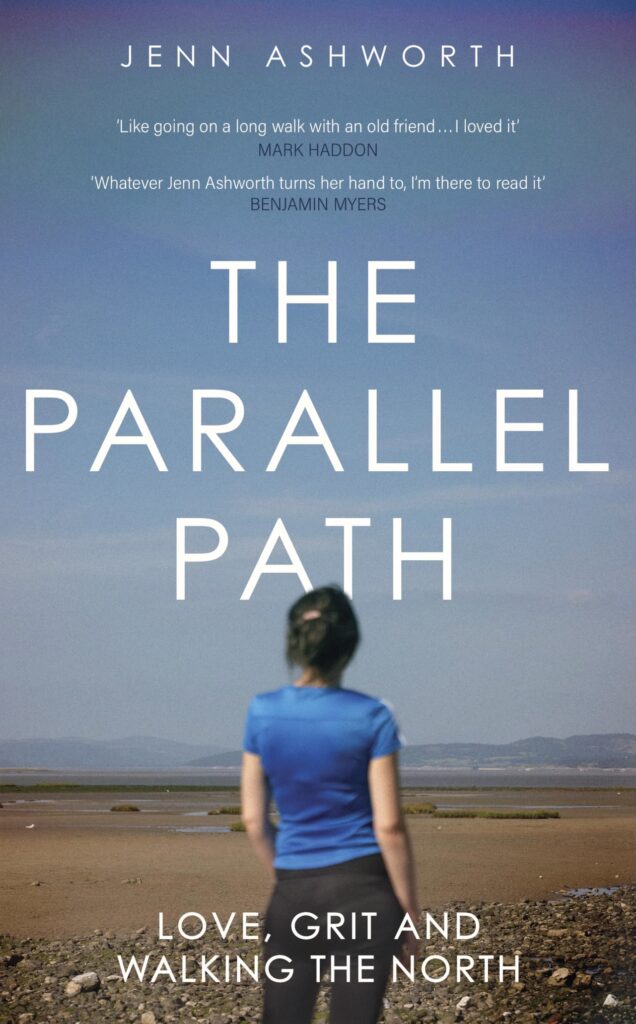
An extract from Jenn Ashworth’s ‘The Parallel Path: Love, Grit and Walking the North’, our August Book of the Month.
‘I’ve decided this is my mid-life crisis. Shirley Valentine in a North Face jacket,’ I said. My friend Clive was polite enough to laugh. But there was truth hiding in the joke I was trying for. The summer I’d walk across the country I would turn forty and my daughter, eighteen. I was emerging from my children’s childhoods as if from a darkened tunnel, or perhaps into one. My sense of humour, my excitement, my creativity had been almost obliterated by trying to make the lockdowns better for the people I felt responsible for. That task – as huge and impossible as walking across the country – I had failed in utterly and the parts of me that had tried to help were frozen now.
In the early spring, I had devoured books about walking as I tried to understand my post-Covid cabin fever. During the pandemic all the newspapers were carrying articles about the crisis of loneliness and the secondary epidemic of ‘touch hunger’. One morning, Radio 4 interviewed a doctor who suggested that being alone too much was as bad for you as smoking. There were campaigns and initiatives to get people together: the local library staff were keeping in contact with their housebound borrowers over the phone and my street had a WhatsApp group buzzing with messages as everyone on the street checked themselves in and made arrangements for shared music on Sunday afternoons. I bounced between what my children and my students needed from me, constantly engaged in the work of domestic and professional care. I cooked. I checked in with people. My phone rattled with so many notifications from the newly formed virtual communities I belonged to that I turned it off and put it in a drawer.
Whatever this out-of-step urge to be outside and alone meant, I wasn’t the only one who’d ever experienced it. William Hazlitt, in his 1822 essay ‘On Going a Journey’, declared that ‘One of the pleasantest things in the world is going on a journey; but I like to go by myself. I can enjoy society in a room; but out of doors, nature is company enough for me.’ For him, one of the primary pleasures of walking alone is freedom from social etiquette and the expectations of others. While walking alone he is free to indulge a bad mood or get lost in a daydream. He harms or bores no one. His relief is palpable: even his enjoyment of the landscapes he moves through seems to depend on the fact he’s under no burden to point out the view or explain it to someone else. ‘Is not this wild rose sweet without a comment?’ he asks. It didn’t seem to me that Hazlitt was a misanthrope, only that he was sensitive to what being in a good relationship with someone else required and keenly felt the work involved in making sure he was good company.
His essay helped me to understand what I had been feeling. I had tried to be there for my children and my students in ways that were helpful, nurturing – or at the very least not out-and-out irritating. This involved trying to forget about myself. Sometimes that happened naturally but more often I achieved it with brute force and a paradoxical, obsessive maintenance and pruning of who I was in the attempt to turn myself into a thing that was both useful and appealing to others. Anyone who has sat up and helped with GCSE Chemistry when they wanted to go to bed, who has answered the Teams call when they needed to eat, who has tried hard to be interested in someone else’s news when they wanted to watch the telly, knows what this work is, but Hazlitt really understood just how utterly exhausting that intricate tending of self that is part of the labour of care could be. And he said walking freed him from that in a way that nothing else did. The essay felt like a promise: maybe the walking would work that way for me too.
Hazlitt isn’t the only writer who has associated writing’s comforts with aloneness. In May 1862, just a month after his death from tuberculosis, The Atlantic Monthly published what would become Henry David Thoreau’s most famous essay, ‘Walking’. Thoreau shared my new distaste for circular walks (‘half the walk is but retracing our steps’) and – with some humour in the telling – suggests that the real walker should set forth in such a spirit of adventure that they expect ‘never to return – prepared to send back our embalmed hearts only as relics’. The world he walks through is defined primarily by what is not there, ‘Man and his affairs, church and state and school, trade and commerce, and manufactures and agriculture, even politics, the most alarming of them all – I am pleased to see how little space they occupy in the landscape.’
Thoreau also suggests that readiness for a proper walk requires a complete detachment from past and future: home and family left as if you’d never see them again, debts settled, will made, and no expectation you’ll be back to tread the path a second time allowed to form. This attentiveness to the present is synonymous with being alone. Even a relationship of care to another person (he remarks on ‘good works’) becomes a kind of distraction from the woods and is apt to drag the mind away from where the body is.
That determined, cold-blooded shedding of anything other than now reminded me of Clive’s fascination with Dennis Potter and the way Potter’s sense of impending death unencumbered him from past and future and somehow made him more available to the world. Clive and I were both envious of that, I think, and for different reasons found the state elusive. The difficulty for me was that most spaces and places contained ‘man and his affairs’ and that being fully available to the world also involved being in connection with other people and their needs. Caring involves a type of attentiveness that sends parts of me forwards and backwards through time (was the school uniform put in the washing machine last night? Have the next set of dentist’s appointments been made?) or, in Thoreau’s parlance, takes me ‘out of the woods’. So many parts of myself had been off on their errands it felt as if the present was scooped out and empty. There was an extremity to the solution Thoreau proposed that had appealed to me: certainty can obscure nuance, but I’d been seduced by his witty confidence. What could be more drastic than setting off to walk across the country?
*
Published by Sceptre, ‘The Parallel Path: Love, Grit and Walking the North’ is out now and available here (£19.00).
Read an extensive interview with the author, conducted earlier this month by Karen Lloyd, here.