Recently published by Ember Press, David Gee’s imagined history of the Green Man is a gift of defiance, of joy, of anger and of hope, writes Eben Myrddin Muse.
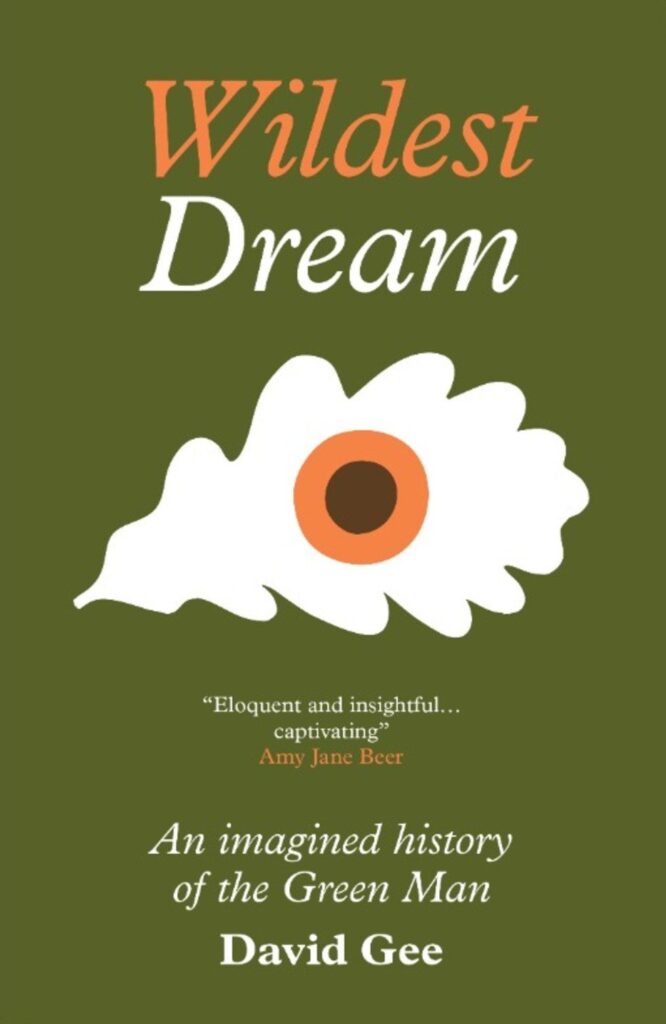
Wildest Dream by David Gee is a short meditation on the folkloric Green Man. Invigorating and articulate, it feels like a quaffed shot of one of those earthy green herbal vinegar drinks, both loamy and stimulating to read.
Whirling through iterations of what it means to be ‘greened’, the book is both a study on a theme and an invitation for the reader to go and chase that same ethereal greening that so infects and drives its many characters. David Gee did not live to see the publication of Wildest Dream and that fact tinges the pages with tragedy, but each word is charged with such a ferocious verve that his presence is very strongly felt.
In the first chapter, Gail E Haley’s The Green Man is elevated from its status as a children’s picture book into a sort of sacred text with lessons that feel strikingly relevant for our time. Its protagonist’s tribulations and transfigurations through a sort of nature cure make for an accessible introduction to concepts that might otherwise seem nebulous: of greening, and wilding. But the pitch at this point is simple: what can be gained and what can be lost by shaking off the trappings of society?
What begins as a theme in a picture-book begins to take a firmer historical shape as Gee reaches further. Past the recent fairytale we go to the ‘horrid pagan’ leaf head motifs which disgorge leaves and writhing vines over the walls of medieval churches across England and Wales. It’s a hazard to project our own purpose and motivations onto objects of such antiquity. Yet the idea that these legions of leaf-men are more than a simple decoration, more than an act of whimsy, is compelling. These leaf heads quickly devolve into serpents and again to primordial beings. The book’s ‘greening’ is set in opposition to a natural world that is tidied and packaged into standardised units of carbon offsets or nuggets of natural capital for our era of rationalism and industry.
Gee waves an accusing frond at modern churches still seeking to ‘wash the taint of the wild from the holy’, denying us a religion where ‘theology and lore danced together’. To someone like me who grew up attending the grey and dismal churches of rural North Wales, there is an appeal to a greener, wilder churching. Having spent many hours staring idly at the rafters of dimly lit churches, it’d have been nice to see a googly-eyed leaf-spitter ogling back at me from dark corners in the roof. These mischievous motifs hark back to a possibly-imagined past where church was still sort of feral and contained more magic, and people by necessity lived more closely with the land and seasons.
As Gee gathers steam, the activist in the author rises and starts to throw punches. The Green Man now takes folkloric form as we find our anti-war figure with non-Arthurian Merlin – Myrddin Wyllt. The scarred veteran of the Welsh old north reacts to war the only rational way: with madness. As a Welshman reading an English take on our folklore and terms like ‘awen’ (bardic inspiration, possibly divine, usually poetic) I am always primed with an eye-roll ready to go in response to the exoticisation that we’ve become accustomed to (if I see one more mystic and verbose essay about ‘hiraeth’…) but Gee manages to use both our bards and our bardic inspiration with a deft touch. I was surprised to be left with a novel perspective of my own culture and new thoughts all of my own on Myrddin, who happens to be my namesake. I’d never considered before that among our earliest myths from this land is an effectively pacifist parable. I find that comforting in these bleak days of unspeakable complicity in war and genocide.
Among the penultimate chapter’s cast is Marion Shoard, a legend of the modern land movement. It’s heartening to see she still has fire in her belly for conquering Normans and enclosers. The vanished village of Wormleighton makes for a strong setting for a polemic on dispossession and rural exodus – issues that find new relevance in today’s micro-enclosures and modern-day land clearances by the very rich. In it we find the book’s first tangible villains – the aristocrats who cleared the land of people, turning nature ‘from a shared home to personal possession’ and whose descendants deny culpability to this day, with laughable claims of ‘sound farming’ as the true source of their riches. Rich indeed.
After I laid my copy down having finished the final chapter, what stayed with me wasn’t the specific green threads of the tapestry woven within Wildest Dream’s pages. Not lines of poetry or folkloric allegories. It was a desire to carry the book’s deeds and transformations with me, to green myself and my community. Although I still don’t exactly know what that means, that greening, wilding, change, I feel a little better equipped to figure it out than I was before. I want to be part of Gee’s ‘motley movements of hope’ because to do nothing and remain on this trajectory truly is madness. Can I be a green person, among Gee’s gallery of fools, rogues, and nutters?
Insofar as The Wildest Dream is a handbook and a manifesto, it is forceful, and enormously rewarding to read. A gift of defiance, of joy, of anger and of hope, carrying the urgency of a man who was running out of time and knew it. It’s a great tragedy that someone with Gee’s vision and voice has left the building, but with this parting flourish he passes his inspiration, his awen on to us.
*
‘Wildest Dream: An imagined history of the Green Man’ is out now and available here (£8.54). Ember Press are donating 50% of profits from the sale of the book to Asylum Welcome, a charity offering information, advice and practical support to asylum seekers, refugees and vulnerable migrants living in Oxfordshire.
Eben Myrddin Muse is an emerging writer and campaigner from Dyffryn Nantlle. In his work he explores land justice, Welshness, commons, and nature connection. He has written for The Welsh Agenda, Viewpoint and Climber Magazines, as well as being a regular contributor to UKClimbing.com. He works as a policy and campaigns officer for the British Mountaineering Council’s access and conservation team and is an ambassador for the Campaign for National Parks. Follow him on Substack, Instagram and Bluesky.