December’s Book of the Month is ‘The Book of Bogs: Stories from a Yorkshire Moor and Other Peatlands’, edited by Anna Chilvers and Clare Shaw. It was published in September, but we didn’t make nearly enough of a fanfare about it — so here we are, making a fanfare. Read an extract from Clare’s contribution, titled ‘A Love Story of Walshaw Moor’, below.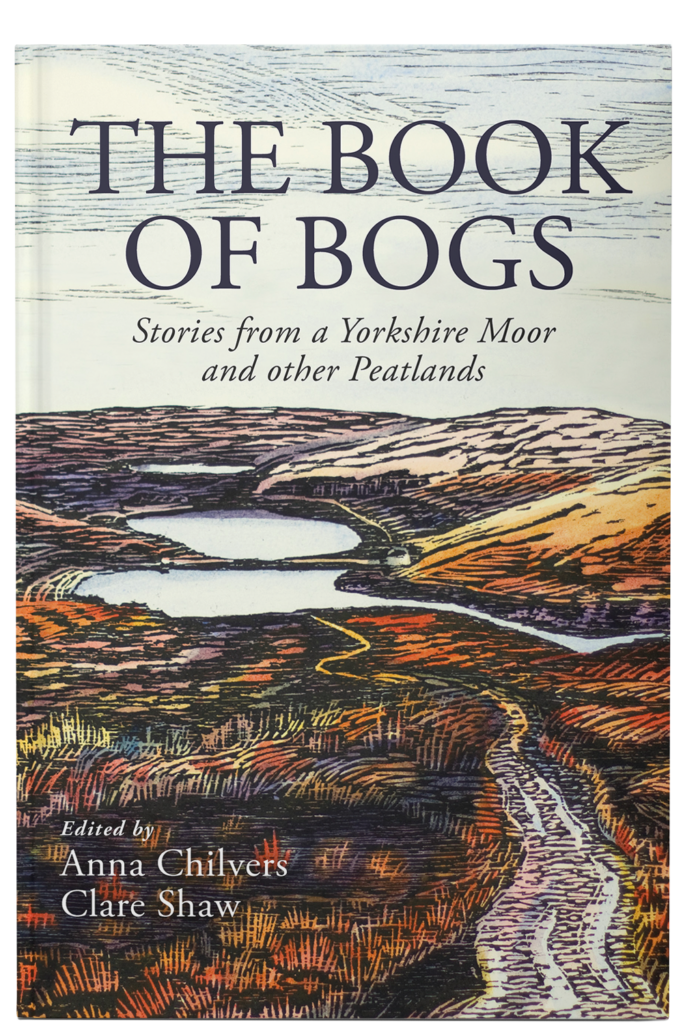
According to Sternberg’s triangular theory (1986), love is composed of intimacy, passion, and commitment. My feelings for Walshaw Moor began in passion – wild skies and ruins and heather – then developed into intimacy, a close knowledge forming carefully, painfully, over years. The wind farm proposal is just the latest and most urgent of the threats facing the moor – and in facing it, I’ve entered the realm of commitment, with its weight of responsibility. This is the shape of love, and this is love’s duty.
For years, we have told a story of bogs as unproductive, unattractive; dangerous places of waste, empty landscapes we pass through. In Calderdale Wind Farm and its renewable energy, we are still fighting the destruction of peat at the level of story. A wind farm is not a farm: it’s a power station. Green energy is not green when it is built on protected peat. The proposal poses an existential threat not just to Walshaw Moor, but to all upland peat and blanket bog – because Walshaw Moor is protected in law on multiple grounds, and if building goes ahead here despite these protections, then all protected peatlands – perhaps all protected landscapes – are at risk.
The need to protect and restore peatland is universal – but I won’t pretend it’s not personal. I love Walshaw Moor, and my love is deep and particular. I learnt that when Auden said that topophilia ‘had little to do with nature-love’, he meant that it doesn’t refer to a general love of nature, but to the knowledge and love of a specific place. It’s this relationship, he argues, which imbues the poetry of John Betjeman and Thomas Hardy with its vivid particularity, and through that detail, its universal depth and life.
According to Auden, love of a particular place leads to better writing. The ‘topophilia hypothesis’ goes further, suggesting that it reflects an evolutionary drive: that people who bond with their landscapes understand them better, and as a result, survive more effectively (Beery et al, 2015). They know how to care for those landscapes. As Synopwich (2020) says: ‘Sometimes the people whose backyard is at stake are best placed to see the value in preserving it – not just its value to them, but its intrinsic value. Far from being at odds with the public good, they may even help ward off public bads’.
It is okay – more than okay – to love where you live. It makes the world better. Loving place leads to deeper understanding; understanding leads to better care – not just for one place, but for all. I love Walshaw Moor; and because of this, I love all moors. I love moors, and because of this, I love nature. Because love with its intimacy, its passion and commitment, is not greedy or jealous; it is not possession. When we see what makes a place wonderful, we see it everywhere. Truly loving somewhere, someone, leads to a deeper love for all people, all places.
The moors tonight are dark and still under a haloed moon. I’ll fight for them. Sometimes, we are islands in a dangerous sea. What land can we save from the tide? I’ll fight for what is marvellous, which is life. I will call this love. Although the wind might blow the roof off, we can always love, and in loving we are saved. The news is not good, but the moon is bright. Rachael and my daughter are sleeping upstairs, and this is love, solid and soft and rich. I will protect them and their peat and purple heather, their sundews like gems. The tiny snails, they will love me, the curlew and merlin, tardigrades, the mystery of deep space between them, they will protect me, the crawling toad with the soft skin, bilberries, lands stretching towards the distant coast, the brownfields and their brave and injured soils, men in the lorries thundering towards the floodlit ports, this is love, green waves and seagrass, the terrified, hopeful lives in small boats, seals snoring on the shore. Forests of moss and lichen, the stone wall; I will call this love. Even the barn owl is silent tonight, even the fox.
*
Edited by Anna Chilvers and Clare Shaw, and featuring contributions from the likes of Robert Macfarlane, Amy Liptrot, Patti Smith, Horatio Clare, Nicola Chester, Alys Fowler, Guy Shrubsole, Polly Atkin, Sally Huband, Michael Malay, Amanda Thomson & Annie Worsley, ‘The Book of Bogs: Stories from a Yorkshire Moor and Other Peatlands’, is out now and available here (£19.00), published by Little Toller.