On the crofts of Annie Worsley and Kirsteen Bell, pine needles puncture the shimmer and shade of winter.
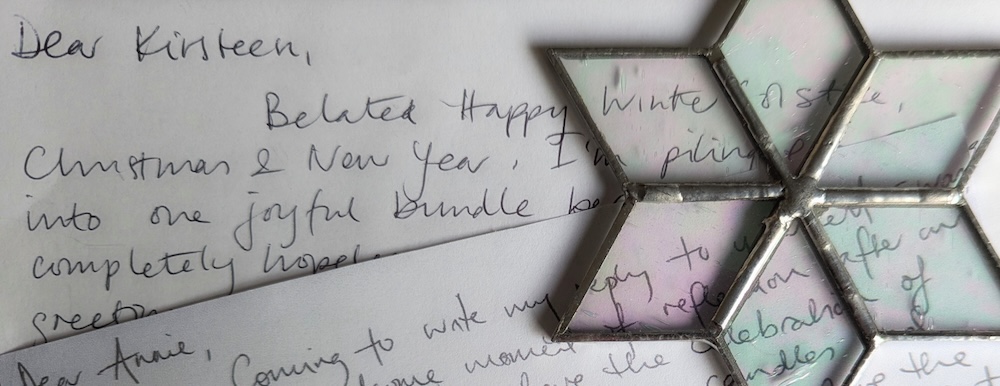
Dear Kirsteen,
Belated Happy Winter Solstice, Christmas and New Year. I’m piling everything into one joyful bundle because I’ve been completely hopeless with cards and seasonal greetings. I hope you all had a wonderful time?
I can’t quite grasp how swiftly this year has flowed. I am about to enter my eighth decade and feel the run of time as a river in spate. I flip from bone-weary tiredness to over-the-top exuberance. Life is a cycle of fast and slow, up and down, pain and pleasure, but one thing is certain, it never stops surprising me.
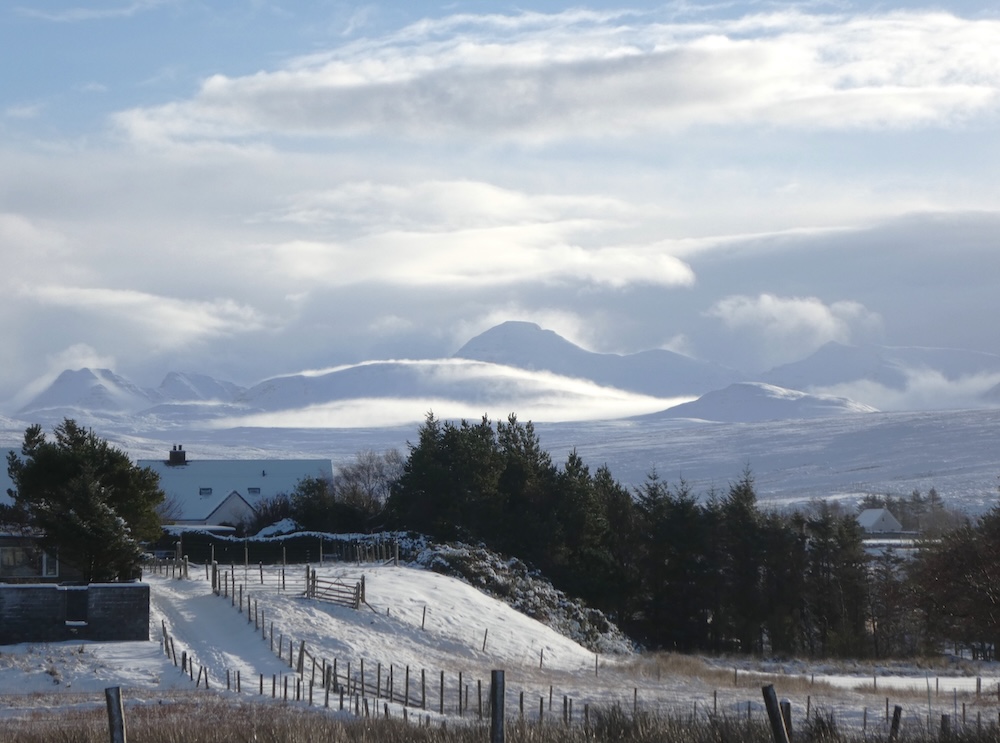
R beat me to 70 (in November) so we enjoyed a few days in Torridon, a wee gift from the family. The weather was cold but kind. Crystal clear air revealed summits and slopes where every nook and cranny was visible. It’s rare to see so much topography and fine geomorphological detail and a joy to walk on relatively dry ground. There was a lot of path restoration work in 2025. Once I’d have preferred a tougher, wilder scramble amongst boulders, heather and tumbling burns following a faint trail. 50 years on, I’m very happy to place booted feet securely on sturdy rocks and gravel. I can gawp at the peaks and see where the path is heading.
In the weeks before Christmas we were busy cutting hedges back to both restore them and regain our mountain views. We’ve been loath to do too much trimming in the past because these big old hedges have done a wonderful job of interrupting and reducing the severest gales. They’ve saved our roof many times in big storms. And they’re home to lots of wildlife. But if we allow another year of growth, they’ll no longer be hedges but woodland. There are so few hedges here in coastal Wester Ross the incentive to maintain them properly is now an important part of our overall croft management plan. They connect our small patch of mature woodland to areas of gorse-scrub containing emerging trees such as rowan and aspen and to our newest ‘infant’ woods. They’re small corridors for wildlife and they provide shelter for grandchildren hell-bent on playing outside in 50 mph winds!
Do you have hedges on your croft? Are there many in Lochaber? I’ve often wondered why there aren’t more here acting as protection from stormy weather but guess it’s due the long history of crofting and because every available corner of ground was needed to support the crofting township. Fences only began appearing in recent decades. I once asked my neighbour about enclosures and she said apart from the grand old dyke wall surrounding South Erradale, there were none. Only when crofts were bought from the laird or ownerships exchanged were they fenced. Posts and wire are a sign of modern practices and the need for legal boundaries rather than the open mutually shared practices of my neighbour’s youth.
Everything has settled back into the earth. Once tall tufts of grasses are bleached of colour. They’ve shrivelled or have been whittled away by the cold and wind. The turf is pale and shrunken but it creates a dense protective matt covering seeds, hibernating insects and invertebrates from the worst ravages of winter. For ages, I watched a few pale gold leaves cling to one old birch by the river. From a distance they looked like small flecks of gold leaf. And then they vanished.
This year, I found the weeks leading to midwinter especially dark. Relief came from the gangs of goldfinches dashing back and forth, from field to garden feeders and back again. I love their Christmas colours. They flicker like fragments of wrapping paper in the gusting winds.
The solstice seemed to be bound in a corset of wild weather, cinched hard at the waist as if by a strong belt. I yearned for the release and time to draw long deep breaths of cold fresh air. And then, just as the family arrived, skies cleared, temperatures dropped and the valley opened out like a flower.
Yuletide and Hogmanay have been joyous; our hearts have been full, despite the darknesses in the big wide world. It’s been wonderful to have a baby in the house again. Flashes of every kind of light have brightened the days — glinting ice-covered hills, the sparkling fast-flowing river, the laughter of children — then meteors in the night sky (did you see them?). We played on the beach in glorious winter sun, frolicked in the snow, looked out at the moon.
The growing pile of pine needles on the floor made us laugh. We remembered our own spell of parenting — young and exhausted with four little ones. I’d hang my best glass baubles on the highest branches of our Christmas tree. Some belonged to my grandmother. Our children could not keep their fingers from fiddling with the decorations. By twelfth night the lower half of our tree would be almost bare. If we’d had a time-lapse camera the result would have shown a tree with mobile tinsel and trinkets, creaturely, with rippling skin of shiny colours and stippled texture.
This year we’ve come full circle. A house bursting with noise and mayhem. Another tree bare of needles below a bauble-filled upper half. The old glass survivors, now more than 100 years old, are still placed high, out of reach.
And then, an unexpected extension to the family holiday. More snow; deep and crisp and even. Our wee sloping track became a sledging-slope of unconfined joy. The ponies — guests on the croft — caught the contagion and cavorted. The baby, cocooned in many layers, laughed out loud.
The family stayed on. A (age 6) was delighted. The roads were too difficult, the journey too long for little ones in such conditions (deep snow, a -80C wind chill), so we were blessed with a few precious extra days.
And now? Slush, snow, silence. Inside and out, the clear-up begins. Slàinte mhath! Ax
*
Dear Annie,
Coming to write my reply to your letter was, as always, a welcome moment of reflection after our own hectic festivities. I do love the celebration of light and life in these dark days, candles and fairy lights in amongst the evergreens. I also love the calm of January when I can sink into that dark quiet for a while.
I did manage to see the meteors – driving round the loch at 6am to beat the Christmas Eve shopping chaos! A single falling spark through indigo skies, above black trees blurred by my own speed along the road. Little moments of magic stitched through the busy-ness were their own kind of gift. The kids are getting old enough that we borrowed the Icelandic tradition of gifting books on Christmas Eve, and the half hour of hushed reading afterwards is up there on the scale with shooting stars.
There is a sweet spot somewhere in the shimmer and shade of winter. December brought cloud inversions, freezing fog that clung low to the loch. Shoreline, hills, houses all evaporated in soft, opaque light. The spell broken only occasionally by the shining slope of a seal head at the surface, or the slap of cormorant wing hidden in the mist. Where it cleared, the revealed landscape underwent its own kind of inversion, dark branches whitened by hoarfrost, and pale sky turned heavy as steel.
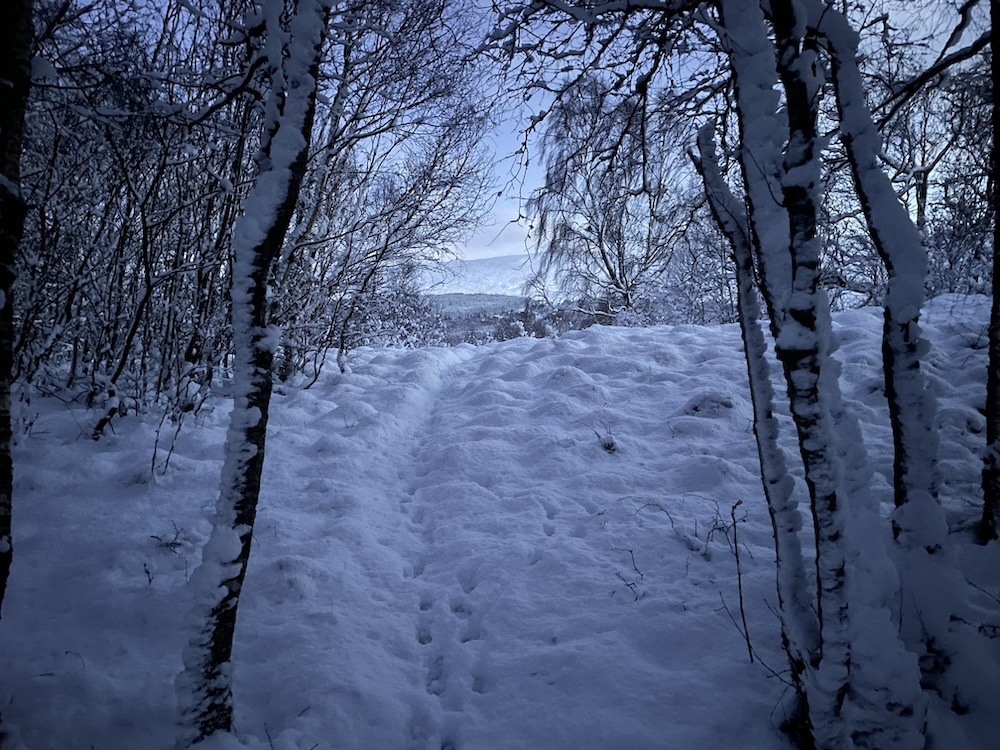
Now we have flipped back again, swarms of snowflakes bringing sky to land. When I take the dog up the hill for her evening walk, the normally bright streaks of birch are shadows in the dusk against silver-blue shine of snow. Unlike you, I have always preferred a path to a scramble, and I have been getting smug walking the same route up the snow-covered slope and into the woods. My body tilts in remembered rhythm over hidden dykes and ditches, and fallen branches turned into deceptively smooth white mounds. Not so smug, mind, when I forget to dip low enough under an outstretched branch and receive three inches of snow to my nape.
We don’t have hedges here, as such. There is shelter in parts from hazel grown thick along the drystone walls, and the post and wire fence runs alongside those lines of moss and stone. As I understand it, before the ‘improvements’ of the nineteenth century, hedges or boundaries were rarely needed as pre-Clearance townships worked their shared land in rigs. When people were moved to the crofts and when boundaries were necessary, they would have had to make do with available materials, and as our own differing landscapes show, each township would have different needs.
Many of the crofts on our stretch of loch have the same old stone boundaries, and this land gives stone in plenty. Just in the few square metres of the polytunnel, still I lift stone after stone, as the frost wheedles more from the depths. This croft is so small that giving ground deliberately to hedge for shelter would have taken valuable grassland, and I think that story will be common with most crofts around here. Our survival doesn’t depend solely on these few acres in the way it would have done to those first wallers, I suppose they might consider it a luxury that we can think about planting hedges.
As you say, two or three shelterbelts on even the smallest of crofts have value now, especially when we’re no longer using the in-bye for grazing or hay alone. We have no yew and juniper here; I have been contemplating planting both to eventually replace the pallets blocking weather from the west end of the polytunnel. It is a luxury that I can go online and order saplings to be delivered to my door. Our predecessors would have had to work considerably harder to acquire cuttings on land once emptied of woodland.
I loved to read of your rich hedges and the visiting goldfinch. We’ve had charms of them here too in the past, along with long-tailed tits, and even a rare bullfinch. However, there is nothing quite so confronting to my romanticising of the winter landscape than having cats.
Part of me is loath to write to you about it. It is difficult to admit to what we have introduced to the wildlife here. As hoped, they are good croft cats, that is, efficient mousers. They don’t limit themselves to rodents though. We see fewer birds now. I remind myself of the damage mice can do to wiring, or to new green shoots, attempting to absolve us from the choice we made. The realities of that choice were never clearer than on New Year’s Day when the tom brought in a woodcock.
Did I ever tell you about my first footer a few years ago? L rescued a woodcock from the road. While we were busy lining a cardboard box with moss and ferns, it came out of its shock and began padding about the house, bronze feathers and dark eye gleaming in our lamplight. It left little white splotches on the laminate as it eventually taptoed out of an open doorway and back into the night. I decided then it was a positive omen, pontificating in my writing that January on how we might blend with the other lives in the land.
Not so this year. This poor bird was caught in one of the clothes horses. It was too late for me to do anything but take it back outside and place it high on the bank under stone and fern, whispering my sorries to the night. That was as close a balm as I could get.
We hung onto the Christmas tree for a few days longer than we perhaps should have, searching for that sweet spot of peace just a little longer until we couldn’t avoid our own growing pile of pine needles either.
With love, and wishing all good blessings to you and yours for 2026.
Kx
*
Kirsteen Bell is a Scottish writer of narrative non-fiction and sometimes poetry. All her words are gathered from the croft in Lochaber where she lives, and the surrounding Scottish Highlands. Her writing and reviews can be found in such places as Paperboats, Caught by the River, The Guardian Country Diary, The Lochaber Times, and Northern Scotland Journal. Kirsteen can also be found at Moniack Mhor, Scotland’s Creative Writing Centre, where she is Projects Manager and Highland Book Prize Co-ordinator.
Annie Worsley is a writer, crofter, grandmother and geographer with an enduring love of the Scottish Highlands. In 2013 she and her husband moved to the crofting township of South Erradale near Gairloch. While her husband was a community pharmacist, Annie worked on Red River Croft. She began a blog about life on the croft and then wrote essays on nature and environment for various publications including Elementum Journal, Women on Nature, the Seasons’ Anthologies edited by Melissa Harrison, Caught by the River and Inkcap Journal. Her first book about life on Red River Croft and the natural history of Wester Ross, ‘Windswept: Life, Nature and Deep Time in the Scottish Highlands’, was published by William Collins in 2023, and is out now in paperback.