A great but undervalued collection of nature poems by Ted Hughes was reissued by Faber this week. Tim Dee thinks it contains some of the best of Hughes.
Forty years ago, in 1986, when Flowers and Insects was first published it was Ted Hughes’s tenth poetry collection. At that time, I was both a poetry reader and a birdwatcher, but I missed the book on publication and thereafter (and only much later) knew just a few of its sixteen poems from Hughes’s Collected Poems, until Faber & Faber asked me to write a preface to a reissue of Flowers and Insects which is published this week. I suspect I was not alone in 1986 and believe the book up until now to be the least known of any of Hughes’s poetry collections. I hope the reissue will change that. It should, because, as I argue in my short preface, several of the sixteen poems are among the best poems of any Hughes wrote.
Ted Hughes was the first poet I ever saw reading their work. I remember his voice deeply earthing the stoney echoes of the Victoria Rooms in Bristol where I’d gone with schoolmates from my O-level English class. We were studying ‘Pike’, and he read it that day.
It would be around that time, fifty years ago, that I first encountered the poem. Immediately I made Hughes’s way of seeing the fish my own. His pike I knew for three decades deep into my adulthood before I saw a real one. And that true fish, gasping on the bank of a fenland lode, only showed me ‘Pike’ again. He had hooked it, and he has it still.
As a taxonomically minded teenager, a.k.a. a bird and word nerd, I had kept my natural history and i.d. books on a different shelf in my bedroom from my animal poetry and stories. That Ted Hughes’s volumes (Crow was the first, Moortown Diary the next and so on, though never Flowers and Insects) asked to be on both shelves or somehow between and bridging them made them essential to me but provoking too. I believe they still have these qualities – richly and valuably so.
My O-level classmates had a high time with my being a bird-lover; I suppressed harder still any poetical urges. Imagine my squirm when I encountered the call-sign of the weedy-wordy schoolboy Basil Fotherington-Thomas in the Molesworth series of Geoffrey Willans and Ronald Searle:
‘Hullo birds, hullo poetry books…’
Reading Ted Hughes answered all of that for me then, and I’d say it still would.
Hughes was unashamedly a nature poet from his very beginning. ‘The Hawk in the Rain’ was the first poem in his first book in 1957, and more or less half those included in the great ark that is his Collected Poems have an animal or plant title and subject. Poetry itself was always what might be described as animalish for Hughes. Talking to schoolchildren in Poetry in the Making (1967), he said poems themselves were ‘a sort of animal … they have their own life like animals’. That Hughes thought that and put it that way has been a great help to me, all the way from my teens to my sixties, both a comfort and a cause.
There are two strands in Ted Hughes’s nature poetry. In one, most evident in Crow (1970), the crows, etc., are of interest for what they might metaphorically mean or suggest to us. But in others, as in Flowers and Insects, as with ‘Pike’, the fish, flowers and insects and other living forms are of interest to Hughes for what they are themselves.
The reissue brings the original 1986 subtitle to the fore, so to emphasise the full range of the contents: Flowers and Insects, Some Birds and a Pair of Spiders. In the sixteen poems in this book of the second (primary rather) type of Hughes’s nature poetry, there are sixteen occasions when you can see, hear, even smell sixteen (and more) distinct species.
On reading the poems there’s a strong sense of each of them coming from a specific encounter with real individuals of each species under Hughes’s attention. The poems have the smack of the real; they seem to have truly happened. Each might be precisely located and seasonably dated. Hughes even mentions using a magnifying lens to get a close-up view of mating spiders in a crack in a windowsill.
The Flowers and Insects poems were written mostly between 1983 and 1986. During that time Hughes was living in a small Devon town. ‘Daffodils’ describes the flowers that grew in his garden there. ‘Brambles’ about jackdaws looks like a poem made from a summer’s day in that same garden. Several other poems sound as if they come from a home acre. ‘A Violet at Lough Aughrisburg’ and ‘Saint’s Island’ are the poetic by-catch of fishing trips to various Irish loughs that Hughes made in those same years.
Alongside and illustrating the poems are fourteen paintings by Leonard Baskin. The artist and the poet were friends, fellow residents in Devon for several years, and long-time collaborators. Baskin’s imagination had summoned the inky crows, in all their stompy and testicular terror, for Hughes’s Crow. For Flowers and Insects Baskin’s images are much less nightmarish and look startlingly fresh and taken from life, as Hughes’s poems do too.
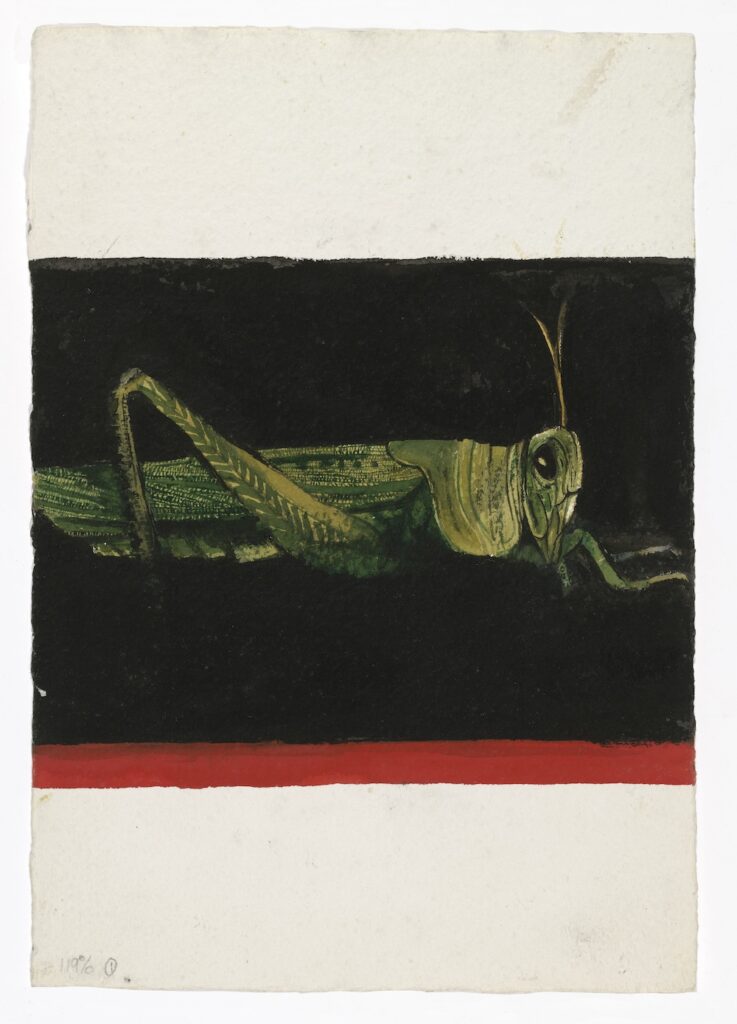
Leonard Baskin, Grasshopper © Leonard Baskin Art Trust, 1985
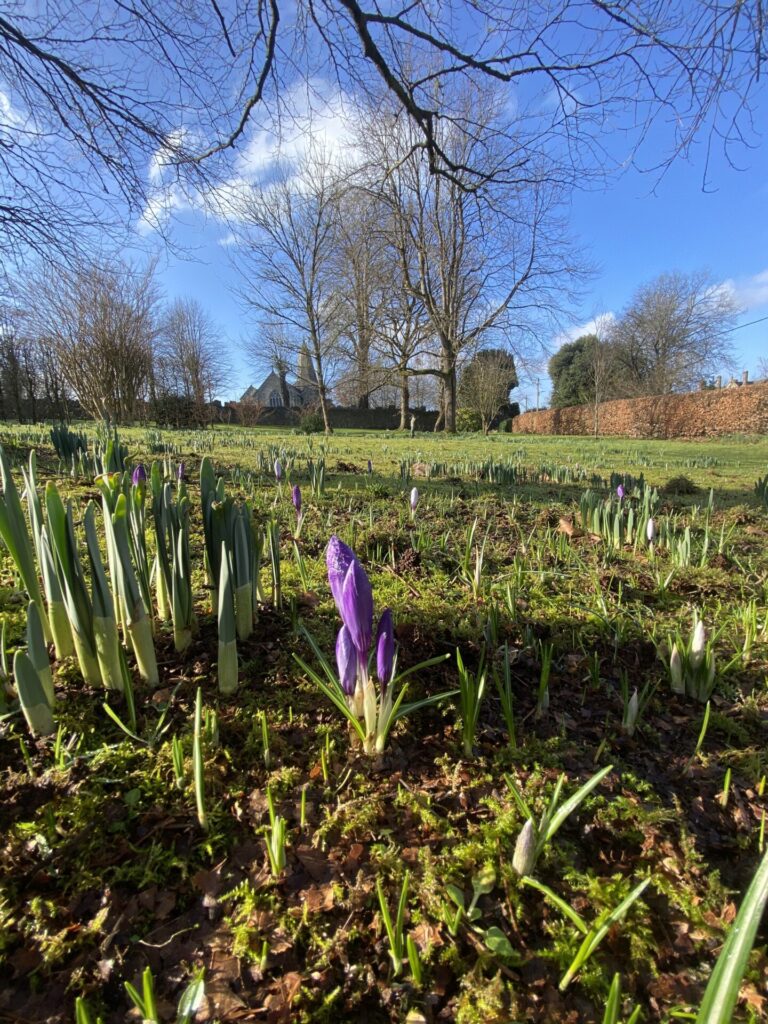
Early last spring, Ted Hughes’s widow Carol invited me to the house to see the place where some of the poems were made and to check on the birds in the garden. A sparrowhawk freaked out the greenfinches that crowded at a feeder; badgers were spring-cleaning their sett leaving rusty spoil heaps of Devon red soil to bleed from beneath Ted’s old wooden observation and writing hut; an early bumble bee nosed at the ivy on the garden wall; furled daffodils were spearing up on a thin-soiled slope studded with crocuses, just as they had for more than sixty springs; jackdaws in flight chakked their sociable talk between the thatched roof of the house and the stone tower of the church next door – I picked a black feather from the lawn, thinking it to be a crow’s at first before realising it was more likely a jackdaw’s; and a starling wheezed and pop-popped a love song from the house roof ridge, its wings in a stutter dance, the whole shiny black kettle of the bird coming to a perfect Hughesian boil.
There’s a poem about starlings in Flowers and Insects, Some Birds and a Pair of Spiders. Carol wrote from her home this last week to give permission to reprint it. It was written, she told me, in Ted’s hut, in the spring of 1984 or 1985, and first published in ‘The Listener’ in June 1985. It would be a ‘good poem to end on’, she said, ‘there were so many more starlings then’.
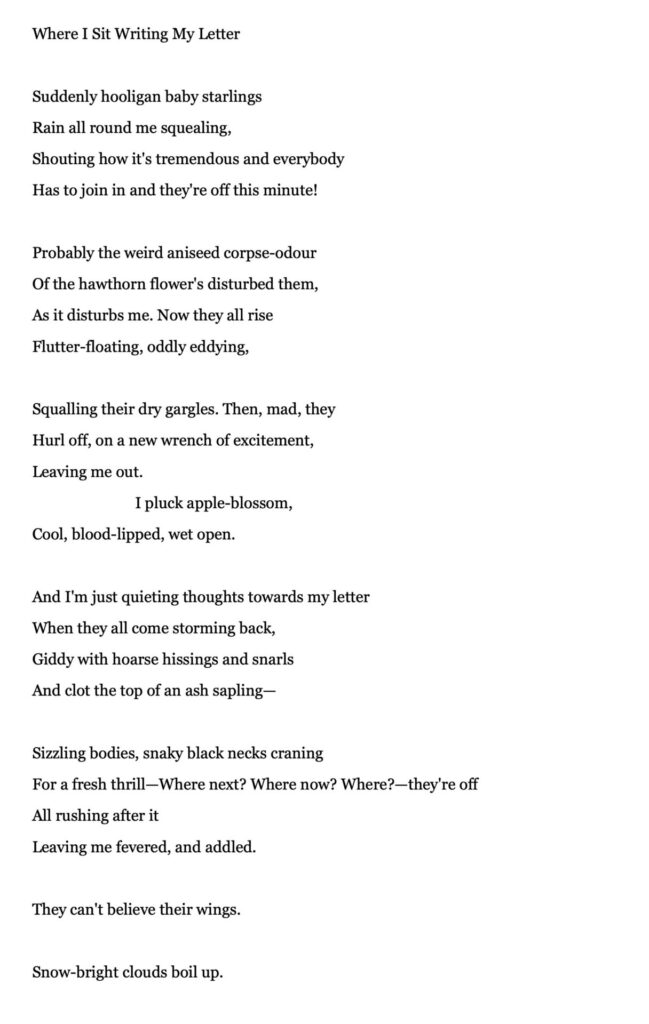
© The Estate of Ted Hughes, by permission of Faber and Faber Ltd
*
Ted Hughes’ ‘Flowers and Insects, Some Birds and a Pair of Spiders’, with illustrations by Leonard Baskin and a new introduction by Tim Dee, is out now and available here, published by Faber.