In the company of Paul Rees’ ‘Raised on Radio – Power Ballads, Cocaine & Payola: The AOR Glory Years 1976-1986’, Travis Elborough dips into the history of Adult Orientated Rock — the sound of a confident, car-driving North America.
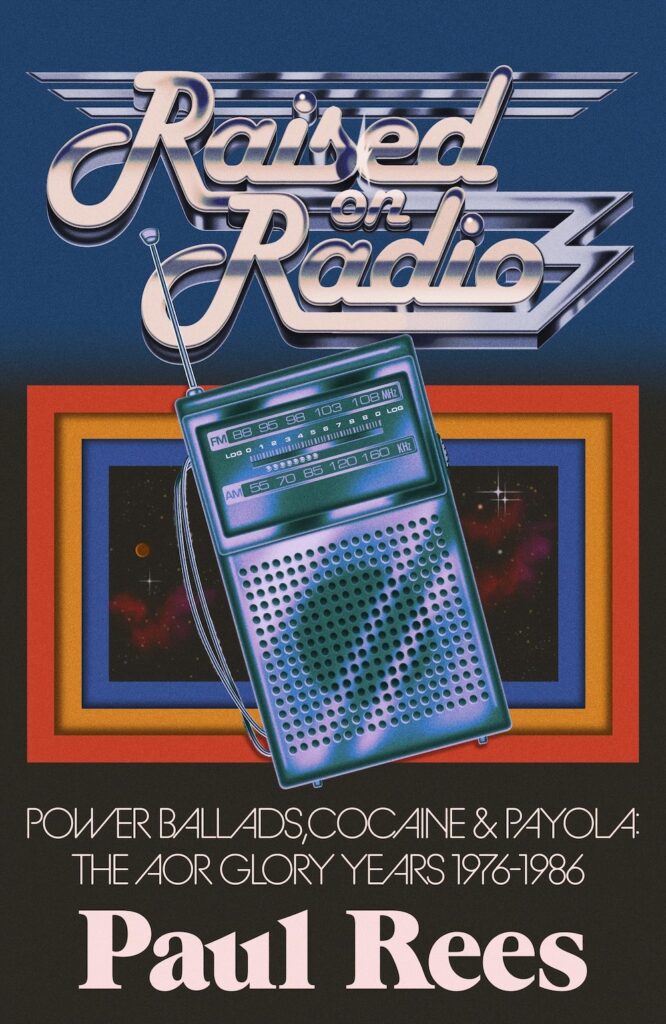
As with books and movies, commercial success in pop music is no guarantee of critical credibility. Reviewers, and especially music journalists in the age of print when the likes of Rolling Stone passed pollice verso judgements with imperial might, could be awfully sniffy about stuff that people enjoyed. No genre, argues Paul Rees, was more scorned by the conoscenti than Adult Orientated Rock, also known as Album Orientated Rock or ‘AOR’, a musical form denounced in some quarters as ‘corporate rock’ that came of age in the mid-1970s and was largely defined by the power ballad.
Its prevailing sound, in Rees’ summary, was ‘clean, polished, finely nuanced’ with ‘bitter-sweet pop melodies married to plangent guitar riffs.’ The records of its greatest bands (Journey, Foreigner, Boston, REO Speedwagon and Toto), sold in their millions. Their music, Rees argues, became by the Reagan era, ‘the reigning soundtrack of Middle America.’ Yet none of those acts, as he points out, ever graced the cover of Rolling Stone and Foreigner would have to wait until 2024 to be inducted into the Rock and Roll Hall of Fame. Toto’s lead guitarist Steve Lukather grumbles that they spent over forty years as ‘the redhead stepchild of rock ’n’ roll’ as far as the critics were concerned.
Titled after a 1986 album by Journey, Raised on Radio is Rees’ attempt to redress that injustice. The book, composed as an oral history from interviews, old and new, lets the artists and their enablers speak for themselves. On occasion it also gives them enough rope to hang themselves, Spinal Tap-style. One Kansas member is saluted by a bandmate, for instance, as ‘a modern-day Mozart.’
While Rees fields these voices with the kind of precision fitting to an œuvre its detractors thought too slick by half, perhaps only the most die-hard fans will have heard of everyone here. This critic found the five-page cast list at the front as useful as any provided in Russian novels for keeping track of exactly who was who. And with the honorable exceptions of Pat Benatar, Cyndi Lauper, and the Wilson sisters, Ann and Nancy, of Heart, it’s a boys’ club and, for the most part, as pale as it is male. That said, Toto, who Lukather describes as ‘the whitest motherfuckers in Hollywood’, would nevertheless provide the backbone to Michael Jackson’s Thriller and collaborated with Miles Davis.
This was quintessentially the sound of a confident, car-driving North America, as reflected in the names of such bands as Chicago and Kansas and Illinois’s REO Speedwagon, christened after ‘a high-speed heavy-duty truck’. AOR was birthed by crack musicians who’d paid their dues playing roadhouses in the Midwest and Oregon. One of its foundational documents is the eponymous debut album by Boston, released in the bicentennial year: a record containing the classic rock behemoth ‘More Than a Feeling’.
FM stereo radio, which by the early 1970s had become standard on most cars in America, was to be the making of AOR, quite literally. While station programmers and DJs gave airtime, their reasons for doing so were not always altruistic. Inducements ranged from straight up cash to nose-down cocaine covered under what record companies euphemistically termed ‘independent promotion’. But the music itself was produced to be heard at its best on car stereos. Dennis Churchilll-Dries, frontman of White Sister, recalls that the Record Plant studio in Hollywood in this period had its own FM radio broadcast receiver for demoing tapes on. Bands could dial in to hear what their latest recordings sounded like on ‘the radio in your car in the parking lot.’
Cars — the flasher the better — appear to have been what many of the acts splashed their cash on too. At the end of 1976, Boston guitarist Barry Goudreau spent all his $25,000 advance on a Porsche 911. His reasoning was that if his celebrity ended the next day, he would still have acquired an impressive car. England’s Def Leppard would dismiss the services of Meatloaf composer Jim Steinman, claiming that they thought they ‘got the Ferrari’ only to be lumbered with ‘a secondhand Ford Cortina’ (roughly a Pinto). The group’s 1987 multi-million selling album Hysteria, boasting the ‘signature multi-harmony production’ of Mutt Lange, hitmaker for The Cars and AC-DC, provides the curtain call to Rees’ glory years here.
Having weathered the arrival of MTV and pop music videos, well-financed AOR groups with promos enjoyed disproportionate coverage on the channel in part because there were so few to begin with. But by the late 1980s, the now CD-buying public just moved on. Hair-metal bands like Guns N’ Roses won the hearts of hard rockers and contemporary country, benefiting from similarly whizzy studio work, reclaimed the ear of the rust belt. 1990s grunge darlings Nirvana would dance on the grave of AOR with their sardonic ‘Radio Friendly Unit Shifter’.
But AOR had the last laugh. On 3 January 2024, Forbes reported that Journey’s ‘Don’t Stop Believin’ was now ‘Officially the Biggest Song of All Time’ having clocked up over 2 billion streams on Spotify. AOR’s influence also pervades the more recent output of Taylor Swift. As Def Leppard singer Joe Elliott notes, Swift’s mother was a fan of his group. Since the superstar was born in 1989, Elliott hazards the thought that ‘She was listening to Hysteria in the womb’. And that, surely, is this enjoyable book’s most provocative idea: that the reigning Queen of Pop had AOR piped into her in utero.
*
‘Raised on Radio – Power Ballads, Cocaine & Payola: The AOR Glory Years 1976-1986’ is out now and available here, published by Constable (£23.75).
Travis Elborough’s books include ‘Atlas of Vanishing Places’, winner of Edward Stanford Travel Book Award, and ‘Through The Looking Glasses: The Spectacular Life of Spectacles’. See more of Travis’s work for Caught by the River here.