Contributing editor Tallulah Brennan talks to ‘Book of Mysteries’ author Rebecca Tamás about wild time, children as animists, what kinds of seasons we deserve, and England as Stonehenge.
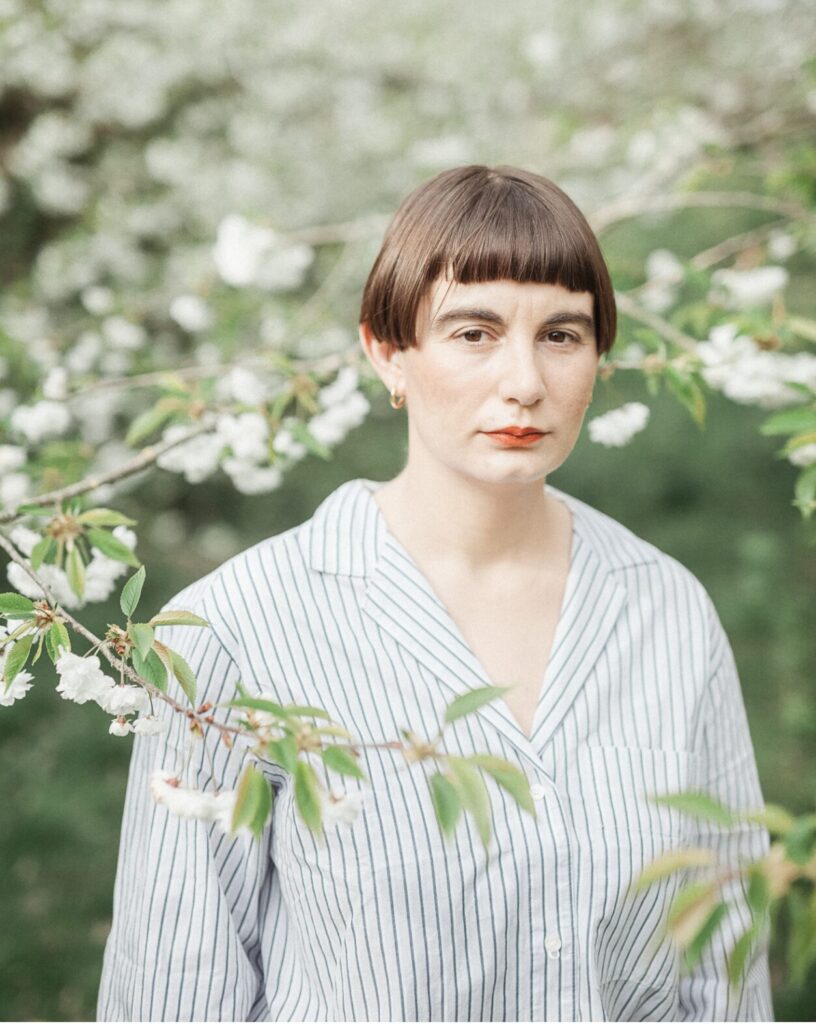
Author photo: Robin Silas Christian
What songs are audible when the wind stops? What has been kept alive in the time snatched from work, and sheltered from ongoing destruction. What moments of recognition? What ways of relating? What other imagined selves? What other kinds of time? – Saving Time: Discovering Life Beyond the Clock, Jenny Odell
Rebecca Tamás’ new book, The Book of Mysteries, revolves around the rituals of The Wheel of the Year, an annual cycle observed by modern pagans in the northern hemisphere. The solstices, equinoxes, and the midpoints between them. These rituals, the following conversation tries to show, are not only incredibly important opportunities for social connection, but suggest in their celebration a commitment to a different way of living — to live within the ecological reality that the world is dictated by solar movements, by the changing of seasons which are marked by non-human life. A world which is governed instead by ‘capital time’ propels us towards disaster. The Book of Mysteries is a thoughtful, tender call to ritualise our lives once again, because ‘if you wish to swim, you must work with the currents and desires of the river, not against them.’ Rebecca and I talked about wild time as a kind of time you are not subject to and punished by, but part of. As we discuss, this is much less a lifestyle change, but an ethic for a new society, a new economy, a restored relationship to our environment. We talked about the possibilities that arise when time is relational to the planet, not to a greedy economy, including possibilities for our language and creativity.
The Book of Mysteries is an ode to a vision of time which acknowledges the innate unknowable, uncontrollable reality of the world, because the alternative, as sociologist Hartmut Rosa writes, ‘a world that is fully known, in which everything has been planned and mastered, would be a dead world.’ It is also a memoir which gracefully explores mental health, grief and friendship, and in tying these human experiences to the rituals which arise from the earth’s rhythm, it is a creative feat. After reading the book and being in conversation with Rebecca, I have continued to wonder what life would be like with unencumbered time, how much fuller it might be. I hope this interview might create the same effect for our readers.
So to begin with, for readers who haven’t read the book, can you talk about the concept of ‘wild time’, and the distinction between this and capital time? And why did it matter to you to begin with these ideas when writing about folklore?
Yes, so, our time is both circumscribed materially and intellectually and emotionally by capitalist time which serves profit, which can’t accommodate rooted relationships with nature. I realised that there was this clash between a form of time that tries to make everyone and everything operate within a sort of brutal sameness, and a version of time which is extremely place specific, which follows something like The Wheel of the Year. Something which follows nature’s seasons or solar time. But, if anyone reads the book, they will see that lots of thinkers, especially indigenous thinkers, have come to that conclusion and in more sophisticated ways than I have. I certainly didn’t invent the distinction between capitalist time and wild time, but I do think it’s one of those things, as with so many things in life, where you have to come to the realisation of a truth yourself.
When I was looking into western time, I found out that the word calendar comes from the Latin, calendarium, meaning ‘account book’ or ‘interest register’, which is where creditors in Ancient Rome placed the names of their debtors and what was owed. These debts were due to be paid on the calendae — the first day of every month. This word is supposed to be objective, it didn’t seem to me to have any particular kind of emotional or political weight to it, and yet, under the surface of that supposedly objective word, there is this history of profit and exploitation always present. It is not the un-emotional, apolitical word we might think. I began to recognise that capital time felt like a false version of time and the other a potentially true version of time. It was that which unlocked for me an understanding of the problems that we have, particularly in the West, with engaging with the natural world.
I’m really interested in how you apply this distinction between time to language, then. You quote Akshi Singh, who describes the vastly different connection she feels with the world’s ‘detail and texture’ in her Christmas break from her academic job. If the surface of the world had been eroded, so too her experience of language, made into a ‘a joyless arithmetic of means and ends’. I think that’s really interesting given your reflection on this is literally in a book, which presumably had deadlines, and exists on a production line. So, I’d be really interested in how you reconciled with your belief that capital time has made it impossible to respond to the world in a ‘capacious and creative way’, whilst writing a book, which was presumably not led by ‘wild time’.
That’s really interesting. The initial suggested time of writing was a year, and I asked for two years. Not because I wanted more leisure time, but because I had a sense of how expansive and time consuming some of these journeys through the various solstices and equinoxes would be. But I don’t think I would have had the confidence to ask for that if I hadn’t already had some experience in the publishing industry. My publisher was incredible, and I had a friend who had worked with Pushkin before, so I trusted they would be very respectful. Another author going into that space though might have felt they had to say yes to the first offer of a year, even if it didn’t fit into what was possible. I knew I was working with an independent press who are very hands on, and so I did feel like I had a relationship within a healthy environment. Maybe there was some wild time at play at Pushkin Press.
To turn towards the contents of the book, when you’re in Edinburgh for Samhain, there’s this really beautiful line where you write, ‘what if the winter we’re given is not the winter we deserve’. I’d be very interested to hear what kinds of seasons you think we deserve? Could you expand on what you mean, for example, when you write, ‘There may be a winter that is fearful and uncomfortable, yes, but not numb’?
Wow, that’s a really wonderful question. I think the seasons we deserve are the ones which actually exist. The ones in which we can actually learn from each of their realities and learn from their variations. In that chapter, I’m talking a lot about illness, about work, caring responsibilities, all the different ways in which people’s lives and bodies can be challenged. On a smaller scale, people are expected to work through these harsh winters. They’re expected to get up at the same time every day in the darkness, to burn themselves out. So I think the way that you’re shaping it is really nice, because obviously there’s the fact that we shouldn’t be tortured by seasons, but there’s also a much more beautiful version of them which can be extremely nourishing. I think the reason Catherine May’s book, Wintering, was this huge bestseller is not just because it’s very beautifully written, but because it recognised that actually there is real value in the slowness that can come with winter. It doesn’t have to be endured, it can actually really benefit you. I think each season has that capacity. In a funny way, perhaps especially in the UK, we do something a little similar with summer, because good weather can be rare. So people don’t always take their time, in the way that countries which are more used to the heat might rest in the afternoon. They protect themselves so as to fit themselves around that season. They might allow it to provide some kind of comfort and rest. Each season has so much to offer us, but only if we are able to take the time to actually reap the benefits.
Yes, and I think it’s a good broader analogy for what we tolerate. Most of us survive this economy, for example, we don’t actually thrive in it. And so I’ve always wondered, why would we accept that a season is a punishment? And why would we accept that to live in an economy is a punishment? I think it’s really interesting that in a book about folk rituals you refer to one of the founders of the degrowth movement, Jason Hickel. It totally makes sense to me that someone working on aligning the economy with ecological realities would also be talking about holidays and festivals, even the medieval calendar. It really adds weight to this pause on why we don’t live for these punctuations of our lives anymore, that supposedly our lives outpace the necessity of these rest and celebration days.
It’s not how the phrase is normally used, but I think we have a version of shifting baseline syndrome in terms of our economic and social lives. Unlike our experience of nature, the shifting baseline is then a misapprehension or a kind of miseducation about the past. We’re taught to think that the past was this completely nightmarish time of grind. And of course there were really large problems – usually related to the fact that there was no medicine, for example. But if you move away from those realities, as you’re saying, there was space for rest and festival. I think it’s very difficult for us to actually metabolise that because we’ve been encouraged to have a quite patronising attitude to the past.
Maybe we also have a shifting baselines then for mystery, in the extremely controlled present in which we live. This takes me onto the next question I was going to ask you, which is to speak about the quote you take from the Ferguson gang: ‘England is Stonehenge, not Whitehall’. When I was reading the book, I was creating this division in my head of say, the office and clocking in, and the language of Whitehall and bureaucracy. Opposite to that would be this other kind of form of life which is freer, where time matters, but life isn’t about harnessing it, and living in celebration of it instead. So for example, instead of the same old, fastest route to work, there are desire paths, freedom of movement, etc. etc. The latter sounds amazing, as do the Ferguson gang’s ideas, but I wonder if it is enough to truly counter capital time? Lots of people are engaging with folklore and with the mysteries of the English countryside more than ever, but is that enough of an antidote? Is it possibly even a bit of a simplification?
It is hard to imagine a total cultural revolution that didn’t also come with a form of social and economic revolution. Even though I think the folk revival is really powerful, it’s obviously not the dominant cultural form of, say, the UK. It’s present, which is wonderful, but it has not taken over. Perhaps one of the limitations, I think, of any one book is that it can only be a piece of the puzzle. Once you start a cultural revolution in the image of ‘England is Stonehenge’, then actually I do think the knock-on effects are really powerful because it’s also an assertion that we’re not interested in borders, we’re not interested in hierarchies of citizens, instead we’re interested in connection. I think it’s always really important that your relationship to the land is real and centred on the material too. I talk in the book about the fact that the far-right people have tried to jump on land connection, but of course they never succeed because their relationship with the land is completely fantastical. It’s never about the real. It’s always a fantasy of invasion and about purity, which a real connection with place has no space for. So I do think a true cultural revolution would have to go hand in hand with a socio-economic revolution as well. But it is really important to not diminish the importance of cultural need. We as artists or thinkers are rightly asked, what’s the relationship between that and a kind of tangible societal change, and I think that’s a really good question that you rarely hear being asked in the inverse. People are not asking economists or politicians, what’s the cultural need? How do we need to transform the ways that we think and relate to each other and the non-human? And I think those two things need to be balanced.
Perhaps some of the only people bringing those together are our aforementioned degrowthers, actually. On the topic of cultural shifts, you talk really poignantly in the book about time ‘as a blade’. Time as something which can be yielded to cut through other worlds and take them apart. I’d be really interested in hearing you speak about who most often finds themselves at that sharp end, and if actually, looking into those kinds of chronologies and worlds offered you a way to push back?
The people who fall victim to that kind of time are most often the colonised, and those without access to wealth. Focusing on the UK, the people who do the work that we give the least respect to and whom we pay the least often have the most unsociable hours. So their relationship with time is damaged, because if you are working in an Amazon warehouse, packing throughout the night, your most basic understanding of night and day has been fractured. The most simple relationship that we have to world time is turned upside down. We know that this kind of work has a profoundly damaging effect on people’s bodies, which is really a story of what happens when we become disembodied from our locations and place.
I mention in passing in the book that the students my brother teaches were completely unaware of the Spring equinox. These are young teenagers in inner London who are not aware of the cycle of the seasons because it is not what defines our economic activity and so does not belong in our education system. So I think they are victims of capital time too. What do you use to push back against that? We have The Wheel of the Year, we do have these solar structures out of which ritual flows out of. These are things which directly relate to the movements of the planet, but which are also hyper local to you in their celebration. They’re very grounded in that sense. And so that’s a really amazing starting point.
Describing time as a blade was a way to also think about how time is inflicted as punishment, too. In the book I talk about how colonisers utilised time to control and punish the colonised, but that is alive and well in the asylum system in this country now.
Yes, on time as punishment, there’s a wonderful book called On the Greenwich Line by Shady Lewis, which is set in London, and is fundamentally about the callousness of the migration system. Its characters work within the housing department, and an asylum seeker on the housing list loses their life. One of the pivotal scenes in the book takes place on the Greenwich Line, where one of the characters, a Nigerian man, Kayode, working for the housing department delivers a speech, in which he says: ‘there’s no actual line either inside the Royal Observatory or outside of it. But everyone believes in it. Every single place on the planet and in the sky is measured in relation to it. The entire world sets its clocks by it. The meridian isn’t a real thing, and yet it still exists, because people agree it does.’ And the other character, Kayode’s colleague, and also a migrant, replies, it ‘doesn’t run through here because people agree it does, like you’re saying. It runs through here because these people had bigger cannons than everyone else.’ I think it’s very interesting that a book which is at first premise about the UK Government’s cruelty and neglect, is made at the most basic level, about time. About who is designated as living outside of time, and who decides that, who I suppose, owns time. And the social and political death that necessarily goes with being deprived of belonging to what is our imposed definition of time. Later in the discussion, the Nigerian character, Kayode, says, ‘People like you and me will always be in-between…neither here nor there’. In the book, the migrant they are supposed to be responsible for takes their own life, which I really believe is the inevitable conclusion to being treated as though your time is nothing. There could be no greater example than the fact that someone being kept in detention on the Bibby Stockholm did take their own life.
Yes, and they have just increased the time to ten years for someone to achieve settled status. Supposedly this is used as a deterrent, but it’s a form of punishment. It says that you have to hand over ten years of your life for something that someone born in the UK will never have to. It is a loss being demanded of you, and it actively negates people’s value.
So I think this is the right moment to talk about obligation, and about family and kinship. The book plays with the idea of linear ancestry, it complicates it in a way I really admire. There’s this beautiful passage about your grandparents: ‘I thought of what I knew of my grandmother’s parents who, in her stories, had seemed like cold Victorians, parents who didn’t know how to parent, who saw their children as inconveniences and didn’t hide the fact. But what if those cold, remote figures were my children? What if their hurt and trauma fell to me to soothe, not directly, of course, but through my own life? What if, by accepting them, holding their experiences with care, as a parent might, the ramifications of their suffering might change?’ Would you tell us about how wild time might change our view of family and ancestry, and perhaps shape greater responsibility?
This is one of the ideas that I can really pinpoint as coming from Aboriginal thinkers, who speak about this idea that within the Aboriginal community, there’s a non-linear sense of kinship.
It’s quite a common and familiar idea now that we inherit trauma. We don’t have to be directly impacted by it to carry it. This is obviously bleak, and needs to be taken seriously. At the same time, in some ways it’s not necessarily that you’re burdened with your ancestor’s trauma or difficulties, but actually there’s a way to resolve it. And your response to that could be: ‘well, that certainly doesn’t help the person in the past’. But if you start thinking about family in a less linear way, to me it feels liberating, and it has a political undercurrent.
In my last book I talked about Walter Benjamin’s idea that revolutions activate the moments of previous revolutions. So there’s this idea that if you have a successful revolution, you have not only activated but completed all the previous revolutions that have led up to it. You go back into the past and turn them from failures into successes. I think there is something similar in families. And I actually think that people are instinctively aware of this, they just don’t frame it in the way we’re framing it. I suppose what I’m saying is that you can cultivate a kinship process which works backwards in its form of revolution and liberation. I don’t think that’s just sentimentality. Perhaps you have an ancestor who had a dream which wasn’t possible for her, your liberation contributes to her liberation too. I think it also encourages us to be less patronising to the younger generations too. I now have a little baby, and with this awareness of kinship, you recognise that those younger than us have something to teach us. It’s not formed from this disciplinary relationship that we most often have with children, we’re not just waiting for them to become self-actualised people. Your tiny child has a real self. That encourages us to be less hierarchical.
That is really interesting. A few weeks ago I went to see Max Porter perform for the PEN Transmissions lecture, and in his speech he said, ‘do we need to re-child?’, and I started to think about the fact that the questions children ask us are often humbling, and very morally loaded. But I was also thinking about how the questions that their lives hinge on are the most pressing and encompassing questions we have to pose right now. As I listened, I kept thinking about how the government we live with sold themselves to the electorate as ‘the adults in the room’. The questions that they pose, or their dreams for the world are not sensible to me, they are made of dreams as much as any other ideology or world building, and I don’t accept them. So ‘rechilding’ could be a great tool, because how do you explain to a child, for example, that the colossal amount of hurting in the world right now is necessary for the line on the graph to go up, so some shareholders can keep selling weapons and so you can have a screen in front of you first thing in the morning and late at night? How do you explain to a child why they sleep soundly in their bed whilst Palestinian children don’t sleep for the heart-thumping fear at the sound of drones, and children in the Congo lie dead with the weight of the soil from a cobalt mine on their chests? So when you were talking, I was thinking about how great this would be as an analogy for what we can do on a more worldly scale. That is, what have we inherited? And how can we work backwards to make amends? And maybe that’s an act of rechilding and rewilding our time.
It is perhaps a cliché at this point, but children in general are natural animists. Because that is an instinct for children, it is a nice way for capitalists and colonising society to denigrate it as an idea for forming political demands or for building a society around. I remember when I was a nanny, the child I looked after asked me what the bugs we were looking at were saying. But she was asking the right question, actually. She recognised that they had a life. Just because it was cute (and it was), or that it came from a child, doesn’t mean it is merely sentimentality. It is true. It’s very common for people to say that their enemies are, instead of wrong, silly and sentimental. I remember having a disagreement with a Labour councillor on the doorstep about tax, and he simply said in response, ‘That would be nice.’ So rechilding would allow us to have genuine arguments about the liveability of the world, too.
Yes, easier to infantalise than explain why it is impossible. The world has to be this way for a certain Labour councillor on your doorstep because if the childish view of the world might conquer and outlive the adults, there would be some kind of revolution. And to pick up on the animism, I think it’s worth emphasising that animals do speak, and they shape our sense of time in their language. If you lived in Beringia as an indigenous whaler, before the Arctic was a playground for British and Russian and American whalers, to be able to live in the world, you had to listen to the whales speak. Their sense of time was shared with yours. That was the only way to survive. According to the Western view, that would be infantalised, it’s almost the stuff of children’s books. It was the arrival of British and American and Russian whalers that broke reciprocity, and has led to the ongoing torture and degredation of the Arctic ecosystem. So what is more unrealistic, to imagine the oceans of Beringia as a never-ending pool from which to draw energy and food for industrialised nations, or to acknowledge the sentience and importance of a whale? Because one is based on a total fantasy of endless extraction and the other is a society premised on ecological laws which have to be balanced with human will on a finite planet. There’s a quote in the book from a Raramuri scholar Enrique Salmon: ‘…indigenous people view themselves as part of an extended ecological family that shares ancestry and origins. It is an awareness that any life in any environment is viable only when humans view the life surrounding them as kin. The kin, or relatives, include all the natural elements of an ecosystem’. I feel I might go mad at the thought that we are literally going to set the planet on fire, because our concept of community is so exclusionary, it is built to be unattentive and unresponsive to what the planet speaks back to us every day. But supposedly that’s a child’s view.
We associate growing into adulthood as a process of complication, and therefore greater sophistication, but actually, we’re living with oversimplifications. People have a nostalgia for a time when ideology was more clearly stated, for example, in the 1980s when saying ‘there’s no such thing as society’ was a very traceable shift, something you could easily oppose. Now, the kind of ideologies you mention are so cloaked in normalcy, that it is simply articulated as reality. This is just the world. And yet the total reverse is true, because as you say, organising the world in this way is completely unfaithful to the natural rhythms of the world.
So, in the spirit of not swallowing those truths, or quietly agreeing to exist in this reality, what is, shall we say, the re-childed and rewilded vision of time you’d like to see? I speak to writers because I believe in the potential of language and literacy in re-connecting to nature, so I guess you don’t have to convince me, but if you were to try and convince someone else of the importance of this, how would you go about it?
I think there’s a micro and macro version of this. The macro version is already a story of hope. Every time I start a book, I think I’m very cutting edge, and by the end find that I am part of a zeitgeist. As I started writing this book, it was clear that a folk revival was taking place, but in the four or five years that I’ve been writing, it has become even more culturally present. Even just thinking about the main solar times in the Western hemisphere, lots of people have been writing about this, making art about it, and generally drawing attention to it in the cultural consciousness. I think people paying attention to the fact that wild time is present, and that they belong to a planetary time, and not the punishing impulse of capital, is in itself powerful. For all of the reasons we have spoken about throughout this interview.
The more micro version, which is perhaps more challenging, is people being able to start noticing the wild time of their specific location. Indigenous peoples, as I document in the book, are so sensitive to seasons because they are embedded in place. They wait for the land to produce signals, the blossom, the salmon. It can be harder in an urban environment to recognise these things, but it is about encouraging people to be attentive and challenge the forms of time that are forced on them in the hyperlocal way. I’m not talking about a dangerous over-fetishisation of place, because you can recognise this wherever you are. You can connect to a place through its signals. If we as writers and creators can encourage people to pay attention to the time that exists where they are, then we are able to profoundly connect to wild time. And that is a starting point.
*
‘The Book of Mysteries: Wild Time and the Ritual Year’ by Rebecca Tamás is out now and available here (Pushkin ONE, £16.14).
Rebecca Tamás is the author of the poetry collection, ‘WITCH’, and the essay collection, ‘Strangers: Essays on the Human and Non-Human’. Her second poetry collection, ‘The Fisher King’ will be published by Fitzcaraldo Editions in 2027. She is a lecturer in Creative Writing at City St George’s, University of London. Follow Rebecca’s Substack here.
Tallulah Brennan is a writer based in the North of England, interested in the relationships between humans and their environment, and how they in turn shape each other. She is also a contributing editor at Caught by the River. Follow Tallulah’s Substack here.