Coco Lone Neal is reminded that endings are beginnings, as she walks the ruins of the Sheffield Ski Village.
An early morning mist clings to the hillside and it is as if we are walking through a ghost, as if the ground were still smoking. My youngest is quiet against my back, bundled in her carrier, stormy eyes peering out. I grab the edges of my sleeves, pull them down across my fingers, picking at loose threads, unspooling.
A wren churrs and chatters and I hum in response. Hawthorns line our path, bare beneath the canopy where above is green splattered with red. Each footstep crackles with twigs and leaves, all is turning and falling, and this is what I love about autumn: everything is on the cusp.
Ahead, my collie Bear looks back to make sure we are near. She became ours through sheer stubborn love and would warn me if anyone was nearby.
Parkwood Springs is a palimpsest, hard to pin down as any one thing: a sandstone ridge formed 300 million years ago rising up from the River Don; an area dotted with pockets of ancient woodland carrying singsong names like Scraithwood and Rawson Spring; a former landfill always looming; graves peering out from bracken and ivy in Wardsend Cemetery, World’s End; a motley history of hunting, mining, coppicing, industry, recreation, and now my local stomping ground without which I wouldn’t have survived mothering through lockdown.
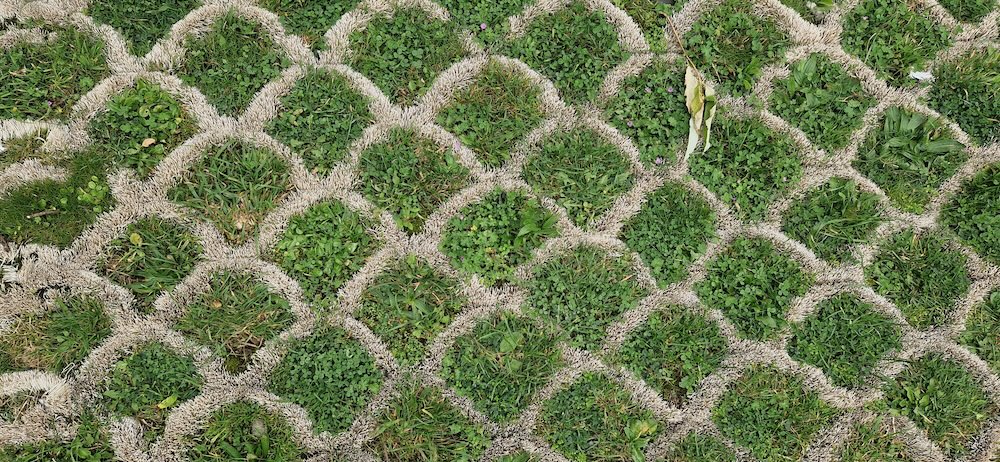
Ahead a barbed wire fence has an entrance cut into it and I squeeze through the gap, careful of my precious cargo. The ground is covered in a thick metal netting, a kind of diamond pattern stretching out in every direction, and where it hasn’t worn away toothbrush-like bristles mimic dry snow. I walk towards the viewpoint, careful of every step.
I am walking on the ruins of the Sheffield Ski Village, the parts that survived the fifty odd arson attacks of the last decade. Built in the 1980s, it was once the national training centre for the British Ski Federation, and at its peak had 180,000 visitors per year. Locals used to joke, The Ski Village is on fire!, and half the time it was true: smoke billowing up from the city’s edge.
On a clear day the views are spectacular – hills of terraced houses, towering apartment blocks, remnants of industry, and then, in the distance, the moors of the Peak District National Park. Not today. Today I shut my eyes and listen instead. Sheffield groans over the sound of the wind, a clunking, sawing, screeching, constant hum of traffic, whirring like a helicopter that never lands.
Carrion crows too, cackling and dipping and on more than one occasion I have seen them mobbing the odd, brave buzzard who dares to hunt nearby. When I open my eyes again just one remains, silhouetted at the top of a tall pine. There are many more out of sight. They will be there when the apocalypse comes.
Bear disappears into the treeline.
‘Bear!’ I shout.
‘Mama!’ I hear back.
My eldest daughter is herded into view, dragging her father after her, trying to wrench her hand out of his tight grip. The questions begin, Why are the leaves falling? Are the trees cold? Where do flower fairies live when the flowers are gone?
We make our way down a narrow path, bordered on either side by a dense thicket. The once plump and sweet blackberries are shrivelled and dry, as are the bitter nettle seeds, and the gorse’s usually edible yellow petals are absent too, much to our daughter’s vocal disappointment.
Buddleia has claimed the hillside here, spikes of soot-like flowers falling all around us. A peacock butterfly sparks. These are not the skeletal remains of a fire though you wouldn’t be blamed for thinking so. Buddleia is often found in wastelands and gained the nickname ‘The bomb site plant’ for growing in sites of destruction during the Second World War. Classed as an invasive species I can’t help but be quietly impressed by plants and creatures that can thrive in so-called dead spaces.
As we come to another clearing the ground flattens out before disappearing into one last steep drop. Here buddleia is replaced by pine, and the ground becomes soft underfoot as the metal netting is consumed by the hillside. It is too dangerous to continue with children, so we walk instead to the edge to peer over the ruins of a fire blackened structure, its bones jutting up from the scrub like a shipwreck out of shallow water.
The Ski Village was once the pride of Sheffield, driving its branding from industrial to outdoor city. In its final years I danced in a crowd of strangers here, staring out from a wooden platform onto the city that would become my home, its lights gleaming in the dark night. It is easy to stand here now amongst autumn ruins and slip into melancholy. Yet, there is a whiff of resistance, of survival against the odds as all around us green gains ground, lichen and moss patterning every hard surface, a sapling oak standing stark against the dying of the year.
I have been talking to my four-year-old about death and last night she clutched my face between her two small hands and said, earnest now, When you die, I will bury you, and surely that is the ultimate expression of love? Edges, ruins, wasteland, perhaps they call to us, like the changing seasons, to remember endings are beginnings, are transformations.
‘Stop!’ I shout, as she goes to pocket a shard of glass. She laughs, full of mischief, setting off her sister on my back.
We ascend another way, digging our toes into rusting metal as if pickaxing a mountain in the snow. I sway like a drunk in an attempt to rock my youngest to sleep but we are flanked on either side by life that wants to keep us there: rosebush, hawthorn, gorse, bramble, clawing at us the whole way up.
My eldest chatters in a torrent of observations, Crow! Spider web! Bottle! Holly! If it spikes you, say thank you! And then, as if remembering she too has a voice, my youngest chimes in, Down! Nothing is clean or fixed, no material stable, no colour alone, every surface is alive, porous, deep, surprising. Ruins bleed into the imagination, time itself is a playground. They climb the final few steps themselves.
One day people will pull up the metal and the shrubs, cut down the trees and build platforms, bring order and purpose, chase out the alcoholics and the artists and the ramblers. What will become of its ghosts, its particular turn of memory? What is it I desire to find here, to offer my children? I fight off entropy every day along with everyone else: take the bins out of sight, pull up bindweed from the garden, say no no no to death. Every season my daughter wants to name what we are losing whilst I try to show her what is to come.
We sit down, trees arching above us, illuminated at the top of a steep wild slope. The sun hangs low in the sky, grasses and mosses are enfolding sharp edges into the earth. The children press their faces close to the ground, investigating the remains of the old ski slope which now looks like hundreds of petri dishes, all lush effervescent green, as if the remains of summer have been framed for us, held for one last moment in stasis, before they turn as well.
*
I wrote this piece a couple of years ago and dug it out in light of recent developments. Parkwood Springs is a much-loved 150-hectare green space in the north of Sheffield, bordering communities identified as having some of the city’s greatest need for access to nature. By the end of this year, tourism company Skyline Enterprises will be submitting their formal planning application to build a major outdoor leisure facility there. While we expected the former Ski Village site, which I wrote about above, to be redeveloped, the current plans extend into the surrounding area: an important habitat for wildlife and crucial for our own wellbeing too. If you would like to learn more or support the campaign to protect Parkwood Springs from overdevelopment, please sign our petition.
*
Coco Lone Neal is a mother, rambler, writer and associate at the Writers Workshop in Sheffield. When she isn’t dragging her children and dog up hills in the rain, Coco is working on a book stitched together with river-blue thread.
Follow Coco on Instagram here.