Edited by Hollie Starling, ‘Bog People: A Working-Class Anthology of Folk Horror’ — our October Book of the Month — is an act of radical collective creation, writes Rowe Irvin.
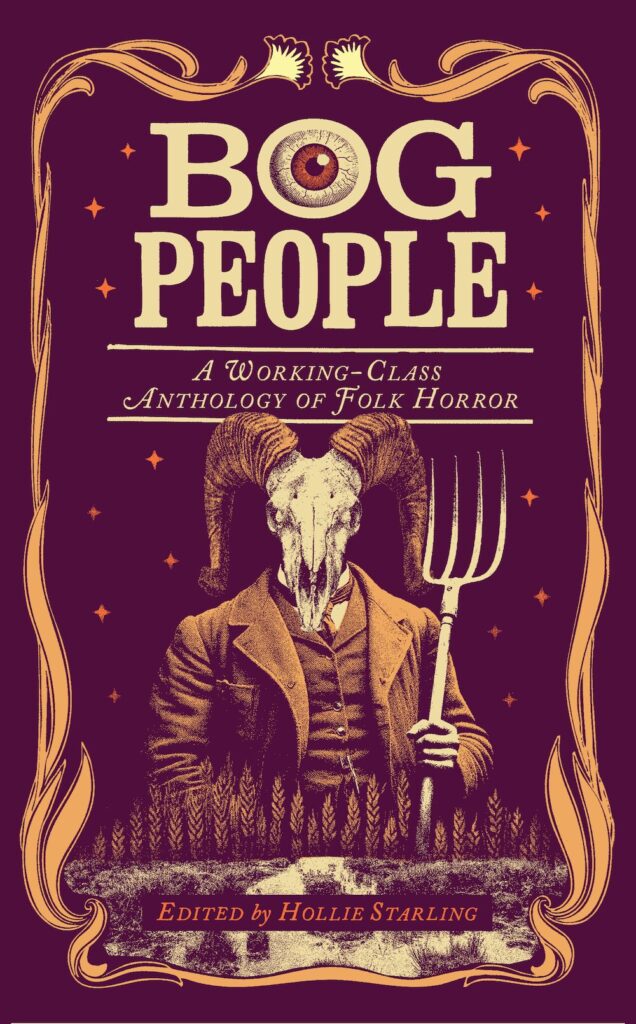
The epigraph to Bog People: A Working-Class Anthology of Folk Horror enlists the words of John Ball, radical preacher and leader of the Peasants’ Revolt, who offers a rallying cry and a statement of defiance against the hierarchical organisation of society, looking instead towards a time ‘when the lords shall be no more masters than ourselves’. This call to challenge power structures of mastery and subjugation is taken up by the ten authors whose stories are anthologised in Bog People. ‘The contributors to this collection’, writes editor Hollie Starling in her introduction, ‘do so as a refusal against the project of marginalisation, and to force reflection on just whose interests are vested in maintaining a system of feast and famine.’ As a whole, the book presents an act of radical collective creation which recovers a tradition of folk storytelling as communal and multivocal – and, crucially, as the prerogative of the ‘folk’. Where nineteenth-century folk tale collectors so often sought to romanticise folk storytelling as an endangered relic of a simple rural past, with stories flowing forth from the mouths of homely peasants, Bog People presents us with a far more nuanced vision of the folk tale – and folk horror in particular – as a space of unease and contradiction, in which the past and the numinous sit in disquieting relation with the contemporary and the everyday.
In the stories of Bog People, the voices of the folk are not othered, nor are they placed in service of a romantic nationalism that laments the loss of simpler and more rustic times. Rather, they inhabit these pages as dynamic living, breathing, experiencing subjects who are above all familiar and known. They are Shirley – ‘always Shirley, never Shirl’ – Lister, the eighty-year-old church volunteer in A. K. Blakemore’s ‘The Ossuary’; they are Steve and Gareth, the feuding brothers in Daniel Draper’s ‘Perpetual Stew’; they are Carole, the grieving single mother seeking closure after the wrongful death of her young daughter in Emma Glass’s ‘Carole’; they are the disillusioned postdoc recently moved back to his Lincolnshire family home in Starling’s ‘Yellowbelly’; they are the Stanley children arguing over the best way to deal with their father’s ashes in Jenn Ashworth’s ‘The Hanging Stones’; they are Everleigh Davies, the young woman living with her friends in London and navigating harmful relationship dynamics in Salena Godden’s ‘I Am Hagstone’.
What all the writers of Bog People do so successfully is create characters that not only reject the bucolic archetypes of ‘the folk’ in favour of fully realised people confronting real-world problems, but that also inspire in the reading a sense of conspiratorial closeness and familiarity. We are drawn in as much by the richly visualised interactions between a young schoolgirl and her nan in Mark Stafford’s graphic story ‘The Spit in Your Mouth and the Bile in Your Stomach’, as we are by protagonist Simon Payne’s Radio-6-Freak-Zone-esque enthusiasm for the band ‘Heptagonal Sons’ in Mark Colbourne’s masterful ‘Eldritch’, which uses the form of ‘a critical retrospective’ to tell its tale of music and occult influence. It is precisely in this sustained appeal to the familiar that the stories individually showcase their command of the folk horror genre. At its core, folk horror is interested in the capacity of the seemingly mundane and familiar to become uncanny and threatening. As Starling writes in her introduction, ‘In folk horror the soil beneath our feet is seismically unstable. Our closest kin are unknowable and depraved, bound by unseen influences.’ The most frightening thing is not some monstrous threat from elsewhere, but that which is already close, already here – that malevolence which has perhaps always been here in one guise or another, every so often reaching out to twitch the veil that separates it from everyday reality.
Such is suggested by the hauntology of Tom Benn’s ‘It Fair Give Me the Spikes’, which pairs its richly imagined cast of workers and performers with a lyrical, incantatory diction – ‘you caught an old song of circular ruin playing within the pillowed skull of a young woman’ – to pierce that thin layer between past and present and allow the spectres of the former to infringe upon the latter. And in Blakemore’s convincingly voiced and deftly observed story, it is the quiet, elderly, keeps-to-herself Shirley, in her ‘neat, comfortable slip-on shoes’, who comes to embody those small intrusions of violence into the daily consciousness, with her morbid fascination with the skulls at the ossuary – ‘she wonders what her own skull looks like, beneath the sagging, rouged flesh’ – her frequent judgements of others – ‘she is sorry to say the world seems mainly made up of absurdly fat women with plastic shopping bags and nose rings, immigrants and spotty children exhaling clouds of lemon-scented vapour’ – and her own suicidal ideation – ‘She’s got a fridge full of insulin, if she ever does decide to end it all’. Blakemore’s story, which opens the collection, encapsulates that capacity of folk horror to lay bare what lies ‘beneath’: the small horrors and violences we are all capable of inflicting upon one another, and upon ourselves. This resonates too with Draper’s tale of family resentments, which, with a nod to Shirley Jackson’s ‘The Lottery’, brings up the question of how a rigid adherence to tradition might have a part to play in the ritual enactment of violence as a way of sustaining community. ‘The cycle continues,’ intones Draper’s protagonist Steve – of course, it is by a sacrifice of flesh (the key ingredient in the ‘perpetual stew’) that the cycle is kept in continuation.
Cannibalism as a means of upholding collective identity takes communal tradition to its extreme, and stories like Draper’s bring a necessary degree of irony to the nebulous quality of tradition as that which might perpetuate harm even as it seeks security. In her introduction, Starling observes that, ‘Unfortunately, tradition has been invoked to defend all sorts of cynical examples of British ‘cultural heritage’, from fox-hunting to blackface to smacking your kids. In online spaces, folk imagery, wistfulness for unspoilt landscape and appeals to ‘indigenous’ pride are used as dog-whistles to further the ethnonationalist fantasies of the far right.’ The authors of Bog People reject such cultural defences, rather invoking folk horror as a way of examining what is malevolent in the British landscape, in its history, and in the idea of British national identity as dependent on systems of marginalisation. Yet in their uses of horror the stories remain infinitely pleasurable and playful. Godden’s tale, voiced by a demonic hagstone which relishes in visiting terrible harm on the men who behave dishonestly towards its young female ward, provides a catharsis that is as gratifying as it is horrifying. And Natasha Carthew’s ‘The Keepers’ offers perhaps the most redemptive vision of how we might come to relate to our traditions, histories and identities, through the story of one woman’s reckoning with her individual grief and her place in a collective past and future.
The anthology is also a vibrant homage to place. From Lincolnshire to Essex to Cornwall, it observes with deep respect and deeply sympathetic humour the varied landscape and the people and communities who inhabit it. It is especially noteworthy that Draper’s ‘Perpetual Stew’ and Colbourne’s ‘Eldritch’ are included as the winning entrants from the Bog People unpublished working-class writers competition, upholding the anthology’s commitment to amplifying underrepresented voices. In the closing words of her introduction, Starling provides both the anthology’s manifesto, and a broader manifesto for storytelling as a vital social tool. There is no better way of concluding this review than by quoting her words in full: ‘With Bog People we excavate the mud-bound relics and restore the great unwashed. In its pages we recognise the countless dead unnamed by the chroniclers of history; the poor, but also women, people of colour, marginal identities, the voices of the colonised, silent and suppressed. Together we will relearn the disruptive potential of stories to upend fortresses of power. Stories of reaping and sowing, stories that turn the staid soil so something fresh can grow from it, stories as sharp as a guillotine blade, stories to persist for all time.’ Persist they will.
*
‘Bog People: A Working-Class Anthology of Folk Horror’ is out now and available here (£18.04), published by Chatto & Windus. Read an extract from the book’s introduction here. Paid Steady subscribers can also read a bonus interview with the book’s editor, Hollie Starling, here, touching on the current popularity of folklore, far-right invocation of soil, land and indigeneity, and the “real monsters that roam this green and pleasant land”.
Rowe Irvin is a writer and artist. In 2025 she was named one of The Observer’s Best New Novelists. Her work has appeared in Prototype, Southword and The Stinging Fly. She has a PhD in Creative Writing with a focus on gender dynamics in folk tale and oral tradition. Her debut novel, ‘Life Cycle of a Moth’ (a previous Caught by the River Book of the Month) is published by Canongate Books. You can visit Rowe’s website here.