Newly out in paperback, Polly Atkin’s ‘The Company of Owls’ demonstrates how we can be better neighbours to the nonhuman, writes Abi Andrews.
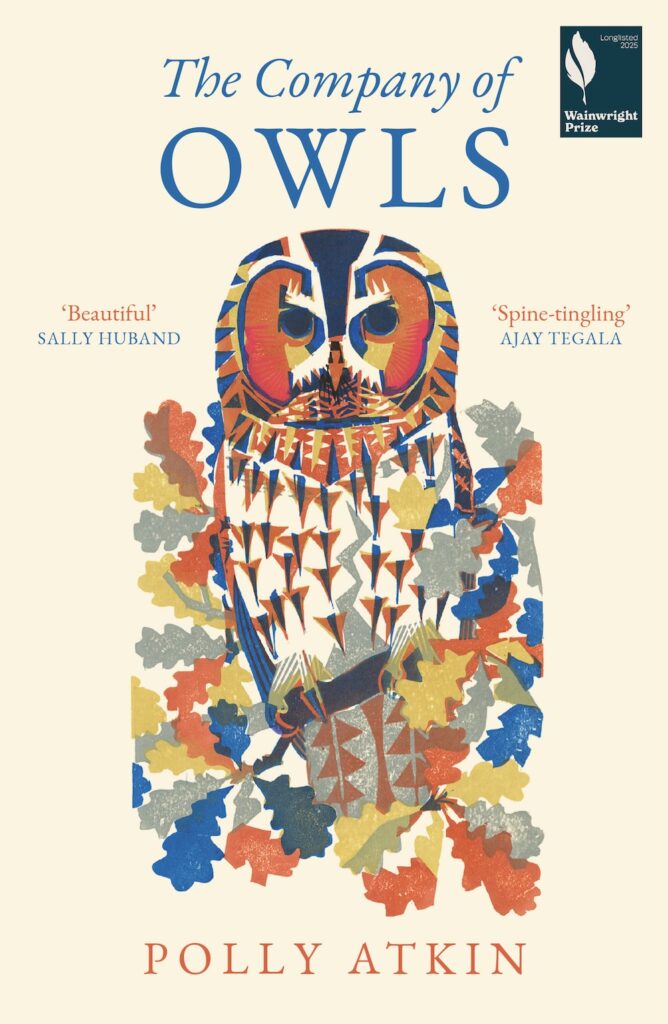
Not everyone has seen a wild owl. Not everyone lives in the kind of landscape that owls depend on, and we are shrinking such landscapes at pace. But wait, that’s not entirely true. Tawny Owls are known to breed in London parks, in sentinel trees with hollows. And owls are an order of animals more favourable to the nest-box offerings we make to the wild world, in patchwork landscapes that scribble over the nature/culture binary. The other important ingredient of owl-seeing then, alongside access, alongside ecological knowledge, is the right kind of attention. Recently out in paperback, Polly Atkin’s The Company of Owls is about the cultivation of exactly this kind of attention, in relation to the Tawny Owls in the woodlands surrounding Atkin’s Lake District home.
Although she had long been hearing their calls at night while drifting to sleep in her draughty attic bedroom, newly arrived in Cumbria, Atkin hasn’t seen any yet either. It takes a disruption in routine enforced by chronic illness, when a bodily exhaustion with academic work causes her to shift into freelancing. Suddenly finding a way to prioritse a daily walk into her schedule, the change in job pattern allows her to fall a little more into step with her body, and brings her into pace with the owls. She spots a Tawny Owl while out on a walk and is transfixed, returning to the same pattern of walking because of the allure of seeing her again, although it is a while before she does.
The Tawny provides an invitation, not only into the world of owls but red squirrels and deer and all other manner of adjacent nonhuman lives. Atkin doesn’t see her Tawny again until Covid, when lockdown further enforces the crack in normality needed to gaze into a parallel world that has been going on alongside ours the whole time, if we will only pay it attention. Pay attention, like a coin we hand over at the gates to a city of wonder.
If we more carefully share their landscape, their lives become apparent to us. If we cultivate a different mode of encounter, we widen our spectrum of experience. But the spectrum of human experience is already bounded and stretched by the differing abilities of our bodies. Hyper-sensitive and hyper-aware, in these ways Atkin is better attuned and empathetic to the owl world. Her illness is oftentimes a restriction, but it also allows her an affinity with which she is well placed to write on the lives of owl-others; she is a chimerical guide to owlishness.
Once we are paying attention, Atkin writes beautifully on the practice of how to be a polite neighbour. She is not, she tells us, an ornithologist — her knowledge knows its limits. ‘What I can tell you about them’ she writes, ‘is only what a neighbour knows’. Her insights are generous, they involve owl-politeness and courtesy. As a good neighbour does, we must balance familiarity with consideration for privacy and autonomy. The Company of Owls is a meditation on attention and manners. It is a book about being a better neighbour to the nonhuman, and respecting owls’ prerogative to keep things from us.
*
‘The Company of Owls’ was Longlisted for this year’s Wainwright Prize for Nature Writing. It is newly published in paperback by Elliott & Thompson. Buy a copy here (£10.44). Read an extract from the book here.