An extract from our March Book of the Month.
For the past two hundred years, peasants and small farmers who lost their rights to food, fuel, and shelter moved to cities where they recreated commons and regenerated urban wastes. They dug up hard-packed earth, recycled discarded nutrients, and turned vacant land into lush, fertile landscapes. Working-class gardeners built with their hands the idea that cities could be more than stone and brick, more than markets and factories. They demonstrated that by turning their part of the city into a garden, they could get by, even flourish, without exploiting others somewhere else. As they worked, urban farmers made use of the river of organic materials that flow daily into metropolitan areas. Turning garbage into soil, they devised the most productive agriculture in recorded human history. And there is more to it than food. Working-class gardeners showed the way to the idea of garden cities. Their mutual aid societies inspired the first glimmers of the social welfare state. As this history has shown, when people exert their rights, take ownership of their resources, and find a way to belong to their landscapes, they shore up civil society, devise resilient economies, and shape more inclusive citizenship.
But what comes next, after the gardens and communities supported by them flourish? In Berlin, Paris, Tallinn, Amsterdam, and Washington, DC, urban farmers with their organization and labor added value to real estate. Their tenure on the land was provisional and short term, and others were eager to swoop in, capitalizing on their labor and ingenuity. From nineteenth-century Berlin to twenty-first-century Amsterdam, gardeners had a simple request. They asked for land to be returned to commons—to be placed outside real estate markets so that people could cultivate with confidence that their labor and creativity would not be stolen. Repeatedly, the competitive demands of commerce overruled them. For this reason, small-plot self-provisioning thrived best in this history in the Soviet Union and East Germany, where gardeners had access to public commons and where the state encouraged tiny gardens with botanical creations such as Michurin’s hardy trees and shrubs and regulations (even if regulations in general were excessive). State support and public land gave gardeners staying power.
Now the need to decrease CO2 emissions opens new spaces for tiny gardens to again flourish. Cities in the Netherlands are gradually shedding their automobiles. Central Amsterdam allows access only to delivery trucks, cabs, and permitted residents. Planners arrange one-way streets so that it takes a very long time to drive across the city, while public transit and bike traffic flow freely. Utrecht is turning an industrial park into the first car-free neighborhood in the country. The Hague, a Dutch city with unusually wide streets and many parking lots, is gradually trimming pavement away.
That’s the marvel of cities and their suburbs. They can be extremely dynamic congregations for human communities to live and work because metropolitan areas are always in a state of flux as people reuse and reinvent infrastructures.
*
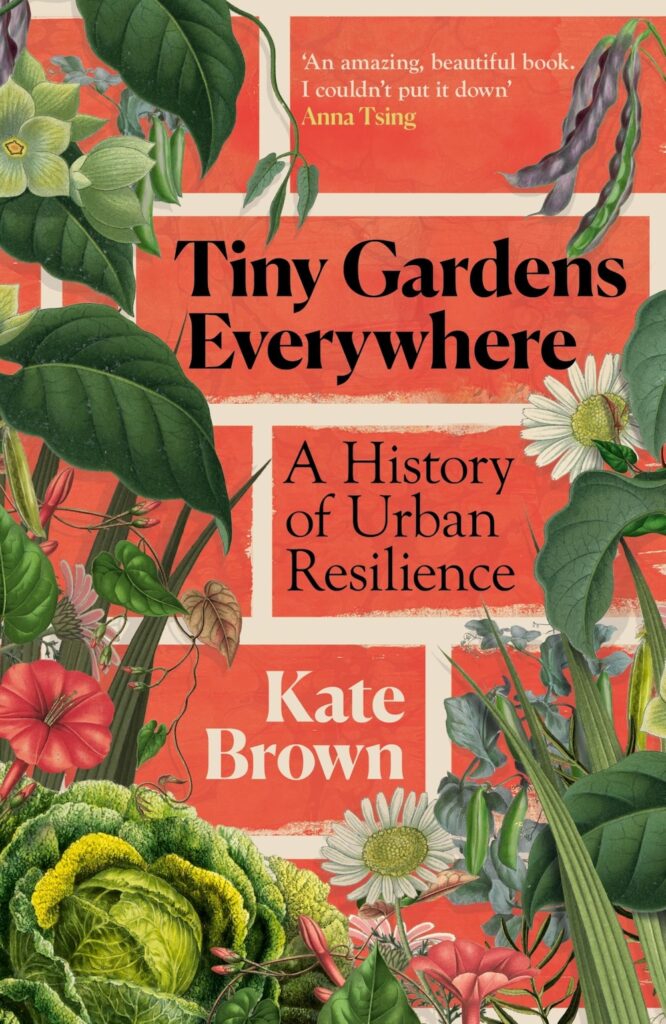
Kate Brown’s ‘Tiny Gardens Everywhere: A History of Urban Resilience’ is out now and available here (£20.90), published by The Bodley Head. Read Tallulah Brennan’s review here.
Our paid-subscriber-exclusive interview with Kate goes out this week. Get a taste of previous author interviews here. Find out more about our paid subscription offerings here.