Melissa Harrison’s latest novel ‘The Given World’ is May Book of the Month. Amy Liptrot reviews — finding in the book’s generous worldview, rich language and dreamlike qualities an ‘Under Milk Wood’ for the twenty-first century.
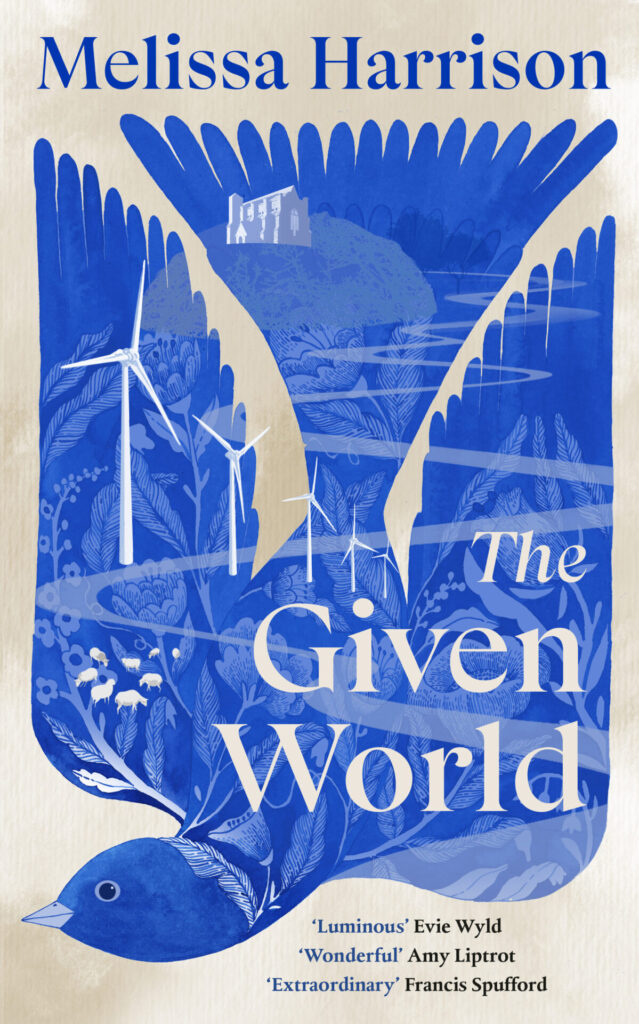
‘What use, after all, is the past?’ asks one of the characters in the wonderful, multiperspectival portrait of a village, and by extension of contemporary rural England. It is Melissa Harrison’s fourth novel and her best, and it has been a great pleasure, over the last decade, to read a writer coming into her powers.
The fictional village of Lower Eodham sits beside the perfectly-named Welm river: ‘A green crease sunk into England since forever, a place as old as anywhere, water-formed and still shaped by the river with its springs and tributaries and long-forgotten wells…’
The opening chapter sees postie Saj delivering to houses around the village, an effective device which harks to Dylan Thomas’s Under Milk Wood. It is not just in this regard but in its rich language and dreamlike qualities, conveying inner lives of a community, that The Given World is comparable to Under Milk Wood, but for the twenty-first century. This is a countryside of solar farms and Yodel vans, of schoolhouses converted to holiday homes, of hedges being replanted after being taken up. It doesn’t dodge the realities of rural life, authentic and deeply observed. We meet Paul in his combine cab: ‘For god’s sake, he thinks: they want strawberries in March, they want tomatoes year round and bloody blueberries on the muesli, but they don’t want Beaumont to irrigate his greenhouses’.
Each chapter broadly follows one different character in close third person that with great skill conveys their voices, rhytmns and concerns yet is occasionally able to see into the future with goosebump-giving effect. We meet characters at unexpected places, before or after the drama: after the affair, when their house is finished — and everyone has secret depths, from the agricultural worker who is a secret vapour wave artist to the old lady with a rich artistic past.
In this way a generous worldview builds, where nothing is just one thing, like how ‘churches used to be full of all sorts of interesting things, you’d be surprised: green women, witchmarks, dragons, mermaids, woodwoses.’
There are wonderful pieces of writing, including a description of a countryside supplies shop, of a really good night out, of driving a Porsche, and of a household attending someone’s death. A central set piece is Hilda lying in a hollow after a fall, thinking back over her life as night falls and animals emerge. It is full of perfect, telling details and subtle moments that reveal themselves on re-rereading: the estate agent’s clients, ‘their eyes slipping past her even as she introduced herself’, or the lover careful of an HRT patch.
Each chapter starts with something going on in the natural world, choosing elements that convey the beauty and brutality of the non-human world with detail and accuracy. In late summer, the mists of dawn rise, a blind fawn hides and a caterpillar: ‘Lit by chance from the sun, like a trapeze artist in a followspot, her body forms a C-shape, then an I, and then another hieroglyph, impossible to ascertain’. Harrison has developed a distinctive blend of the specific and the strange. Moments of mysticism and magic are earned and appropriate. Builder Roy replaces superstitious totems found in old roofs. An ancient spring reappears.
One character thinks: ‘there isn’t one big story that everyone’s part of: everyone’s all up in their own separate realties, everyone’s a main character. It’s just that the stories touch up against each other sometimes’. While the book does a brilliant job of converting these separate realities, it also shows that there is one big story created by the place and its history. The past, it seems to suggest, is something that can unify and inform if we are willing to look and listen. The people are going through different things but they are in many ways connected, especially by the environment and the spectre of ecosystem collapse, of drought and flood, and by a growing unease. Towards the end, plants are not growing and the Welm rises.
Dreamy yet real, careful and full of care, The Given World is a masterclass in contemporary fiction. I thought it was excellent from sweeping start to spine-tingling end.
*
Melissa Harrison’s ‘The Given World’ is out now and available here, published by Hutchinson Heinemann. Read an extract from the book here. Read an interview with Melissa here.