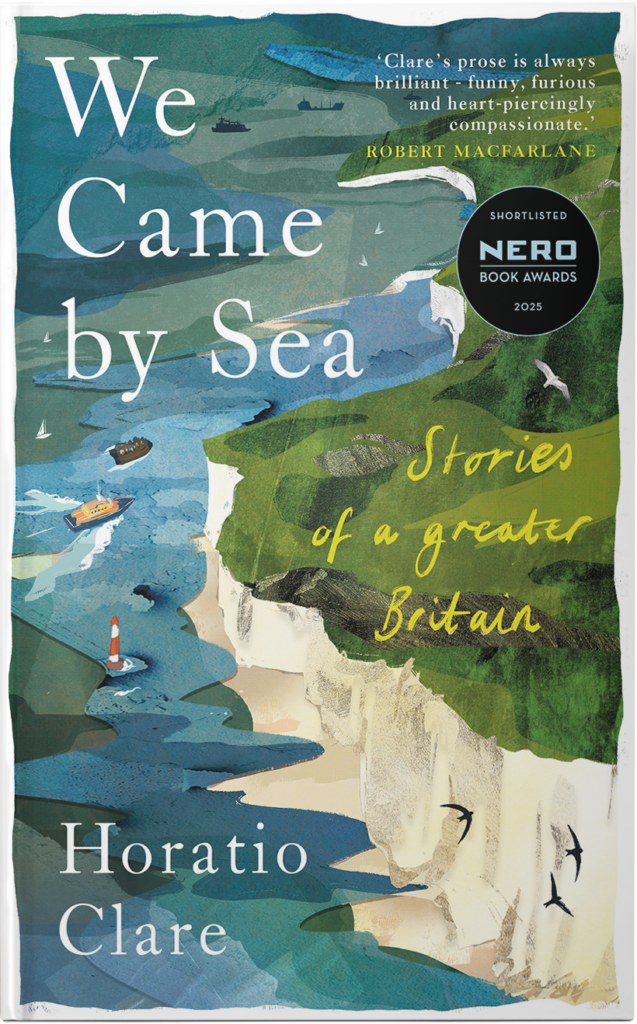
In an extract from Horatio Clare’s acclaimed book ‘We Came by Sea: Stories of a greater Britain’, countless dreams soar over the dark water of the Channel.
The security guard looks as though he is crying as the rain runs down his glasses but his voice is steady and warm. We are behind Lord Warden House, a shabby ghost of old England, white as a whale in the darkness, haunting Dover’s Western Docks. Once a grand hotel, a favourite of Charles Dickens, George Eliot and Napoleon III, its shell now hosts the offices of freight firms. Visitors come for its parking spaces and the tents on the quay behind it. This is Tug Haven, where the people from the small boats are escorted off their rescue vessels. On the ramp up to the processing tents is where the photographers catch them. Thousands of people from across the sea, anonymous figures with their dark hair and orange life jackets, some wrapped in blankets, some carrying children, some children themselves, begin their new lives here. This facility will be attacked with petrol bombs, and the screening will be moved to Western Jet Foil nearby, but for now this is Britain’s threshold.
Once they have been processed in the tents, people from the small boats are driven to a second fenced and guarded area where they await further processing, or just wait, until they are directed to a coach and driven up the hill and over the chalk cliffs to an England of motorways, outskirts, reception centres and hotels.
Between the processing tents and the holding area, the security guard is keeping an eye on a potential weirdo in a cagoule, wet jeans and soaking shoes, shivering at him. I am here in Dover because what is happening on the French coast and in the Channel, and in this town and behind these fences has become an obsession – for the press, for the politicians, for the people of Britain and for me. I have come here to try to understand it.
The Channel looked surly and thuggish at noon, the sea a spiteful yellow-grey under fog. Through the short dusk and into nightfall the wind has been bitter and inconstant from the south-west, spitting squalls of mist and rain. Surely, I think, nobody in a dinghy has tried to cross the Channel today. I hunch in my jacket, feeling awkward with the guard’s eyes on me.
‘Good evening!’
He looks uncertain. ‘Can I help you?’ he says. He is quite an elderly man.
‘I’m writing about Dover,’ I say. ‘What do you think about the people in the small boats?’
And that is all it takes. As rain runs down his specs, the security guard speaks softly. He talks as though he has been waiting to tell someone this: ‘I’m from Dover,’ he says. ‘Lived here 30 years. Retired. I came down here to see if these people are being treated properly. And they are. Really well. We can be proud – we’re looking after them. We got an alert this morning – they cooked 200 sausages and then we had to eat most of them because it was a false alarm.
‘There was a 26-year-old girl with a three-month-old baby on a night like this, January 4th. That really upset me. These people need help. And look at these fences! Look at the size of them. They’re not going away – the world’s on the move and politicians are not telling people the truth. I shouldn’t be talking to you really.’
After a short while we say goodbye and I move away, bend over my notebook in the gloom and write down what he said, and then I stand in the rain, amazed. I have only been here half a day and already the story that I thought I knew, the one everyone knows, has collapsed.
On the slipway earlier I met a jet-ski team from Border Force who told me they were trained and willing to do pushbacks out at sea. I was surprised, because according to the news and the narrative of this crisis, Border Force are preparing to go on strike rather than have their members risk prosecution for sinking dinghies. Ramming an overloaded inflatable crammed with people, which is what a ‘pushback’ means, could amount to attempted murder, so the union which represents Border Force is angrily opposed to it. But the jet-ski men I spoke to on the slipway are excited at the prospect. Some of them could not wait to get ramming.
‘We’ve practised it!’ one said. ‘We know it works!’
‘But what about the union?’ I asked.
‘We’re not members of that union.’
‘How do you feel about doing pushbacks?’
‘I was in the Falklands,’ said a senior member of the team.
‘The mission then was “Get them off there!” If the mission now is “Push them back”, this team won’t have a problem with it.’
To this frank, stocky man with his Welsh accent and straight back, Argentinian soldiers had become people in small boats. They are them.
When I told them I was a writer they said they were not bothered about speaking to me, albeit anonymously. ‘No one has been down here to ask us what we think,’ said the Welshman with a shrug. We talked about their jet skis, and I mentioned volunteering on lifeboats when I was young.
‘You should sign up!’ the team leader said. ‘You can find the application on the Home Office website. There’s lots of jobs!’
They also said they sometimes turned their transponders off when they were out at sea. With the Automated Identification System disabled, they could not be tracked.
‘We switch it off when we’re doing something covert,’ said the youngest and most excitable. He refused to elaborate on that. Perhaps it was a fantasy. On the French shore, a young man dreams himself on the other side, safe in Britain. On the English side, a young man dreams he is some sort of commando, repelling Britain’s foes mid-Channel. How many dreams soar over the Channel tonight, over this black and sloshing sea?
In London, politicians dream of resolving the crisis and news editors dream of milking it. Behind mansion gates, the owners of private outsourcing firms dream of ever bigger hotel-accommodation contracts and higher transport and custody profits (their dreams are real). Across the sea, smugglers dream of euros, sacks and bags and cases full of euros (their dreams are real, too). And across Europe, Africa and the Middle East, across the Earth, countless closed eyes have imaginary Englands flickering behind them tonight, Englands like Edwardian Lord Wardens in Edwardian sun, with sea views and tall windows. And here in Dover, the security guard stands in the rain beside the ghost of a once-upon-a-time hotel.
*
Horatio joins us on Elmley Nature Reserve, Isle of Sheppey later this month, where he will be interviewed about ‘We Came by Sea’ by CBTR contributing editor Tallulah Brennan. More info, including about full lineup and day tickets, available here.
‘We Came by Sea: Stories of a greater Britain’ is out now and available here, published by Little Toller Books. Read Sue Brooks’ review of the book here.