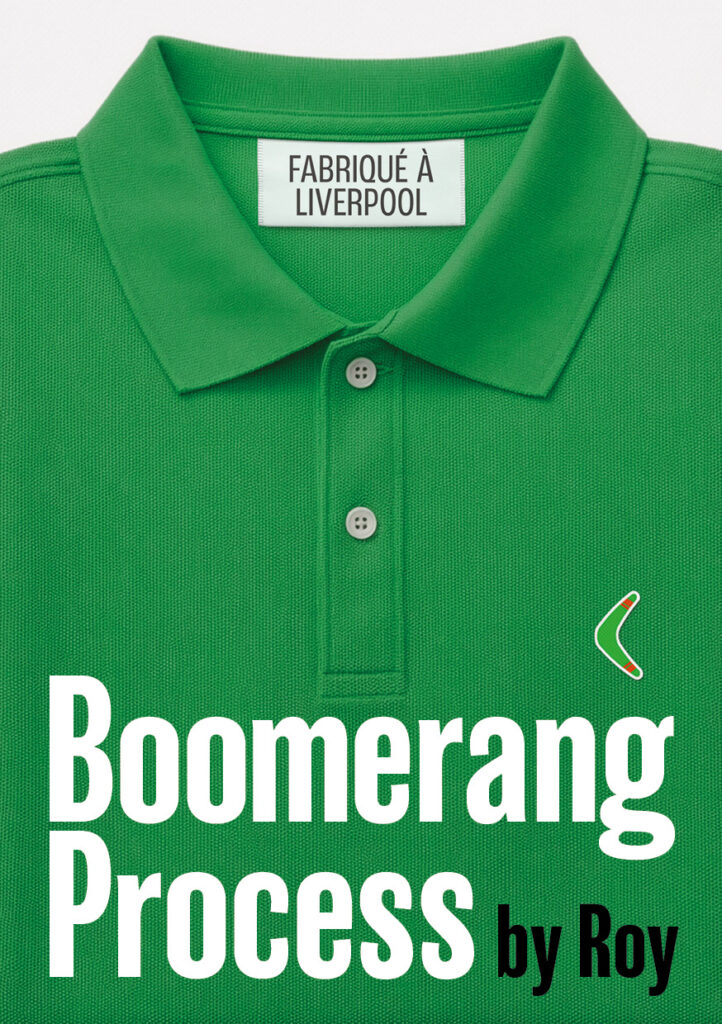
Recently published by TNC Books, Roy’s ‘Boomerang Process’ is full of the extraordinariness and unpredictability of human existence, writes Wendy Erskine.
Brian Scanlon, at present of HMP Altcourse, is writing a series of letters to the girlfriend he’s in jail for assaulting. The first one begins, ‘To my darling Melissa’. As correspondences go, it’s reflective, nostalgic, warm. Brian likes his cell-mate. And he has been thinking about life: ‘I have been talking to a counsellor here. I am not getting counselling. I’m just talking to someone who happens to be a counsellor.’
In the next letter, Brian says that his cellmate is now getting on his nerves. ‘Can feel myself getting edgy,’ he writes to Melissa. ‘Can’t wait to read your letter. Spray a bit of that Tom Ford gear on it. The one I got you. That’ll keep me going.’
By the third missive, the opening address is a curt ‘Melissa’ and the contents are racist, vindictive and threatening. In his last letter, however, Brian is telling Melissa that he loves her and can’t wait to see her. It’s signed off with eleven kisses.
This story, ‘End Credits’ is from the collection Boomerang Process, by Roy.
If memory serves me correctly, I heard Roy read this story, or at least an iteration of it, at a La Violette Società event in Liverpool a few years ago. These gatherings featured four artists of equal billing drawn from music and spoken word, with the money split evenly between the participants and paid the next day. Cool set-up, huh? It was a brilliant evening. The bands were great. And Roy’s reading was fantastic. ‘End Credits’ was ridiculous, funny, brutal and real. The conjuring of Brian Scanlon made so many other literary characters written feel like paper cut-outs of people. Just so you’re clear then, I know Roy and really rate him as a writer and human being. That means that if you are looking for an objective review, surgical in its precision and critical perspicacity, you’re not going to get here. Instead I want say why I feel this book is worth your time.
As I’ve mentioned, it’s my general view that in fiction of all kinds people are presented as significantly less complex and strange than they are in real life whereas Roy’s — on buses, in shops, in cafes, in work, in prison, on their way to meditation classes — are never simplified or reduced. In ‘A Bad Dancer Blames his Kecks’, Richard, our narrator, takes us through a day in work: the people involved, conversations about fire-alarms, haircuts, mugs. We also get the strange terrain of his interiority: ‘Time slows down in here, I’m convinced. My imagination’s guest list is so strict, even I’m not allowed in.’ When we break off from him at the end of the story to return to our own world, Richard is speculating on what might be on ‘George Clarke’s Amazing Spaces’ that night. Simultaneously, he’s thinking about the WhatsApp message telling him about how Jason, ‘a posh kid who was alright, if a bit naïve’ has died after an overdose. And he’s wondering too about the meaning of the word ‘permeate.’
So many of the stories in Boomerang Process function through dialogue, the kind that’s sharp, utterly convincing and, with its rhythms and repetitions, great to read aloud. In ‘None Shall Sleep’, two pensioners watch the recurring figure Brian Scanlon getting emotional in a car park. ‘Is he alright?’ one of the women asks her friend, Joan. ‘He’s just been shouting the odds over in that car park. You don’t see many people shouting the odds these days, do you Joan?’ Joan replies that ‘No, you used always to see it. All the time. It was a big thing, shouting the odds. Particularly in the seventies.’
Endings aren’t constrained by unnecessary and artificial artistic framing. There is the sense that after we finish with these individuals, their lives will continue. They’ve not been corralled into a story to make a point about anything in particular, or to have a convenient epiphany about four-fifths of the way through. ‘The Wide Awake Club’ features Carl who sees a photo of his brother behind the till in a Chinese supermarket. He’s on a wanted poster because he has stolen money. The ending of the story involves Carl making his brother attend a meditation class. ‘Tomorrow,’ our narrator concludes, ‘they may find they share a deep affection for the meditative methods of the class. There’s an equal chance that they’ll end up punching each other’s heads in and bring up dormant resentments from 20 years ago. Who the fuck knows’.
Life, in the world of the stories of Boomerang Process, takes strange turns. And so when a dead father communicates to his family through Alexa, or when someone is recognised as dead while still being alive, these occurrences seem less magic realist tropes and more to do with the idea that existence just generally, is extraordinary and unpredictable. It’s also so various. Sometimes we move from a third person partial focus on a specific character to take in a wider perspective. On a train, for example, ‘a woman with her dreams still intact told her mate that she saw a millionaire footballer trying to win twenty quid on a fruity. An intensity gleamed from a lad’s face as he saw a pram on sale on Facebook marketplace that needed collecting in the next ten minutes. An old fella thought that mistakes were just excuses for adventure […] A wife informed her husband that she won’t always be sad.’
In his introduction to the collection, Roy says that he wants you to ‘see these people, to feel their insecurities, to carry hope for them, to imagine their faces, to wonder what they’re thinking, what they’ve done.’
I do.
*
‘Boomerang Process’ is out now and available here (£10), published by TNC Books.
Read ‘Tomorrow Might as Well be Today’, a story extracted from the collection, here.