What does The Animals of Farthing Wood’s displacement tale look like in the age of AI? Abi Andrews considers animal sentience, the data centre deluge, and the new “pay-to-destroy” approach to planning.
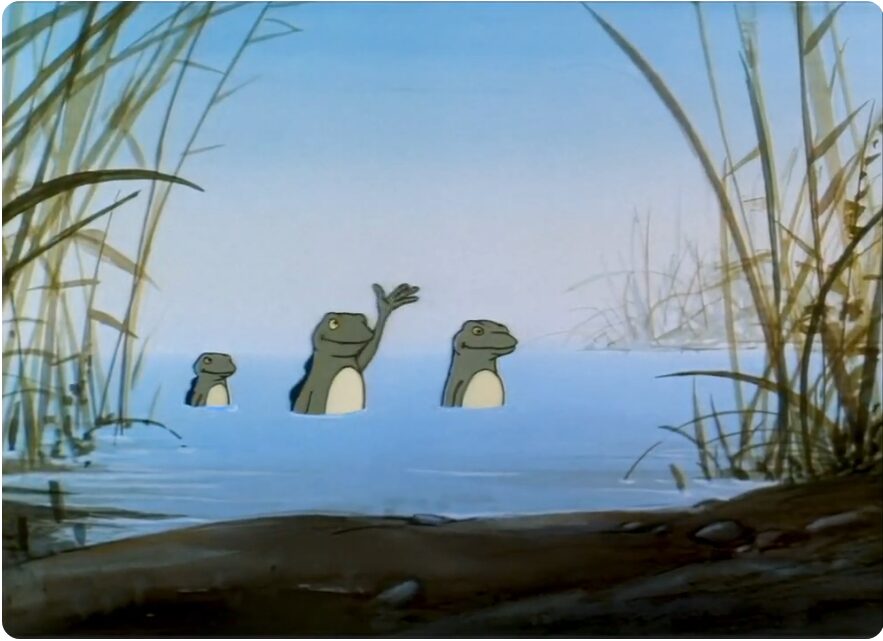
A bucolic scene of thick woods atop a green hill, a fox jumps onto a hollow log looking pensive yet determined, he turns to a badger who has joined him with a mole on his head. Five rabbits, a mouse, a stoat. All of them turn, quaking, to the dramatic noise from a looming yellow bulldozer, concrete dripping from its maw, a salivating beast. The woods disappear in an explosion of concrete. The fox, snout pointed forwards, leads the others away. They abandon their wood, and the frame ends on them poised on a little hillock, the fox’s paw is up, all snouts forwards, silhouettes against the moon.
Sound familiar? Yes, this is the intro scene of The Animals of Farthing Wood. It graced TVs in the nineties, a decade in which historic acts were passed for species protections following on from the Wildlife and Countryside Act which had been introduced in the decade before. The WCA protected some native species in the UK so that it was no longer legal to wantonly kill them or destroy where they lived. For the first time, animals like the ones in Farthing Wood needed to be taken into consideration when developments like the one represented by the yellow bulldozer went through planning. Sadly, this rarely got to mean that the animals had equal say to the developers, or got to keep their homes. It meant that the developer, at the very least, had to survey the habitat it was planning to destroy, take account of what would be lost, and gain the appropriate licences to destroy the bits that it wanted to, which would include mitigating in some form the impact it would cause. What might have happened to the animals of Farthing Wood under a mitigation license is that the animals may have been trapped and relocated. The developer might have left a 30-meter buffer around any badger sett, or gained a “badger licence” to destroy the sett and build an artificial sett nearby.
Not all animals are protected equally. Of the animals from the moonlit silhouette, adders, toads and badgers are only partially protected. Otters and squirrels fully. Foxes didn’t make the list of animals in the WCA, nor mice, shrews or rabbits. Infamously, bats and newts have the strongest protections. Interesting, then, that it is a fox who leads the band of animals to the safety of White Deer Park, a nature reserve where they would be safe from the bulldozers. Whilst in episode one, the newt family, who struggle with the journey, decide to stay behind when the group passes through a marshland. Badger doesn’t like it, “not in the team spirit” he says. “You do see it’s better for us, don’t you badger?”, reasons the Dad newt. Later in the episode, a fire rips through the marsh, leaving a charred scar on the landscape. Badger narrates a recap at the beginning of the next episode where he recounts the fire, saying solemnly, “for the newts, there was no escape”. Am I reading too much into it, or is this a formidably prescient scene? Ye animals, abandon your comrades at your peril; human legislation will not protect you.
It is easy to be pessimistic about the state of nature in Britain. I knew, getting into it, that the conservation sector, by and large, would be a hopeless place to work, considering the battles. The last couple of years have been depressing in terms of policy surrounding nature, and just as I have entered the sector. I have already learned from my job the weakness of the nature and species protections that we do have, when it comes to planning issues. A study by the University of Sheffield and Wild Justice found that developers often do not meet existing environmental obligations. 83% of hedgehog highways and 75% of bat boxes required as mitigation measures were missing from recent construction projects. Just under 40% of trees planted for offset purposes were either dead or missing. And just so we are clear, that’s the bare minimum they were supposed to do to make up for the animal homes they admitted to destroying. Anything they ‘missed’ is out of sight and out of mind. Swept under the car park.
All of that is before the 2025 Planning and Infrastructure Act (PIA), brought in despite heavy criticism from our big conservation groups. The act has essentially created a pay-to-destroy system, where instead of doing all that mitigation, developers can opt to pay into a “nature restoration fund” which Natural England will use for nebulous “nature improvement” purposes. Natural England seems to think that nature is something we can create and manage — destroy in one place then just make from scratch elsewhere, like it’s just a further extension of civilian infrastructure. Bio-tokens to be swapped around in a “green economy”; nature viewed as data. Seemingly oblivious to the fact that nature is made up, in part, of individual sentient beings that have a right to life and thriving.
The Animal Sentience Committee has picked up on this — did you know we have one? It is an advisory committee that produces reports and recommendations on policy, ‘containing its views on whether, or to what extent, the UK Government is having, or has had, all due regard to the ways in which the policy might have an adverse effect on the welfare of animals as sentient beings’. The committee wrote their recommendation letter to the government regarding the PIA when it was a bill. In their letter, they outlined how it ‘appears to conceptualise “biodiversity” or “the environment” as a single entity, without recognising that these are populated by individual animals capable of experiencing positive and negative welfare states.’ It might be almost moving if it weren’t so inconsequential. The Government’s response was due at the end of last year. As far as I can tell, they have yet to respond.
Nature is not units of data, but its opposite. It is relationships and delicate systems that take hundreds and thousands of years to become the life support systems we need to flourish. It is individual lives with strivings and wants and thoughts and cultures. It is integral to who we are as humans too, our identities and psyches. It keeps us connected, anchored, and alive.
And the undeveloped land that is the home and habitat of much of our wildlife — our living world — is a finite space, and each conversion to human-only use shrinks it. If a restricted species population is destroyed in an area then it is gone forever, it won’t just appear as a new population somewhere Natural England have planted some trees or put up some bat boxes.
As if it wasn’t already dire enough, we’re on course for things to get worse still, because the Government is also now proposing to follow the recommendations of the Nuclear Regulatory Review and further weaken habitat regulations for nuclear developments, in order to build them more quickly. The Wildlife Trusts and other conservation orgs have spoken out against this. But it doesn’t stop there — Kier Starmer had indicated that he wanted these recommendations to apply not only to nuclear developments, but to other “Nationally Significant Infrastructure Projects” (NSIP). He said, “The Taskforce makes clear that we can and should go further for civil and defence nuclear, and the broader infrastructure that underpins our future economic growth. And we will.” The wording on “economic growth” is vague enough at this stage that it could be applied to seemingly anything the government fancies, and what it is sure to include, are data centres. That sudden tipping point into AI usage, which we seem to have passed in the last few months, so that now its uptake seems unstoppable — that deluge is going to need many, many more data centres to power it.
At the conservation organisation at which I work, we have already started to receive emails from citizens concerned about proposed data centres in their neighbourhoods. Our organisation is supposed to represent citizens and we promise our members we will hold the government to account while advocating for our species. About the most devastating part of my job is the number of requests we get to intervene in situations of planning and development. There are simply too many battles for us to step into, it would overwhelm all of our resources. Instead, we offer the public guidance on how they can object to developments using legislation related to the species we campaign for, and failing that, take account of exactly what will be destroyed, make sure that correct mitigation is followed through, and contact the relevant authorities if a developer breaks environmental law. But still every day we receive desperate pleas from communities that want to protect the living world around them. Thorough, considered pleas for us to make it stop. Attached photos and videos of the creatures they love and care for: videos of bats about to lose their foraging routes; trail cam footage of badgers tumbling in play; gleeful children cupping newts. Evidence of animal lives clinging on in our already diminished environment, and the local people coming together in defence and solidarity with the animals that live besides them.
It’s David and Goliath, and you know who’s likely to lose. It’s the opening scene from The Animals of Farthing Wood playing out again and again and again. Each day I come into contact with a new community who are concerned about losing their nonhuman neighbours to development. We as an organisation rely on their stewardship as the best line of defence for those species — on local people taking their concerns to their local planning department. And now, in places, this already weak civic power may be utterly lost. The NSIP framework would have Development Consent Orders processed by the Secretary of State rather than by local planning authorities. The suggestion is that in many more cases, citizens will have the power to resist development and take stewardship of their natural landscapes completely removed, to be decided by the State, and (by extension) American Big-Tech.
We already know that data centres are bad for the environment, with their use of copious amounts of energy and water. We know that as a developed nation, we are already guilty of mass emissions due to our excessive energy usage, even pre-AI. This is all expected to vastly increase in the coming years, due to data centre energy usage, and the intensity of personal energy use where AI replaces ordinary processing functions. It really feels like we are about to accelerate nature’s decline, getting carried away by this so-called “AI revolution”. The Animals of Farthing Wood tells a displacement tale as old as time. But that opening sequence could soon seem twee, compared with where we are heading. Rutger Bregman doesn’t think we quite understand the scale of what’s to come. On his substack, he called the AI boom ‘the largest capital build out in the recorded history of our species’. Combined, he reckons Microsoft, Google, Meta and Amazon ‘will spend three times as much on AI infrastructure in 2026 than the entire Marshall Plan that rebuilt Europe after the Second World War’.
It may seem childish to a lot of people — like a children’s cartoon about talking comradely animals on a quest to find a safe home — to consider animals as sentient individuals in our planning decisions, like the Animal Sentience Committee do. That I can say this and it still sound like common sense shows how vastly animals lose out to us, featuring as only an appendage in our legislation. How we fail them, and how much more indifferently these proposed weakenings of already scant protection treat them. What we are talking about really, is condoning extinguishing the lives of sentient species to make way for processors; sentient beings who are treated like data by the new ‘pay-to-destroy’ approach to planning. This is nature versus data.
There is something particularly, darkly poetic about stripping nature protections for data centres, quite literally demolishing the natural world to build a metaverse on top. The coming societal shift facilitated by AI does not bode well for the living world — the energy use, sure, but also the epistemology. AI is fundamentally in opposition to nature, because it embeds us more deeply into a virtual reality. The clamour that surrounds it is symptomatic of the hyper-enchantment of the digital world, and the bad sorcery of capitalist extractivism that underpins it. I’m scared of the effect this is already having on our ecological values. It will only serve to reinforce the systems, as well as the ethics, that are driving ecological destruction. And if we already offer such scant protections to nature, where will further disconnection and indifference lead us?
It’s an ethical question we haven’t paused to properly consider. Might we find that we have swapped one kind of world for another before we stopped to take account? Do you want more AI slop and less newts? I actually don’t think you do, but no one is asking or being asked. A couple of weeks ago I saw crested newts drifting through a rewilded swimming pool. They floated about like tiny zeppilins, not a clue what a portent they’ve become for the fate of threatened species. I was ecstatic to see them; I teared up.
I think that the question of whether the environmental cost of AI is outweighed by the benefits — with the supposed solutions it can invent for us — misses the fundamental cost to our values, and the continued consequences of this pathway. What would a proliferation of data centres give us really? Deeper surveillance and further disenchantment. Whilst destroying critical habitat for threatened species. To me, data centres are the most perfectly warped symbol of all of the infrastructure we deem more ‘critical’ than nonhuman flourishing — as they convert the living world to the machines that might swallow us into a virtual one. Those dark satanic mills become bright-lit, humming, grid-like, spreading out across our landscapes like mechanised approximations of the lifesystems that preexisted them. Heat and thirst-making, they extract from the living world – its water and its lifeforce – converting this to light, megabytes and money. The Animals of Farthing Wood taught lots of us young that it is pure human-supremacy that the kind of growth we prioritise is economic. What grows there already is perfect.
*
Abi Andrews is a writer, researcher and conservation worker. Her debut novel ‘The Word for Woman is Wilderness’ was published by Serpent’s Tail, and she is currently working on a nonfiction book about solidarity with animals.