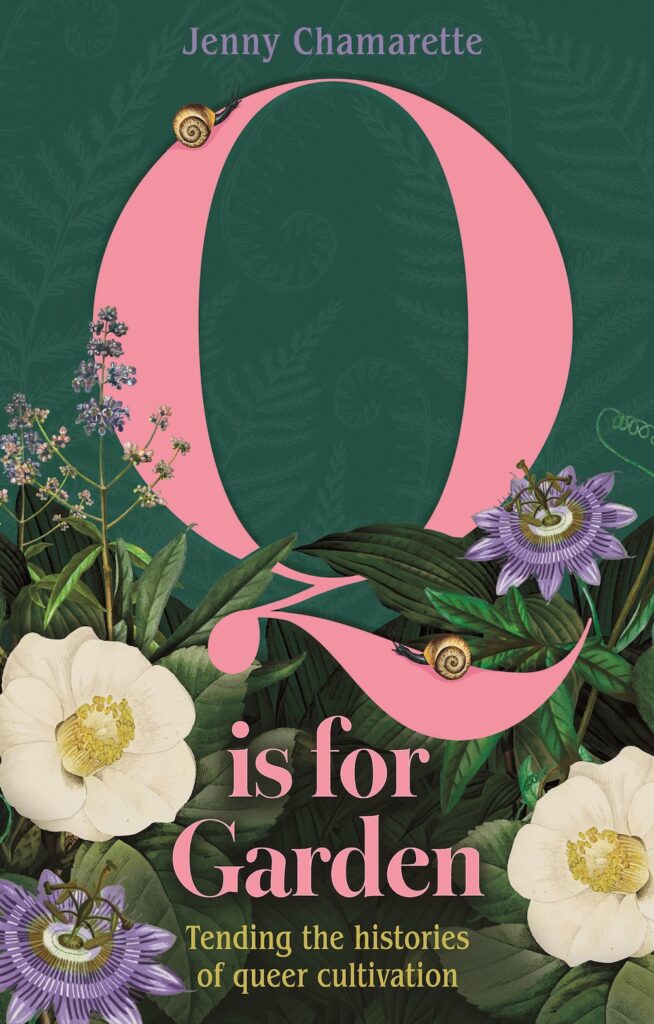
July’s Book of the Month is Jenny Chamarette’s ‘Q is for Garden: Tending the histories of queer cultivation’ — a bold, tender exploration of how queerness and nature entwine, and what happens when we step beyond the binaries that fence us in. Read an extract below.
love in the mist (on wildflower meadows, queer kinship and grief)
A few years ago, we planted a meadow in our shallow front garden. Planted is the wrong word: planting is for seedlings that need hospitable soil-permanence to survive. We raked gravel, scattered wildflower seed, watered, and waited. After a few weeks, tiny plantlets sprouted, like it was no task to thrive in ground that had previously been a plot for cat shit and crisp packets. The serrated leaves of salad burnet and the occasional cornflower, tall cocksfoot grasses and feathery protrusions of yarrow grew squashed in beside one another, an unstructured, messy community in the small five-foot-deep patch between the front windows of our home and the street beyond. In May last year the oxeye daisies opened simultaneously. For a short while a few square metres of waving white-and-yellow heads resembled the flowered pasture you might think of in midsummer, breathing gently for miles. This year, it is already early June and the daisies are barely in bud. The magnolia sits behind this riot of green life, observing in its silent, hundred-million-year-old ways. It had its feast weeks ago. Beyond the shonky pallet fence, poppies and red valerian have self-seeded between gaps in the paving stones.
Year on year, I forget the sadness that comes with summer. It is supposed to be a time of plenty: gorgeous golden-hour light, blue skies, warmth, the return of time outdoors, long hours of talk winding into the night. But I find myself awake at four in the morning, ruminating.
It is an anniversary of sorts – a year, two years, three, more, since I left a full-time, open-ended contract as an academic – the only career I had ever known. There was a before and an after, but the precise moment of the pivot is occluded. I wasn’t present to it.
So instead I draw on my body’s intuition. My body knows in the fabric of sensation that I walked away. In Ursula Le Guin’s short fable ‘The Ones Who Walk Away from Omelas’, bright, young, vigorous people go about busy industrious lives while a filthy, starving, miserable child lives in a prison cell underground, begging to be released. Its allegory haunts me. The intolerable things that must be tolerated, in order to remain. And the haunting feeling of turning your back on everything that is familiar.
***
Queer ecology in a garden is about the untamed and unpruned. As Palestinian visual artist Jumana Manna points out, differentiations between weed and plant are made all the time in a garden, ‘where ideas of the familiar and foreign, native and invasive, the border and its transgression, are installed. Like state formations, gardens are defined by who is curated and who is cared for, pruned, contained, against the unwelcome intruders.’ Decisions rule about a plant’s appropriateness or suitability, and what falls beyond the garden’s always-failing borderlines. Gardens, like states, enact borders – who is tended, who is torn out.
Ecology is also subject to similar differentiations. Ecology is a human-made concept, no matter how much we might wish to decentre humans from it.
In a spiral of chorus and echo that feels familiar to me now, I am introduced via Susanna Grant and Rowan Spray’s pamphlet From Gardens Where We Feel Secure to Indigenous writer Dennis Martinez’ concept of kincentricity, ‘a unique Indigenous cosmology and relationship to nature […] one of equality.’ As Martinez explains, ‘the Indigenous kincentric model is based on a gifting ethic … where gifts cannot be owned but have to be passed on to others in the community.’ It is a familial model, whereby the natural world, plants, fungi, more-than-human animals and humans exist in a continuous ethical contract with one another – an Original Compact based on love, mutual care, respect, abundance and restraint. If ‘ecology’ is the cold, clinical post-Enlightenment term, kincentricity is its warmer, older, land-based ancestor – less concept than covenant.
Kincentricity is Indigenous knowledge with heart and spirit. Its ecologies are forms of living knowledge: they are land-and-people-based, relational and endangered as Indigenous peoples around the world are forced off the land to which they are so intimately connected. Successions of empire and colonialism, agrarian and industrial revolution, and capitalist mass-farming technologies have repeatedly assailed locally embedded knowledge. So has the larceny of language.
Across Europe variations on the theme of racial purity steal from the language of land intimacy. ‘De souche’ – of ancestral roots (another arboreal reference) – is how white French lineage is described, for example. In Britain, a word like indigeneity leaves a sour taste in the mouth. Used interchangeably with whiteness by extreme right-wing political factions, it gained traction under the ultranationalist British National Party in the 2000s and continues to misappropriate the rights demanded by minority ethnicities and communities, serving instead the interests of white supremacy. On an island subject to millennia of occupations, trade agreements and cycles of dependency on other land masses, not to mention the legacies of violence that are an endemic condition of European empire-building, there is no skin pigmentation that plausibly indicates who is or is not Indigenous. It makes more sense to consider Britain’s imperialism as an opposing, extinguishing colonial force to kincentrism and Indigenous land relations.
I long to know what place-loving knowledge was already lost, buried in the land I care for. And what kincentric circles remain in those still powerfully connected to the land they tend.
In a much more prosaic sense, it feels warming to consider the wildflowers in my front garden as my kin. The deadnettles and ribwort plantain that spring up through the pavement, the huge wild rose that showers me in petals as I walk past my neighbour’s front garden; the insects that inhabit it and the birds who scuttle in to feast on invertebrates; the cats and foxes who stop to drink from the half-barrel pond we rolled into our five-foot front patch the moment we moved in. They are all part of the small world I tend and watch, and they bring me more happiness than I can possibly reciprocate.
The natural world holds inconceivable complexity. It also encompasses a richer, earthlier erotic–ethical connection that I call queer because it is certainly not straight. Queer kincentrism, perhaps.
*
‘Q is for Garden’ is out now and available here, published by Manchester University Press.
Jenny Chamarette is a writer, researcher and arts critic, curator and mentor based in London, UK. Shortlisted for the Fitzcarraldo and Nature Chronicles prizes, and longlisted for the Nan Shepherd and Space Crone prizes, Jenny’s non-fiction has been published in anthologies by Saraband and Elliott & Thompson, in Sight & Sound, Litro, Lucy Writers Platform, and Club des Femmes among others. See Jenny’s previous contributions to the site here.