August’s Book of the Month has been Alycia Pirmohamed’s ‘Shorelines: Memory, migration and the selves we become’. In this month’s author interview, Alycia speaks to Tallulah Brennan about embodied experiences of place, writing against the lone explorer, and the interrelation between the natural world and empire.
Find an extract from the interview below.
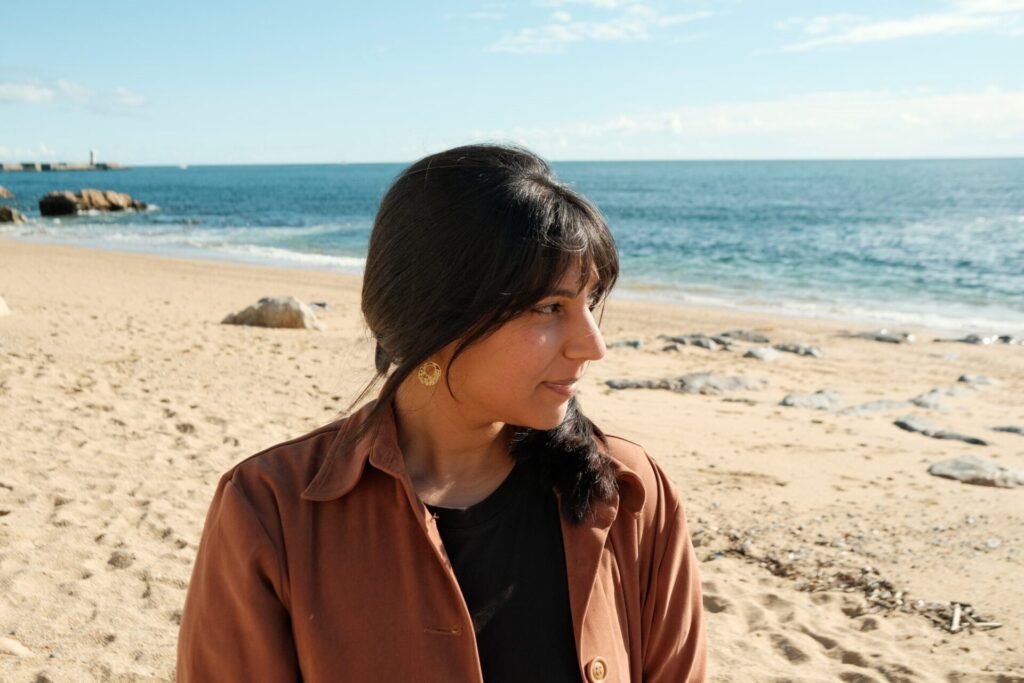
Alycia Pirmohamed, photographed by Tim Phillips
Firstly, some quick-fire questions.
So much of the book is about your walking journeys, whether in Canada or Mallorca the Lake District. Can you tell us if there are particular trails which have been essential to your writing life, or brought you key moments of redirection or realisation?
Not so much a trail, but a particular walk: the loop around Lochend Park near where I live. When I was living on Easter Road, specifically during lockdown, I went to Lochend Park almost every day. This little loop, with its swans and coots and herons, is where I started my project of reading a poem by a South Asian woman out loud every day of Ramadan. I’m not sure if I could name any specific epiphany that came through, but the walk itself did feel spiritual in a way that I sometimes feel disconnected from, being so far away from the religious community I grew up with.
Something more unusual about the book is its focus on friendship. You write about being with people ‘in a way that is embodied and slow and woven with care.’ Is this something you feel is missing from the nature writing genre?
I came to writing from a very community-oriented perspective, through online forums and peer-to-peer workshops. And I feel like friendship and community are essential to both the writing I do, to the process itself, and to why it matters to me at all. Perhaps historically, in the Western tradition specifically, the lone explorer was a common narrative in nature writing. And sometimes writing itself can feel like a solitary act, even a lonely one. But I think most of what I’ve read lately focuses on collaboration, intertextuality and friendship of various kinds. I’ve also been really buoyed by the kinds of collaborative writing I’ve seen in the nature writing field. A great example of this is Dialect Press’s imprint DIRT, where poets create eco-critical work together. And I write a little bit about this too is a glistening in Shorelines, which is a pamphlet I co-wrote with Pratyusha, Nina Mingya Powles, and Jessica J. Lee over a magical weekend of cooking, walking, and swimming in lakes in Germany.
In the book, you write: ‘I find the image of the wayward seed compelling, but I’m also distraught by it.’ The question of home is a preoccupation of the book, but clearly one of the guiding questions of your life too. I was wondering if the process of writing the book helped you to come to some new conclusions, whether it gave you closure on where it is you belong?
I think writing Shorelines did both: the writing process helped me come to some conclusions, some certainties, but it also freed up more questions about place, about self, and about what it means to live within the diaspora. These questions are so valuable because they help me to remember that my perception of self, and my feelings around home, are constantly shifting as I myself change and as the political context changes. And that’s okay. Sometimes, I feel adamant that a place, like Scotland, is my home. And then, I wake up to news of race riots and Islamophobic attacks, and those feelings rupture, they cause so much pain. I recently revisited Bhanu Kapil’s How to Wash a Heart and felt very seen by the way she portrays the host-guest complex as enacted by nations and institutions. I needed that book again. Shorelines itself transformed a lot from proposal to publication. I originally thought I’d write a book focused on poetry criticism and the fricative feelings I’d had around the word ‘belonging.’ I’m so hesitant about that word in the publishing industry, and wanted to write about how, as a theme, it seemed like shorthand for books by racialised writers, a way for the white gaze to easily categorise and digest our work. And while some of that friction, that complexity and confusion exists in the work, I think one of the conclusions I came to is that I didn’t want to only write to or against these narratives all the time. I wanted to just be, and to let my exploration surprise me too.
*
Sign in or subscribe via Steady to read this interview in full. Paid memberships help us secure the future of the site, in exchange for monthly author interviews, seasonal reflections, discounts in our Bandcamp shop and more.
Alycia Pirmohamed’s ‘Shorelines: Memory, migration and the selves we become’ is out now and available here, published by Canongate. Read an extract here.