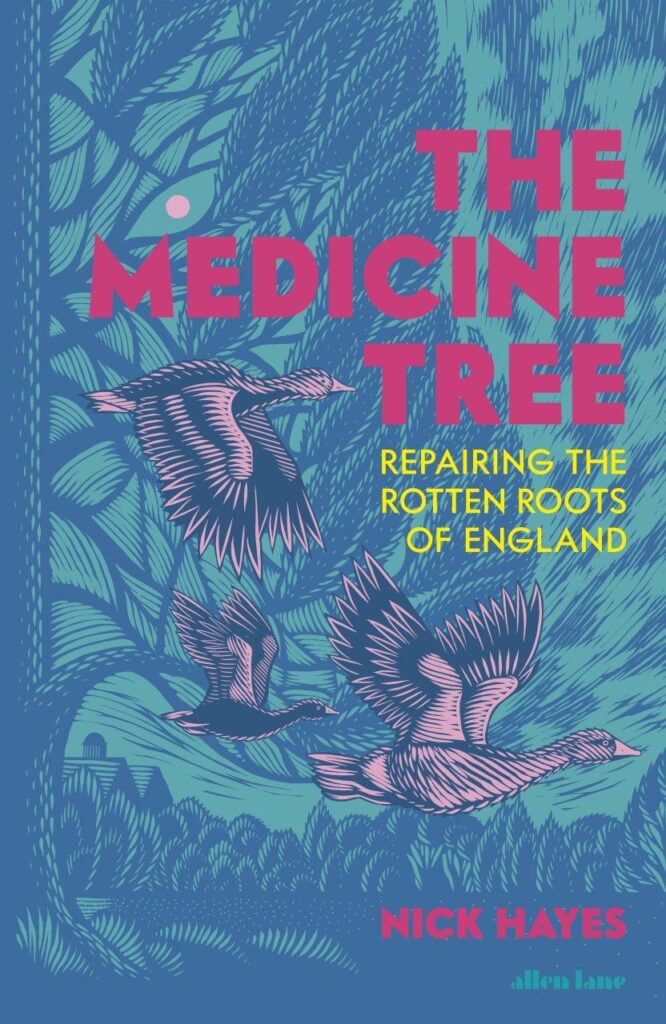
Without a culture of reverence for our land, is it any wonder that it is ailing? ponders Nick Hayes, in an extract from ‘The Medicine Tree’, our October Book of the Month.
I had spent most of my summer in the river. I swam for exercise, but also for sheer bodily delight, sliding beside the red veins of the willow roots, writhing around submerged tree trunks like a snake in the mangroves, exploring the secret arbours and coves concealed by the falling cascades of leaves. These little ignored places, where the crayfish dig their nests in the clay, had become my favourite haunts and I would hide my naked body in them when the plastic boats of summer daytrippers rushed by, smeared in silt, wrapped in hornwort, like Jenny Greenteeth, unseen in their wake.
In these secret groves, I would meet coots and kingfishers,electric-blue speckled dragonflies, and, most commonly of all, the river’s rubbish. These sheltered coves are an Aladdin’s cave of shite, a thieves’ horde of detritus snagged and clogged for decades in the bankside roots. I would pull out old butane canisters caked with blue-grey clay; industrial baling wrap; cracked plastic tubs; webs of translucent fishing wire, each with a needle-thin hook trailing somewhere beneath my feet; infinite flimsy, yellowed plastic bottles, whose rust-coloured waters poured out of cracks as I lifted them; and harder, industrial bottles, brittled with age, that spilt what remained of their chemical concoctions back into the river.
Rivers used to be gods. Now they are sewers, run-offs for a catchment of shame that includes much more than sewage and litter: microplastics, pharmaceuticals, factory waste, chemical fertilizers from industrial agriculture, heavy metals from our motorways; it all seeps through the soil, and ends up in our rivers. The lowest point of our landscape, rivers now express the nadir of our culture: they tell a story of a society that has somehow normalized undrinkable, poisoned water. Meanwhile, English society is cracking; in the cities and towns, angry men gather around statues, draped in the Union Jack, burning cars and attacking migration hostels, defending a story of this land that ignores the land itself.
That summer, as I swam, I wondered what mantras, philosophies and cultures existed on this land before the story of England was harvested and bale-wrapped into what we have today. It seemed an act of extreme exceptionalism to suppose that we were the only country on earth not to have had a spiritual, mythopoetic relationship with the land, unmediated by its ‘owners’. But if there was such a land culture in England, I knew nothing of it. Why? The Māori were colonized by Britain and by France, by war and by treaty, their culture vandalized by physical and psychological violence wrought by invasive forces. But how had our land culture – our stories, practices, songs, dances and rituals – been taken from us? And without a culture of reverence for our land, is it any wonder that it is ailing? It seemed a complicated, grotesque irony for a country which had systematically destroyed traditional, indigenous cultures across the globe to be in such desperate need of one of our own.
*
Nick Hayes’ ‘The Medicine Tree: Repairing the Rotten Roots of England’ is out now and available here, published by Allen Lane.