Exploring the villages, towns and cities of our coast and meeting the people fighting to keep these places alive, Natasha Carthew’s ‘Rough Edges’ is June Book of the Month. An antidote to dominant, romanticised nature writing narratives, it keeps the genre’s humanity intact, writes CBTR contributing editor Tallulah Brennan.
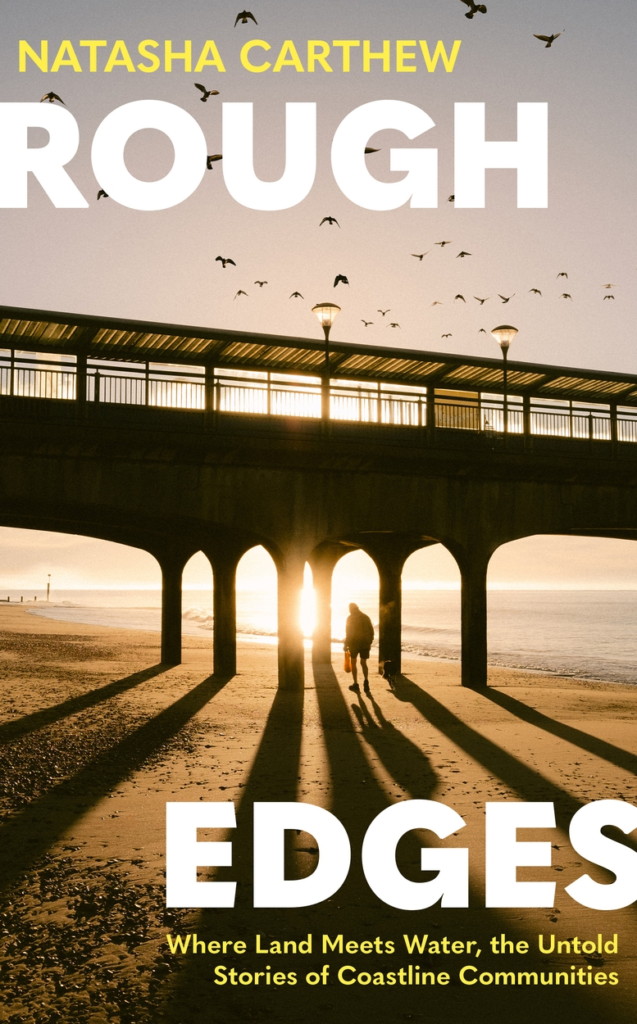
In her latest book, Rough Edges: Where Land Meets Water, the Untold Stories of Coastline Communities, Natasha Carthew says of herself, ‘all I know is to keep talking’. This is the greatest virtue of Natasha’s writing. It is a book borne out of conversation, and you can tell. The book’s list of chapters is therefore misleading — Homelessness, Crime, Pollution, The Right to Roam are ultimately sterile headings for a book which above anything else, keeps nature writing’s humanity intact, an entirely fitting trait for a book which is perhaps most fundamentally about loneliness by the sea.
An elderly woman called Joan sits on a bench which looks out over the pier in Southend. With her, a packet of rich teas, the arms with which she trades conversation, stashed in a handbag. The story Natasha finds in Joan is one of a terrible combination of conditions — the death of her husband and subsequent rising rents which forced her from the place she lived. Miles out of town, the infrastructure of her life was crumbled by structures way beyond her control, within an economy which has no space for vulnerability. What is the emotional apocalypse of death in a coastal town ruled by landlordism, the limits of council housing, and the dreams of property developers? By a different pier, in Brighton, we meet a young man who has been kicked out of his home, who has a collection of his belongings and a story to tell about queer displacement, and the common convergence of class and LGBTQ+ experience. The conversation we are privy to is insightful, and it is kind. Rough Edges bestows on the people we meet an even greater thoughtfulness for their being placed in the book; given the rightful social and political analysis they deserve alongside a devotional to the promise of coastal towns — the constant of the sea, the wonder of being able to build a life by its ‘moody undercurrents’ and salty expanse.
‘Third spaces’ are public places which are not work or home, but places where communities can gather. A church or a pub or a library are all third spaces, but each are threatened for different, yet intersecting reasons like gentrification, demographic change, austerity, high rents, the cost of living. If people do not have places to dwell and to meet with other people, then we have succeeded in creating atomised, deeply unhappy individuals. A librarian working in Brighton, Jo speaks of the delight of the children at the new arrivals, of the importance of a public computer, of the elderly people who are able to congregate here, and the activity groups for young children. These are all things I witnessed in my public library as I squirreled away on my studies, a lonely endeavour in itself. Undoubtedly, the potential and promise of intergenerational collisions was reshaping my life as much as my Master’s degree. Jo explains that three of the community libraries are threatened with closure while Brighton and Hove City Council conduct a ‘needs and use’ analysis to determine whether their closure could save the council money. If we already have a crisis of loneliness and mental health, what might we be in for if even more third spaces are set to disappear?
The interesting thing about Rough Edges is that the story is not exactly new. Media outlets have been writing about the decline of the seaside town for many, many years. It has been ten years since the Brexit vote, where towns like Blackpool and Southampton and Clacton-on-Sea were momentarily noticed so that the media could wonder, if only briefly, what had, according to the establishment view, gone awry. What is new in Natasha’s retelling, is for one, the empathy she leads with, and second, placing this story within a genre of publishing which has at least in part, made a name for itself in stories of escape and redemption, like The Salt Path. If The Salt Path has since been disowned, it nonetheless represented an achilles heel for an industry which has built itself from these romantic relationships with nature. There are truths that writing from the sea does not seem to be able to hold: Salty air is no replacement for government investment, the wind in your hair is no remedy for the anxiety of how the rent will be paid, from where the next job might come. Rough Edges is an antidote, formed from the imagination of someone whose writing accommodates many truths. At once, the sea is of Natasha’s ‘same saline bloodline, the same green eyes on a moonlit night’, but it has at times been ‘giant volatile bully’, its tides seeming inescapable because of poverty, or ill mental health. As she writes, there is no getting away without resources, and though the ocean’s horizon is always there, ‘promising the world’, this means little when you have no means of escape. If Rough Edges fails to meet the marker of escape and imagined peace of mind, then good. Both England’s coastal towns, and its often brutish, eroding, polluted and poisoned ocean long deserved better.
The Home Office estimates that the number of asylum seekers housed in coastal hotels rose by 8 percent between 2024-2025. When Natasha veers into this thicket, we slip for a moment into something a little too romantic — the ocean as a symbol of expanse and therefore remedy. ‘You can feel the power of all the people looking out to sea’, seeing that the ‘the biggest community is our planet of people’. In a world of poisoned water tanks, racist pogroms, and politicians baiting the public towards violence, more thorough dismantling of these people’s arguments will have to follow, not just sentiment. Throughout the book, there is a referral to a future in which we will need community more than ever, but how do we change the current so that such a wave isn’t able to crash? I wonder if this feeling that a challenge hasn’t been risen to is worth its salt, until Natasha concludes towards the end of the book that the rise of Reform has pushed her from the country. Aside from the simple fact that you cannot outrun the coming far-right tide — across the channel, it is very likely Marine le Pen or Jordan Bardella will take hold of power in the very near future, and just across the Atlantic, three consecutive summers of race riots are unlikely to dissipate anytime soon — there is also the fact that Natasha’s bold writing is surely up to the task of keeping it at bay. Rough Edges does not lack boldness; the tone is assertive, it demands culpability from the people who have engineered a societal loneliness which has whole communities positioned precariously on the cliff edge.
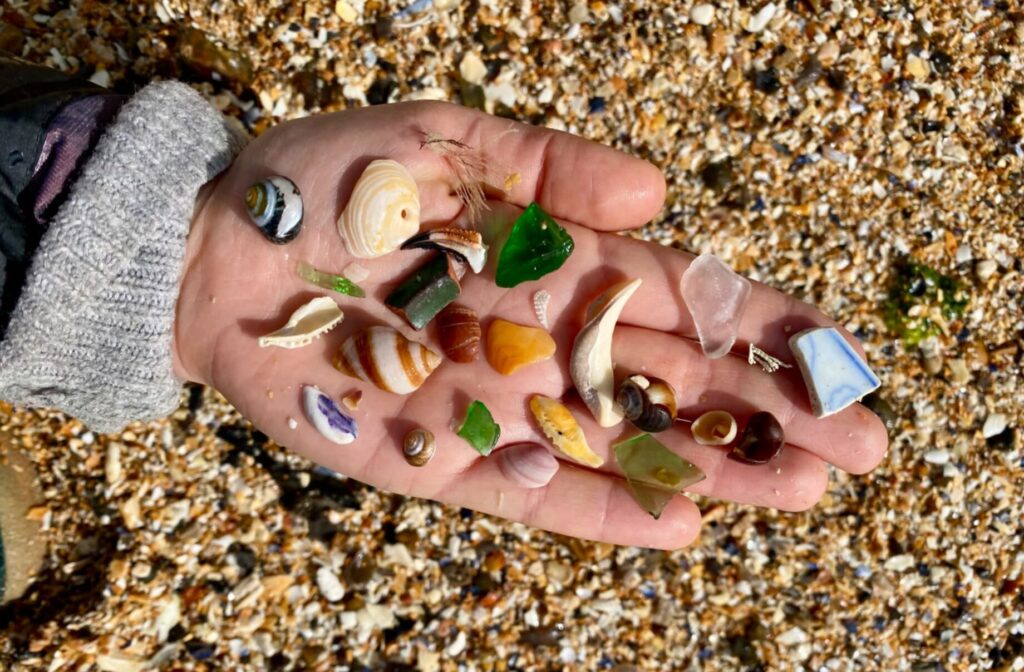
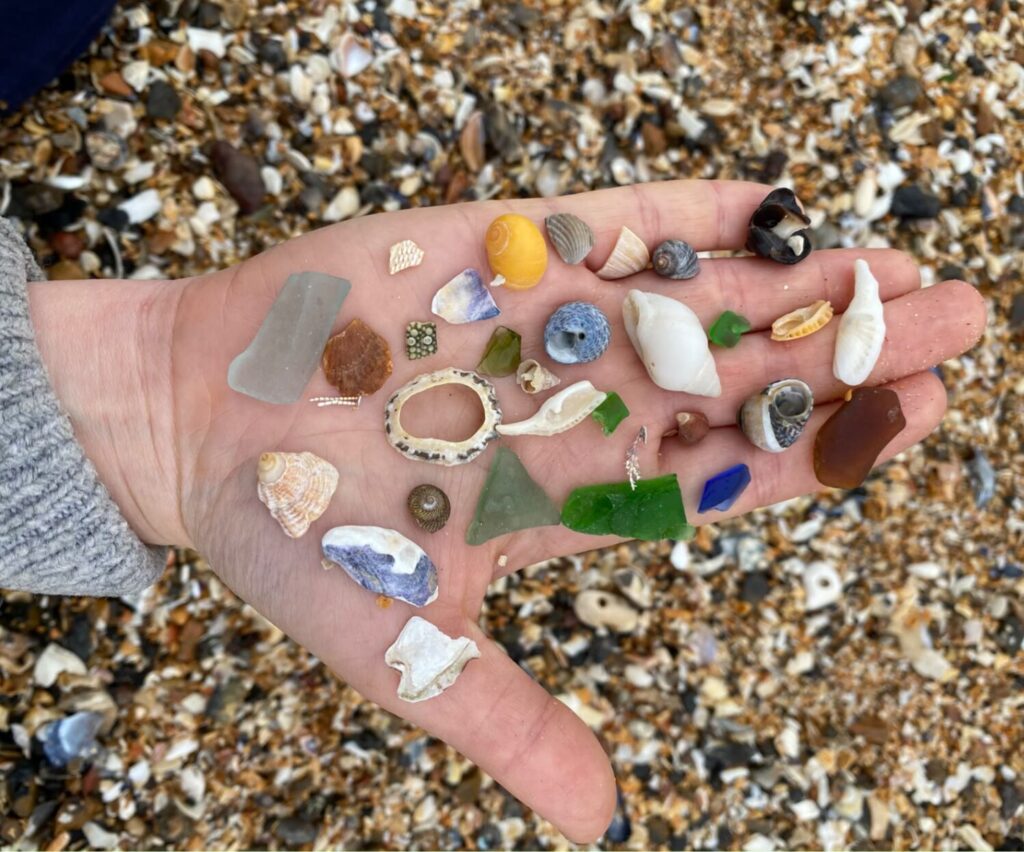
One of the last times I was on the South East coast, I was not underneath the white chalk cliffs that have come to mean home, but by gift shops and brutalist housing and brunch cafes in Margate. My colleague, Diva and I, were combing the sand between light showers of rain for anything we could find. I managed to collect sea glass, washed out ceramic pieces, pieces of crab shell, dried up strands of seaweed. Limited only by time, not by the sea’s infinite offering underneath my feet, I select the most colourful or interesting shells until between the two of us, I have an exhibition on the palm of my hand. I remake this collection a couple times over, but meanwhile, people with power are pulling their own collections from the beach, from very real griefs that emerge from being dispossessed of a sense of home, of public life, of trust, of care and a social contract that might hold you at your most vulnerable. And their harvests are as real as the ones in my hands. While I pull ceramics and sea glass in an attempt to connect my life to something bigger than this moment I am in, men in suits, backed by inordinate amounts of money, are gathering their data, their resources, their time, and dedicating it to transforming deep-rooted feelings of neglect into burning anger.
The coming years will shape England’s coast, quite literally. There are parts of the north-east Yorkshire coastline that are eroding at an average of 1.8 metres a year, while along the Welsh coast, advisors warn Cardiff and other towns are ‘sleepwalking into oblivion’. Similarly, the coasts of Norfolk and Suffolk have been named as some of the fastest eroding coastlines in Europe. As Natasha writes, ‘we are literally washing away’. A party which campaigns for an end to net zero as passionately as it does for punitive immigration controls promises these coastal towns they will be better off placing their hopes and desires for a resilient future in their hands. What they will return to the people who live and work on these rough edges will be a slow washing away, a future which can summon only an assortment of rubble of chalk, sand and mud.
Natasha’s book is a dose of this reality that nature writing too often neglects. You step into it not for a naive tour of England’s romantic seaside towns, but for a challenge, a reminder of the urgent crises of England’s coast. I think Natasha is an effective populist as well as nature writer — her ‘we’s’ and us versus them narrative is functionally uncomfortable — I feel both guilty and galvanised. How do I do better than invoking the ocean as escape, my beach finds as contemplation? The stakes are too high for this mirage. If the ocean can be ‘a stabiliser, a constant, a long view when your future looks brick wall myopic’, how then to infect lives lived by it with the same sentiment? How to exist as a ‘nature writer’ that makes mends, that has courage? That summons the ocean to mind as a place of possibility, better horizon, safe harbour, when to many others, both on English shores and gazing towards them, it is anything but.
*
‘Rough Edges: Where Land Meets Water, the Untold Stories of Coastline Communities’ is out now and available here, published by Sceptre (£19.00). Read an extract here.