Kirsteen McNish chases hope, as her herbs cry out for rain.
I recently learnt to drive, something I never wanted or thought I would be able to do. We can no longer carry my disabled daughter on our backs when her hypermobile limbs and buckling ankles give way. She is now a 17-year-old woman. Piggybacks are out. I am scared but grateful for the freedom, the burden of having to rely too heavily on others somewhat lifted.
I listen out for my daughter; for the low cooing sounds that tell me she is ready for the day. Last week she had a vasovagal episode which shook me as for a few moments I struggled to bring her around. I watch her intensely for repeat signs like the hospital told me to, trying hard not to over-analyse or take my usual catastrophising routes, biting my nails until they speck with blood. I wake every hour and check on her as she sleeps. I need three strong coffees in the morning before I can unravel enough to start the day.
As I drive to a class a few days later, I can feel the invisible cord stretching between us and anxiety tangles itself in my throat, making me want to turn back. I arrive late to twenty or so people lying prostrate in the village hall, eyes closed in brightly-coloured sports gear whilst I creep in in a worn black cotton t-shirt and paint-splattered joggers. The air is gloopy and there is a faint smell of plimsolls and floor polish. A chain from a blind tick ticks in conversation with the fan, creating a kind of metronome. Grateful for a space other than my home, I lie down and feel like I could fall through the floor, imagining the dark earth beneath, the twists of the roots from the surrounding trees and the smell of petrichor I am missing in this normally damp microclimate.
The teacher speaks of the importance of breathing slowly and internally in a round from the back of the throat, mouth closed. I am not used to moving slowly: I want to move quickly, like the water that rushes from tributaries lacing the surrounding hills. I lie in a supine twist and imagine walking out of the room and up toward the teat-shaped tip of the imposing Tor, screaming my lungs out.
I try not to catch anyone’s eye as I hastily roll up my mat, missing the relative anonymity of the city. I cannot face kindly strangers striking up conversation as I fall increasingly into burnout. I do not want to make plans for coffee that I likely cannot keep. I do not want to explain that I cannot find anyone to help me with childcare in a long summer that stretches out before me, blinking blankly. I especially do not want to feel the discomfort of someone’s kindness or pity. My centre line is off-kilter.
Sitting for a few moments as the car door clunks beside me I wonder what I am actually doing, trying to write, trying to work, trying to do anything outside of caring. All this said, I notice as the car engine chokes into action that my breathing — since the class I resisted — is more even, and my limbs feel lighter. My phone randomly selects the scratched-out violin saws before the swell of Rufus Wainwright’s ‘Agnus Dei’ fills all the hollows as I wind down the windows to release suffocating heat. The trees in the nearby graveyard bend towards the earth, reminding me of cattle taking a much-needed draught, whilst dozens of moths flitter in the last of the early evening light.
As I pull across the bridge, past the station house café, past the now vacant hairdressers, past the deli which is run by a much-loved Italian man who chuckles when he talks, I feel the air gently cradle my face. I wait at the junction to allow people to cross the road. I see a woman in an abaya outside the kebab house blowing up an England beach ball whilst her two small children clap delightedly. As I drive further down the road a woman squeezes a teen’s shoulders as tears are brushed away under a pulled-down baseball cap. In the layby opposite the doctor’s, a man in a housing estate holds a battered green watering can as glistening drops spurt over abundant crimson and deep purple Sweet Peas in his front garden. Even the light on the hills seems to caress the ground.
Meanwhile my daughter seems to be concertinaing herself in sadness. She oscillates between rage and hysterical laughter. Her moods these days are passing heavy thunderstorms, and I feel almost scared of their force. I clamour for advice in a scattergun fashion with health professionals, psychologists and friends and at night I dream of tsunamis that I stave off behind a surreally huge door with no perceptible walls to support it. My friend J feels as if my daughter is a barometer of the state of the world, her spidery senses aflame.
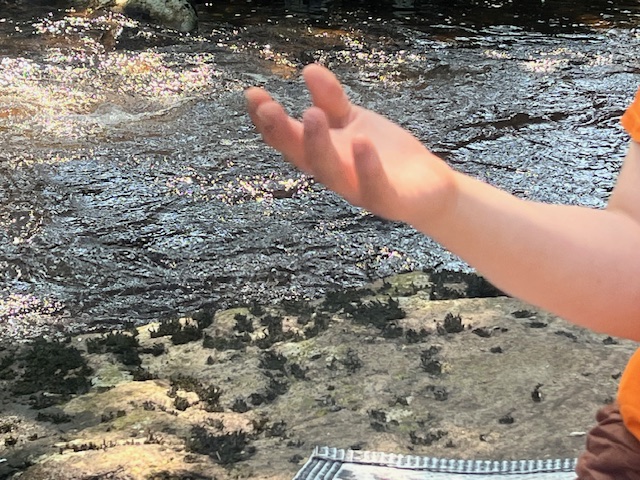
I drive to Avon Dam in the hope that the amber waters will soothe my child and my nerves. I play Aldous Harding — the only thing that seems to stop her crying as she rocks in the back seat. I want to find a way to soothe her. Sometimes, through a loss at what to do, I feel I want to run. The car screams out its alarm as we walk the short distance to her favourite spot. My son runs back with the key fob and tells me that I left the door wide open on my daughter’s side. Feeling slapped by my befuddlement and the noise emanating from my daughter’s throat, the sun feels twice as strong. Surely the water will soothe her. As we clamber down the granite platform, we find another woman there with hair piled loosely high on top of her head, radiating calm. She tells me over the shouts of my disgruntled daughter that she is a personal assistant, and gestures towards the young woman that she cares for, who she says is non-verbal as she grins our way, splashing happily, neck-deep in the water — picking up stones and dropping them back in. My daughter pauses then starts shouting again. The woman offers medical and sensory advice. My son slopes off ahead to another spot and stares at his phone.
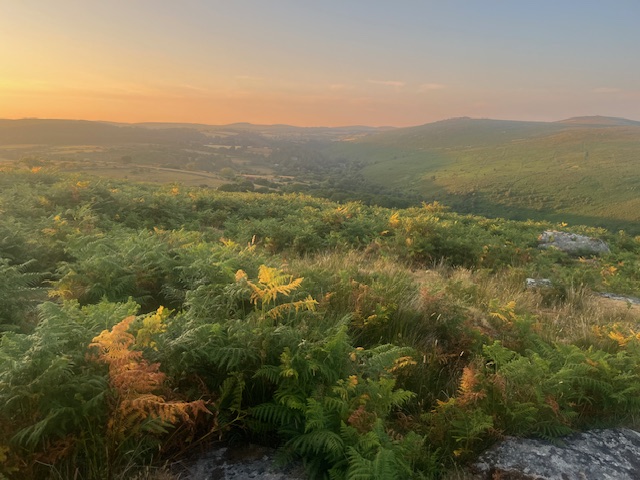
Shortly afterwards, leaving the carpark, I start to apologise to my teenage son for how difficult it has been lately. I offer him words of gratitude but am unable to wipe away the tears as my hands are newly navigating the winding country roads that fall away into tumbling riverbanks. I feel his hand reach out to the back of my head, and his soft words emanating from a newly deep voice. I pull over into a passing place. Holidaymakers pass by slowly; eyes fixed on the ribbon-like road smattered with dusky potholes and clouds of dust. He speaks, not for the first time, of how time is simultaneously stretched and compressed. Clouds of emotion pass over his face as he says that he feels we are just specks spinning in space and that most of us are just trying our best. That we all have ups and downs. That we are still human. I knock the windscreen wiper button on instead of wiping the tears from my face, which reduces us both into rasping cackles in its irony. For the remainder of the way home he rests his hand on my arm as the hills reveal varying burnt umbers and yellows. I wonder if my daughter, always leaning so close to the earth, is also picking up on the vibrations of the natural world. I pray the moors don’t catch fire.
Days later I pad around my friend’s softly glowing garden. All the flowers have sprung in the heady mixture of sun and early summer showers. Earlier in spring, this celebrated artist learnt she would lose her house and garden amidst a housing crisis sprung from a law originally designed to protect tenants’ rights. The legislation initially backfired, resulting in countless evictions and unearthing people from their homes – often leaving them nowhere to go as rentals became scarcer. The landlords of the estate she lives on planned to auction her house, and those of many of her neighbours, providing them with three months’ notice to bid or vacate. Her celebrated creative work which has in turn inspired countless others pivoted around these four walls and garden, as does her teenage disabled daughter’s whole life.
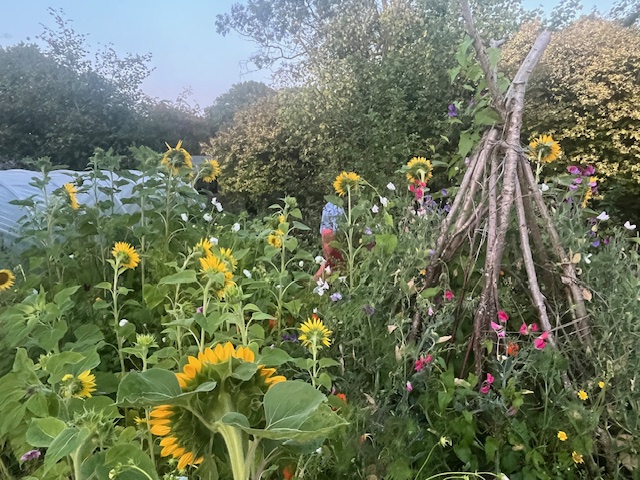
Sunflowers curiously face away from the house in the direction of the River Dart, as if they are sentinels pulled by its ancient waters – a ley line of protection of this home and its occupants. Zinnia, Poppies and Cosmos burst in fireworks from the polytunnel. Cornflowers and Fennel reach their delicate fronds for the sun. I have never seen a garden grow quite like this one – it has a lifeforce of its own. It is a garden where human form is miniaturised by the abundant plants – much like the paintings of the Middle Ages artist Hieronymus Bosch. Countless feet have walked through this home and garden and felt its tender power; many laying their bodies down to commune with its undeniable energy. Countless bodies have danced with the sap of these garden plants against their skin in the kitchen, cried and laughed on the sofa, and gathered in this artist’s kitchen for simple sustenance.
A group of us got together to make plans to support our friend and her daughter, and within weeks hundreds of people stepped up to help her gather funds to contribute to a deposit for her home, so she and her daughter weren’t uprooted and cast to the winds. Soon messages of encouragement and love for her work started to flow amidst the often-dysfunctional and polarising framework of social media. It took her breath away. The fine threads of a web started to vibrate and reach many others. Where people could not afford to donate, they generously sent messages of support or shared on their platforms so others might do. Children offered up pocket money, and people that didn’t use social media asked how they could donate having heard on the grapevine. Before long groups of artists who had attended Siân’s creative courses sold prints of their own work to help boost her house fund. Despite the precarity of the situation it became clear that community can still exist in a world of fragmented dislocation. Despite the dictat of those who govern and yield power, tender shoots can also grow when the right seeds are scattered, and even when the playing field is unlevel. That love can indeed spread.
*
I lie on the parched ground at 7am praying for rain to help the tender herbs I planted when I started a course with a herbalist who encourages her students to listen, look then commune rather than simply extract. My eyes seek out hope lying here — in the second flowering of the bobbly yellow globes of the Mimosa tree, the bug that crawls slowly across my face, in the two Peregrine Falcons that have returned to the nearby fields. I think of the multitude of organisms buried in the towering hedgerows, holding on to the in-between-spaces. I think of those who create despite the odds stacked against them. I think of the words I have just read by writer Jenny Chamerette in their exceptional book Q is for Garden:
Germinate
Break ground
Pivot.