Translated by Mira Rosenthal, Małgorzata Lebda’s ‘Mer de Glace’ — written as its author prepared to run the entire length of the longest river in Poland “as a poet, not as an athlete” — is November Book of the Month. In this month’s author interview, Małgorzata and Mira speak to Tallulah Brennan about funerals for glaciers, attentiveness as a form of love, and rivers as friends and sisters.
Read an extract from the interview below.
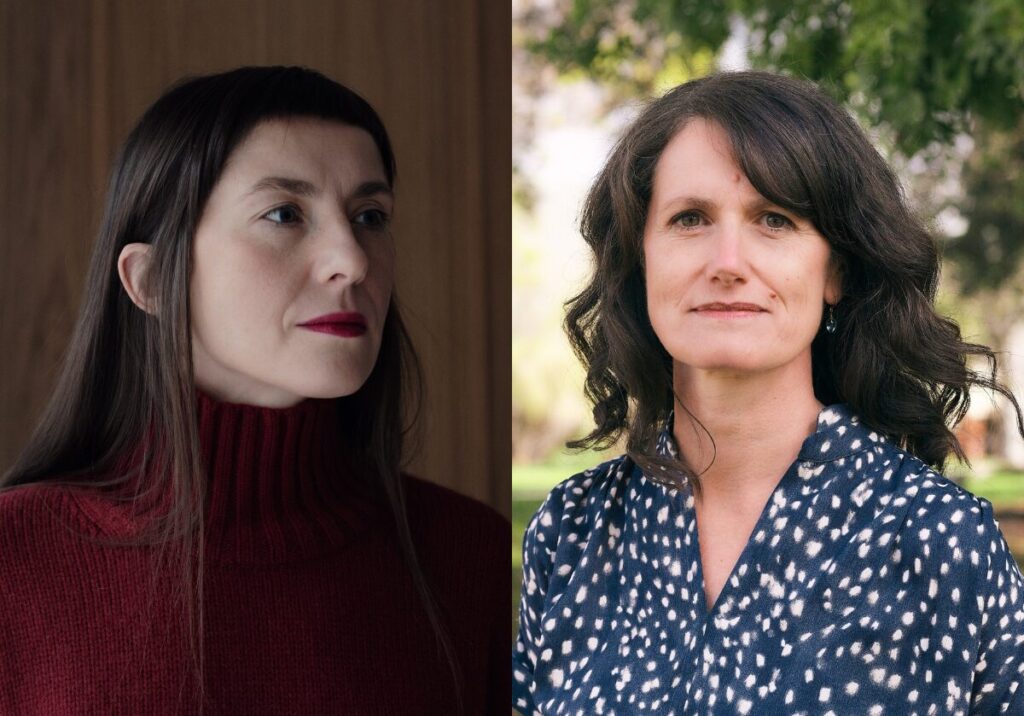
Left: Małgorzata Lebda, photographed by Weronika Ławniczak. Right: Mira Rosenthal by Slav Zatoka
The first poem in the collection, ‘The Feeding of the Dogs’, begins, ‘mornings here in the damp valley are good, the end of the world that continues rarely comes to mind’. There are not only things I do, but places I visit which allow me a certain amount of forgetting about the changing climate. (And I am glad of it!) I wondered how you both feel about how this relates to poetry and escapism? What makes an ecologically responsible poem? Does such a thing need to exist?
Małgorzata Lebda: Poems by other poets stay with me. They demand to be remembered and revisited, mostly because they bring relief. So, for me it is less about escapism than about relief. Beyond that, as a reader I want poetry to provoke me with questions and to give my imagination some exercise. I hope readers find that in my own work too. As for an ‘ecologically responsible’ poem, the word ‘ecology’ comes from two beautiful Greek words, oíkos (home, household, environment) and lógos (study, words, knowledge). Seen this way, almost any poem could be called engaged or responsible. But I know what you’re getting at: a poem that takes a stand and calls for action or change, like a manifesto. I have faith in my readers, and I don’t think we need manifestos. I trust that a poem about feeding dogs can inspire love for the world and still be a call to action, without sending anyone to the barricades.
Mira Rosenthal: It might be that the idea of an ‘ecologically responsible’ poem, or the category of ecopoetry, has ceased to be a useful term, since all poets are bearing witness to the changing environment, whether or not the author acknowledges it directly. Such changes are simply a fact of what it means to be alive at the present moment. I suppose I’m more interested in how poetry grounds us in the body, in the senses unfolding, and how reading is an embodied experience. In other words, I go to poetry for the opposite of escapism. Through sonic texture especially—that is, through the sounding of words on the vocal cords that vibrate the house of my body—I’m brought into the present, following the play of a mind through the stream of music. Bringing the attention to the physical realm through reading poetry feels like an intentional commitment, given how many things are asking us to go numb and competing for our attention these days.
I really want to talk about the line, ‘The talk is of drowning out our dread, of averting our gaze, of writing poems closer to the subsoil than the news broadcast on British radio.’ ‘Poems closer to the subsoil’ reminds me of academics who speak about ‘putting on their rubber boots’ to be able to write. Małgorzata, can I ask how living very immersed in nature affects your poetry? And Mira, what that experience is like as a translator of what is so local and known to the author but not to others, who are presumably on quite different soils?
Małgorzata: I grew up in a village in the Beskid Sądecki mountains. My parents were farmers, and my father also kept bees. Today I live in the countryside with my husband and 17 animals (three geese, three goats, three sheep, two cats, two dogs, two mares and two foals born on our farm just over a month ago). I think about writing a poem the same way I think about working the land. To me, soil and words are similar materials. Most of my day goes on the animals: I feed them, muck out, trim hooves, pick off ticks, shear the sheep. All of this finds its way into my poems, unbidden. My vocabulary is earth, landscape, mud and animal fur. But being ‘closer to the subsoil than to the news on the radio’ doesn’t mean I turn my back on the world. I start with what I can touch and name, and from there I look further afield.
Mira: The specificity of her landscape felt very important when translating Małgosia’s poems, and it was really helpful to visit the region where she was living when she wrote the book. Each variety of apple, for example the White Transparent, carries with it a particular flavor, hue of blush on the skin, shape of branch against the horizon. But it’s also inflected with cultural associations, such as being indicative of the home gardens in the countryside that died out with the rise of supermarkets after 1989. The quick-to-bruise tart apple couldn’t compete with those better suited to a long shelf life. I’m not sure if the associative elements come through in the same way for readers elsewhere. But while translating, I found myself pausing to think about correlations to my own rural upbringing in Northern California: the Gravenstein apple orchards now mostly gone to make way for more lucrative vineyards, the sheep and goats eating away at invasive blackberry vines in our fields, the manzanita groves withering back and turning ashen during drought. From region to region, the act of naming is important. It shows a connection, an intimacy.
*
Sign in or subscribe via Steady to read this interview in full. Paid memberships help us secure the future of the site, in exchange for monthly author interviews, seasonal reflections, discounts in our Bandcamp shop and more.
‘Mer de Glace’ by Małgorzata Lebda, translated by Mira Rosenthal, is out now and available here, published by Fitzcarraldo Editions (£12.34). Read an extract from the book here.
Małgorzata Lebda is a Polish poet, fiction writer and ultramarathon runner. Born in the Beskid Mountains, she now lives in the countryside with her husband and a herd of seventeen animal friends.
Her seven poetry collections include Mer de Glace, which received the Wisława Szymborska Award in 2022. Mira Rosenthal’s English translation (Fitzcarraldo Editions, 2026) was shortlisted for the PEN Heaney Prize in September 2026. Writing in The Guardian, Fiona Sampson called it ‘ecopoetry at its most profound and informal, challenging and pleasurable’.
Her first novel, Voracious (Łakome), was published in English by Linden Editions in 2025, translated by Antonia Lloyd-Jones. It has more than twenty foreign editions published or in preparation andis being adapted for film.
In 2021 she ran the entire length of Poland’s longest river, the Vistula, from its source in the Beskid Mountains to its mouth at the Baltic Sea, a distance of 1,113 km, as part of her poetic-activist project ‘Reading the Water’.
Her next novel will be published in Poland in July/August 2027.
Mira Rosenthal is an American poet and translator of Polish-language writers such as Tomasz Różycki, Małgorzata Lebda and Krystyna Dąbrowska. She is the author of Territorial, a Pitt Poetry Series selection, and The Local World, winner of the Wick Poetry Prize. Her work has received NEA, Stegner, and Fulbright Fellowships and twice been nominated for the Griffin Poetry Prize. Recent translations include Małgorzata Lebda’s Mer de Glace, which was a finalist for the PEN Heaney Prize for socially engaged poetry, and Tomasz Różycki’s To the Letter, which won the PEN Award for Poetry in Translation, the Found in Translation Award, and the AATSEEL Award for Best Translation into English.
Tallulah Brennan is a writer based in England, interested in the relationships between humans and their environment, and how they in turn shape each other. She is also a contributing editor at Caught by the River. Follow Tallulah’s Substack here.