Jenny Chamarette’s ‘Q is for Garden’ — our July Book of the Month — offers connections between queerness and the soil that Kate Bradbury didn’t know she needed.
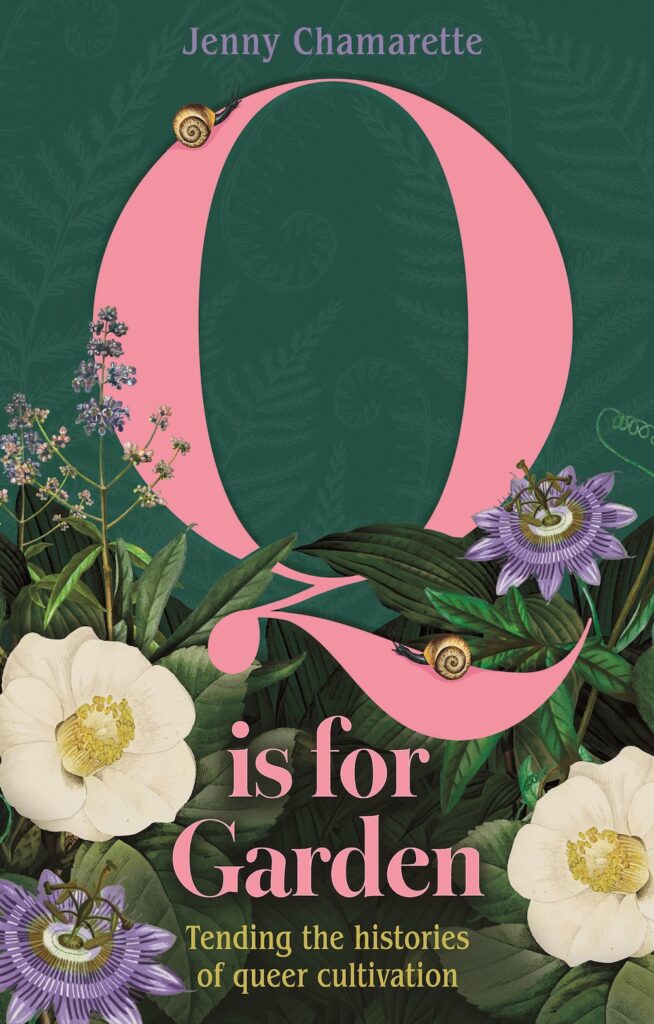
Jenny Chamarette is a writer, curator and cultural critic. I first came across their work in This Allotment: Stories of growing, eating and nurturing, an anthology of tales of allotment life, edited by Sarah Rigby. Chamarette’s story is one of reconnecting with nature via their allotment in the context of a sudden debilitating illness, the Covid pandemic and the climate crisis. Their first book, Q is for Garden: Tending the histories of queer cultivation, sees Chamarette continue this story via both their garden and allotment, while also weaving in histories of queer gardeners such as Derek Jarman, Vita Sackville-West and (perhaps) Gertrude Jeykyll. There’s a queering of other horticultural histories, too, including of Jean Baret, the first woman to have circumnavigated the globe on explorer Louis Antoine de Bougainville’s expedition from 1766–1769 (she was only able to do so as she was dressed as a man), and the ‘Kewriosities’ – the first women gardeners at Kew who were required to wear the same uniform as the men so as not to distract their male colleagues (they inspired much ridicule from the London Press). Then there’s the queerness of the plant world itself: the hermaphrodite snails, the bisexual and transitioning trees and flowers. And the author writes eloquently of the language that connects us with the natural world. Of the etymology of root, radix and radical, they say:
‘Root and rhizome. Rage and root. Root and radical. What was my process of taking root? Of radicalisation?’
As Chamarette states in their introduction, the Q of the book is for questioning, querying and queer. They ask questions that I didn’t know I wanted the answer to, offer connections between queerness and the soil that I didn’t know I needed. This is a memoir, certainly, but it is as much about Chamarette’s own experiences of realising (and moving into) their queerness, and of their battle with depression and the healing powers of the soil – ‘when there was nothing, there was the garden. The allotment. The tiny place of being that did not require reading, writing, thinking’ – as it is about the treatment and oppression of queers throughout history, as it is about tomatoes and the colonial assaults that led to the cultivation of them today. They say, ‘sitting with the Q of the garden is where I began. Seeing the invisible in the visible. Finding the trace of scent in the air. Sometimes that scent is heavy, mossy, earth-bound’.
At times there is rage: the treatment of Saartjie Baartman (the ‘Hottentot Venus’), the ‘shameful truth of white complicity in empire, colonial botany and racial violence’, anti-vaxxers, ‘gender-critical tears’. They link the centuries-old oral history of herbalism with queer trans colonial botany: ‘Queerness in the Straight. Queerness in the empire’s asylums and prisons. Queer all over, entwined in the shivering bodies of plants and humans’.
Of systemic oppression they write ‘queerness and gender fluidity have always been a part of landscapes of Britain. They are suppressed by the same hands who systematically deny that post-renaissance Britain was a colonising nation upon whose hands will always be the blood of peoples it wittingly or unwittingly subjugated and destroyed. Am I angry? Yes, I am.’
But, there is hope, too. Chamarette reminds us:
‘In 1943, at one of the darkest points in the twentieth century… Eve Balfour [the co-founder of the Soil Association] spoke of the hope and gifts of the soil.’
Of the climate crisis they write ‘the Q in the climate crisis is about learning again to see myself in the landscape, to see and feel, with hands in the mud, what an intimate, personal relationship with the land might be.’
And for this queer gardener, about to up-sticks and move to the woods on her own journey to be closer to a larger patch of land, they write: ‘anyone who has experienced a major life transition will know its accompanying sense of lostness. It is not comfortable to shift the ground you walk on. But it is necessary for the continuation of life.’
Gardening has always been queer; queers have always gardened. But it is nice to read that someone has queered the landscape for us, queered the botanical histories, asked questions, made assumptions that hadn’t been made out loud before. All queers know the feeling of not fitting in, of working out their sense of place in the world. In Q is for Garden we find it.
*
‘Q is for Garden: Tending the histories of queer cultivation’ is out now and available here, published by Manchester University Press. Read an extract here.
Kate Bradbury is a garden writer based in Brighton. Her latest book ‘One Garden Against the World: In Search of Hope in a Changing Climate’ is published by Bloomsbury Wildlife. Read Kate’s Substack here.