Spurred on by Nabokov, Sue Brooks seeks the company of a favourite butterfly.
July’s pleasures came early this year on account of the heat wave. Butterflies that migrate here from Europe were on the wing in large numbers in May and June. But July is the peak month. It’s the time when I open Chapter 6 of Nabokov’s autobiography, Speak Memory, written in English when he and his family were living in exile after the Russian Revolution.
I travel with him to the days of his passionate love affair, aged nine, with butterflies on the family’s summer estate at Vyra, south of St Petersburg. In exquisite prose, he revisits the moments when he was standing among rare butterflies and their food plants — this is ecstasy, and behind the ecstasy is something else which is hard to explain. It is like a vacuum into which rushes all that I love…the highest form of timelessness.
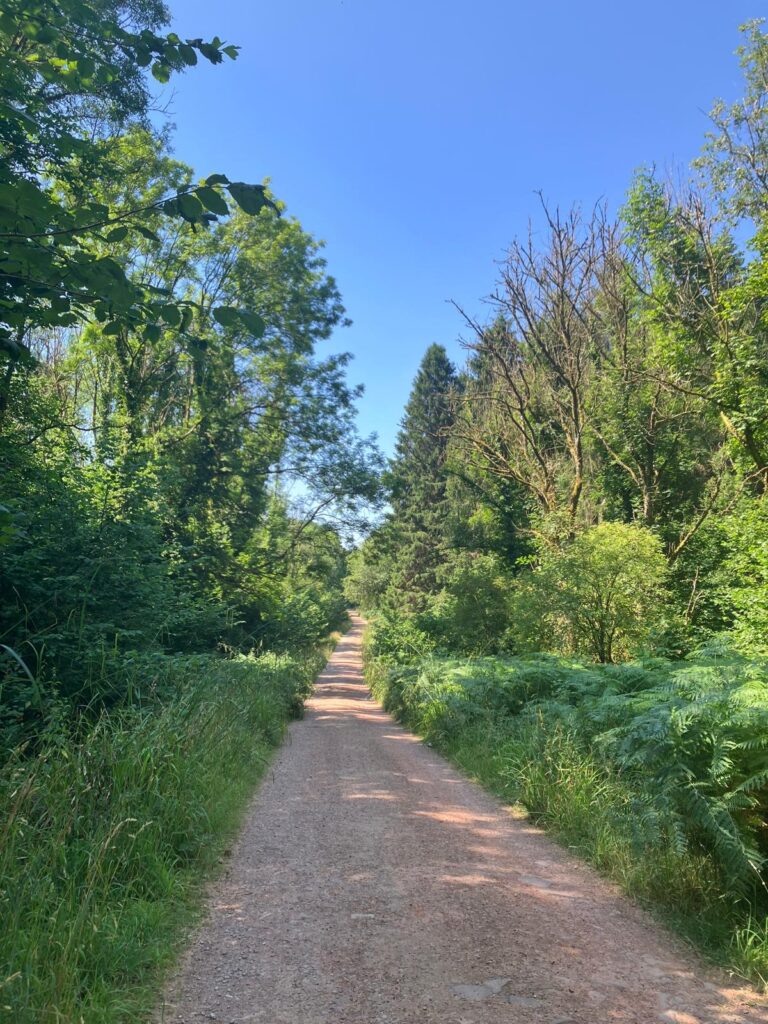
It wasn’t quite like that on July 10th. There was nothing remarkable about the forestry track ahead, except a distant memory of seeing certain butterflies there. Nabokov spurred me on. A feeling that this year was different, exceptionally and frighteningly different. It was 11am after the hottest night on record, without a trace of wind. No sound, no birds, no other walkers.
A flash of brilliant orange — a comma butterfly. Walking slowly in the tree shadow with the stones of the track in full sun, there were ringlets everywhere, meadow browns, tiny skippers and holly blues. They kept company with me as I tried to work out what was so special here. What were the food plants? A few thistles, plenty of nettles. The odd valerian and patches of late flowering bramble. Not the luscious banks of bramble around field edges — these were scrambling as best they could, with few flowers, very small and tightly packed, already forming their berries. Was this the preferred nectar for silver-washed fritillaries? The equivalent for me of Nabokov’s darlings.
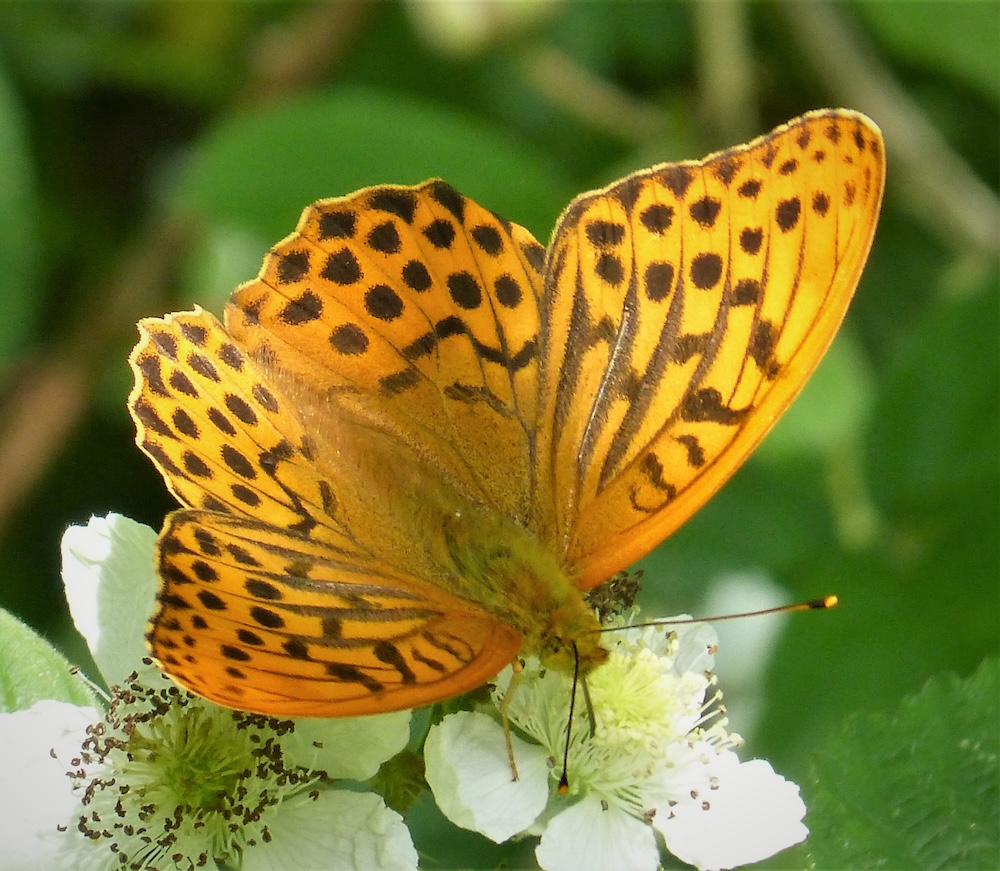
Silver-washed fritillaries are the largest of the fritillary family in the UK. The females have a wingspan of 8mms. They lay their eggs in crevices in the bark of oak trees and the caterpillars hibernate until the following Spring when they find their way to the ground to feast on dog violets. In this dense woodland, violets are very secretive in their habits. A hidden world, in which the caterpillars go through five Instars (shedding of their skins) and a Pupa, which resembles a dead leaf. I’m rehearsing this in my memory, as I walk slightly downhill. They are only on the wing for three or four weeks. Could I have been guided somehow, to the place where these glorious creatures cruise and sometimes dance?
In brilliant sunlight, with the darkness of the trees behind, two silver-washed fritillaries were at play. Gliding, swooping, briefly resting on an obscure bramble cluster, and off again. As I watched, heart in mouth, I saw — witnessed — a consummation. Or an attempted consummation? It was over so fast. But I like to believe it happened. There was a moment of union where I could see the silver scales on the underwings of both sexes, usually hidden by the sensational orange of this fritillary in flight.
One of the butterflies came towards me, as if I were an object in the landscape, and circled around, coming close to my ear. I heard the zoom of the wings, not made by fluttering. I thought…if a silver-washed fritillary were a bird, it would be Apus apus — the common swift. How absurd…but it made me smile.
Other words from my memory — the final ones in Chapter 6…A thrill of gratitude to whom it may concern — to the contrapuntal genius of human fate or to tender ghosts humoring a lucky mortal.