A rousing call to reach for the pitchforks, Nick Hayes’ ‘The Medicine Tree’ — our October Book of the Month – shows that community and land culture grow and thrive wherever they are allowed to, writes Abi Andrews.
In the verdant home counties, among chequered fields and kite-flecked skies, is an Oxfordshire estate that appears much like any other — an arcadian emblem of Englishness; a signifier of assumptive hereditary power. But something radical has taken root. Since the 1970s, the Lord of the manor has been practicising organic farming on some of the estates’ lands, has opened up some of that land to others, and around this, a mixed community of growers, rural skills keepers and heritage craft makers has formed. Currently transitioning to become England’s first community-owned estate, the Hardwick Estate will soon be handed from its heirs to the non-landed-gentry residents who have made their lives and livelihoods there over the decades.
Touching on so many things that tangle back to the rot at the heart of contemporary England, Hardwick is the setting for Nick Hayes’ spirited investigation into hereditary land ownership in the UK, its inextricable links with ongoing global colonialism, and the contradiction at its centre, between owning land and belonging on it.
Estates have their tentacles around the world, gaining their wealth by extracting it from elsewhere, and this particular estate has the origins of its wealth ensnared with railway expansion across Canada — the opening of frontiers that enabled the thieving of land and resources from Indigenous populations who lived there. This period saw a clash of two very different worlds. One had a reciprocal relationship with the animate land on which its sustenance and flourishing depended. The other had a rational, alienated conception of land as something that must become the exclusive possession of a person, usually a man, by right of a deed written on paper. Hayes deftly sets this up as a kind of magical thinking — a spell we have been hoodwinked into.
And the crux of his argument is that the colonialism that allowed for the accumulation of such wealth and power was begun, tested and perfected, on home soil. The very methods by which Indigenous people are colonised around the world — the theft of land, exclusion from means of sustenance, as well as the cultural genocide committed by the distruption of ceremony and the banning of song, dance, language — much of this was practiced first when the commons were taken from the peasants of England. We find ourselves a landless people, deprived of our indigeneity. Now this claim might be a risky one to make if handled less nimbly, and a review short as this one can’t do justice to the way this is done; you will simply have to read the book. But to condense to a sentence: belonging to land is not about descent but instead relation. We are at the far end of a process that colonised countries and peoples are still undergoing — that is, almost absolute alienation from the land and its spirit. They honed their spirit-breaking on us. We have more in common with the peasants of the world than we are led to believe, and it is only for the good of the powers that be that this is disrupted and hidden from us.
Hayes finds glimmers of an animist past lingering in English stories and traditions, but much of his evidence comes from what he finds growing at Hardwick, where a land-based culture has been given space to flourish. Before arriving at Hardwick, lots of its inhabitants were squatters, drifters, boaters, travellers. In its ways, the community is fumbling towards a memory of being-of-this-land (we might call it indigeneity where we take this to be about being-in-relation) — at Hardwick new shoots appear from something severed but never killed off entirely. There is no going back to the commons, but neither are we detached from its history.
I must admit, I was a little skeptical of this book and its premise at first. That comes from my own prejudice against what I will call philanthropic landlordism. Like with another such landed-gentry-redemption-story that has taken the publishing world by storm in recent years (I’m talking about Isabella Tree’s Wilding) there is something of the fervent platforming of decent acts by people with the means to undertake them that rubs me up the wrong way. Why do we so enthusiastically praise the inheritors of wealth for being a bit less rubbish with their massive assets? Often these rewilding initiatives come about because the estate can’t turn a profit and there are grants available to change their land use. Hugh Crossley, heir of the Somerleyton estate in Suffolk, told Countryfile that his main motivation for rewilding his own estate may have just been to be contrary to the Victorian-garden-sensibility of his father. I don’t trust philanthropy, I don’t trust leaving important work to the whims of rich people, holding out for those whose vastly disparate worldviews might line up with your own on some ethical planes or whims.
Likewise, where estates are opening themselves up to the enterprises of us commoners, it’s not even necessarily from a sense of responsibility or even generosity, but rather that deteriorating estates have become harder for one family to manage. Let someone set up a vegetable enterprise in the crumbling kitchen garden! I have twice been to the Organic Growers Gathering, a small festival that has taken place on the Hardwick estate, and attended talks on exactly this tactic of landless landworkers approaching estates in order to get access to land on which to grow food for a living. There was a bristle from some in the crowd, it felt like coming with a begging bowl — a bit too on the nose in its likeness to feudalism. A comparative viewing of the recent film Our Land (based on another arm of Hayes’ land-rights work, the Right to Roam campaign) gives countervailing profiles of three estate owners who are wholly against (or tepid in their acceptance of) peasants even setting foot on their land for an afternoon stroll, let alone giving them over to community ownership and disinheriting themselves. Isn’t Hardwick just a utopic anomaly, reliant on the whim of a guilt-ridden heiress?
But Hayes has preempted my reservations. Hardwick isn’t allowed to stand simply for goodness prevailing because alongside it is the neighbouring, evil twin estate, Mapledurham. This tale of two estates does a fine job of tempering any optimism with the futility of what we are up against. Hayes’ friends on Mapledurham face eviction from the house they have lived in for decades, and their story is as horrific as it is ordinary. Their change of fate at the passing of the land to its new heir reveals the precarity of philanthropic landlordism, and its dependence on the whims of a landlord’s personality or politics. And yet more dispiriting still, the landed gentry are a dying breed. Hurray! But wait…the new aristocracy that replaces them are multinational corporations and globally, extractivism is more intense than it has ever been. These corporate bodies can’t be hoped to have a change of heart about their dubious inheritance — they’re not even people. The lord of the manor starts to appear a rather simpering, tame foe…
The Medicine Tree gives us something to work with, a vision, and visions can be replicated. Visions can be multiplied and stacked, so that you might imagine every manor house taken over by the common people. This isn’t unprecedented — there are communities living in the derelictions of wealth and power across the UK: old Georgian rectories, halls, and once-stately houses. The Old Hall in Suffolk, or Braziers Park, also in Oxfordshire, are examples. The book stokes more militant impulses too. Will Hayes throw a rock through the window of the evil estate’s mansion? Might we be incited to storm and squat all the stately homes that sit empty? And what if we just ignored it, this magical thinking of landlordism? A nice accompaniment to reading is to go along to the William Morris gallery for their current exhibition Earthly Paradise: Radical Alternative Living in the UK, for more on the UK’s colourful history of squatting, or taking the housing it needs.
But I think the main thing I have taken from this book is that community, given the means, wants to be, it flourishes. Hayes puts specifics on what exactly it is you are missing when you are yearning for ‘community’. It’s a Ceilidh band. It’s dancing, it’s creating new rituals. But most importantly it’s mutual aid, coming to the help of your ‘kith’ and knowing this will be reciprocated. “I’m wondering if land culture just grows like weeds,” Hayes ponders. So too, community. There is a sense of completeness in that, at a place where the walls once guarded exclusive flourishing, mutual aid has popped up like dandelions. This answers in a way my initial hesitance at using a setting that doesn’t seem replicable — because it’s not so much the rock Hayes is showing us, but the moss. Community need not wait for the perfect conditions (like a disinherited estate) to be able to build itself. Hardwick’s community built up over the decades prior to the estate’s handover. What Hayes shows us is that even where its future is on shaky ground, might collapse or have the rug (or housing) pulled from under its feet, community wants to be.
Peasantry is in vogue, on the very fringes of the UK at least. Courses on landwork offered in London are churning out Level 2 qualified organic horticulture students, and an opening in a market garden in the city will receive hundreds of qualified applications. Training centres are setting up, offering more routes to land skills, like the Apricot Centre in Devon or Black Mountains College in Bannau Brycheiniog. This training pulls in first generation land workers from all sorts of backgrounds, many of them burnt out from modernity, and looking for a way to reconnect with the land around them, myself included. Across the country, it’s difficult to get an entry-level grower job without first undergoing a good deal of unpaid work. This is the tiniest bottle-neck, and it is unbeknownst to most of society. But it’s there and it’s wearing dirty Blundstones. It feels to me sometimes like we might be living through a back-to-the-land moment like was had in the 70s. But whereas the 70s iteration was a movement towards self-sufficiency, this time, we will go together.
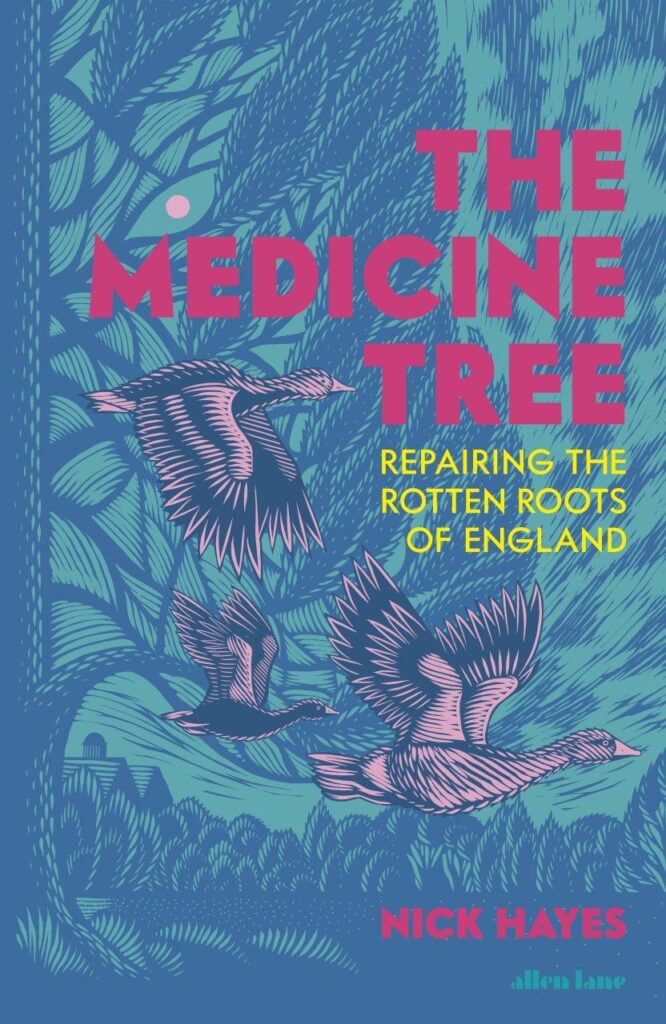
It is only a taboo against the tearing of pages from books that stops me from slicing Hayes’ illustrations out to frame them. The book is lively, pacey, and the embeddedness of Hayes living in and from his subject is snug to the book’s own endeavour for placeness — he’s in the Ceilidh band with the rest of the book’s cast of characters. It’s participatory writing, and you feel swept up into the throng of it too. The eponymous tree of the book’s title has a mythic quality, in the way it conducts all of the topics of the book like a lightning rod. It’s almost uncanny the serendipity with which the tree, the setting, and our narrator all fit around the subject, and this manages to never feel ham-fisted. You get the feeling Hayes was born to moor his boat next to the Medicine Tree, to write this book, which might in part carry forward the land-movement he calls our attention to. It might sit alongside its moment in a similar way that Wilding does against the current appetite for ‘rewilding’ land, but instead adjacent to the land’s re-commoning. The Hardwick community has set the tone. One heiress is already atoning. Pick up the pitchforks then, let’s go.
*
‘The Medicine Tree: Repairing the Rotten Roots of England’ by Nick Hayes is out now and available here, published by Allen Lane. Read an extract from the book here. Read an interview with Nick Hayes here.
Abi Andrews is a writer, researcher and conservation worker. Her debut novel ‘The Word for Woman is Wilderness’ was published by Serpent’s Tail, and she is currently working on a nonfiction book about solidarity with animals.